
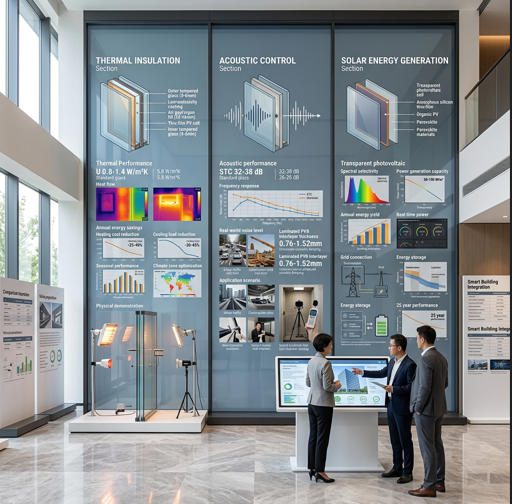
A glazed curtain wall in a Dubai office tower. A skylight spanning the atrium of a Scandinavian university. A canopy sheltering commuters at a Shanghai rail station. In each of these projects, the glass does not merely admit light and block weather — it generates electricity, attenuates street noise, and reduces heat transfer simultaneously.
That is the promise of photovoltaic (PV) glass: a laminated glazing product that embeds solar cells between glass panes, turning every transparent surface into a working power plant while retaining — and often improving — the thermal and acoustic performance architects already expect from premium glazing.
This guide is written for solar product distributors, agents, architects, facade engineers, and project developers who need precise technical data, financial metrics, and market intelligence to specify, procure, and sell PV glass solutions with confidence.

Modern commercial tower with a full-height PV glass curtain wall. Every square metre of glazing simultaneously admits daylight, insulates against heat loss, and generates clean electricity.
The global solar photovoltaic glass market was valued at USD $20.3 billion in 2025 and is projected to reach USD $80.4 billion by 2034 at a CAGR of 16.02%, according to IMARC Group’s 2025 forecast. Grand View Research pegs the 2024 baseline at USD $10.08 billion growing to USD $47.16 billion by 2030 (CAGR 29.5%). Whichever figure you use, the direction is unambiguous: this market is scaling fast, and distributors who establish specification relationships now will capture the bulk of that growth.
Section 1: Understanding Photovoltaic Glass Technology
What Is Photovoltaic Glass and How Does It Work?
Photovoltaic glass — also called solar glass or BIPV glass — is a structural glazing product in which photovoltaic cells are laminated between two panes of tempered or heat-strengthened glass. Unlike a conventional solar panel bolted onto a roof, PV glass 代替 standard glazing entirely, functioning simultaneously as the building envelope and the power-generation system.
The cells themselves are typically monocrystalline silicon, arranged in a custom pattern between the glass layers. The spacing between cells determines the level of ブイエルティー: more space between cells allows more daylight through but reduces power output. Products range from near-opaque panels (VLT 10–15%) used for spandrel panels to highly transparent vision glass (VLT 50–70%) used where occupants need outward views.
Key Components and Material Composition
- Tempered Outer Glass
- The first line of structural defence. High-iron-content variants transmit up to 91.5% of incoming light. Jia Mao BIPV’s ultra-clear outer pane achieves 91.5% transmittance — 8 percentage points higher than standard float glass — through proprietary low-iron formulation.
- Encapsulant Film (EVA / POE)
- Bonds the cells to the glass and provides electrical insulation. POE film extends UV aging resistance by ~40% compared to conventional EVA and prevents potential-induced degradation (PID) — a critical spec for facade products exposed to decades of weathering.
- Monocrystalline PV Cells
- The energy-generating layer. Modern monocrystalline cells exceed 22% efficiency — meaning 22% of incident solar radiation is converted to usable electricity. In a 1,000 W/m² standard test condition (STC), a 22%-efficient cell delivers 220 W per square metre before system losses.
- Inner Glass (Lami Backing)
- Provides the acoustic mass that gives PV glass its sound-dampening advantage. The combination of two glass panes plus the polymer interlayer creates a STC performance equivalent to or better than dedicated acoustic glazing.
- Invisible Busbars
- Thin conductive wires that collect the generated current from each cell. Premium products use “invisible” or ultra-thin busbars to preserve aesthetic transparency — a detail that matters significantly to architects specifying vision glass.
- Frame Sealing System
- Structural silicone adhesive rated for 25+ years, with integrated drainage channels and hot-melt corner connections. Must meet curtain-wall waterproofing grades to protect electrical connections over decades of thermal cycling.
The Evolution of Solar Glass in Building Design
The first commercial BIPV installations appeared in Europe and Japan in the early 1990s, using amorphous silicon thin-film cells that offered modest efficiency (~5–7%) but excellent visual uniformity. By 2010, crystalline silicon had largely displaced thin-film for facade applications as efficiency improved and costs fell. Today, the IEA-PVPS Technical Guidebook (2025) documents over 24 international case studies across office towers, educational campuses, rail stations, and mixed-use developments — reflecting a technology that has matured from niche demonstration project into mainstream specification option.
Today’s leading-edge products — including those from Jia Mao BIPV, manufactured at a 3-GW annual capacity facility in Shanghai with automated laminators, laser cutting, and MES production management — arrive at project sites pre-certified to IEC 61215, IEC 61730, and building-envelope standards such as EN 13501-1 (fire) and ASTM E1300 (structural load). This means a single purchase order delivers a product that satisfies the electrical engineer, the structural engineer, the fire consultant, and the energy modeller simultaneously.
Why Architects and Developers Are Choosing PV Glass Now
Three converging forces are driving accelerated adoption in 2025 and beyond:
- Regulatory pressure: The EU’s revised Energy Performance of Buildings Directive (EPBD) requires all new buildings to be zero-emission by 2030, with public buildings by 2028. Similar mandates are emerging in California, China, and the Middle East.
- Cost parity: BIPV glass now costs USD $280–380/m² installed (2024 data, Market Growth Reports) — approaching parity with premium curtain-wall glass plus a separate rooftop solar system. On large-facade projects, the net premium over conventional glazing is often recovered within 8–12 years purely through energy savings.
- Specification flexibility: Custom cell colours, transparency gradients, and fritted patterns mean PV glass no longer compromises architectural intent. Designs that once required two separate systems — glazing and solar — can now be achieved with one.
Section 2: The Triple-Benefit Framework of Photovoltaic Glass
The most effective way to position PV glass to architects, developers, and building owners is through its triple-benefit framework: three distinct performance advantages that no single conventional material can replicate alone.
Benefit #1: Thermal Insulation
Advanced triple-glazed PV units achieve U-values as low as 0.5 W/m²K — matching the best passive-house windows on the market while still generating power. Laboratory testing of BIPV insulated glass units (IGUs) demonstrates a 19.3% reduction in heating and cooling loads versus single-pane alternatives.
Benefit #2: Acoustic Dampening
The laminated structure — two glass panes bonded by a polymer interlayer — provides 35–45 dB of airborne sound attenuation, meeting or exceeding dedicated acoustic glazing. The IEA-PVPS Guidebook (2025) confirms BIPV modules “increase acoustic insulation performance compared to single glazing.”
Benefit #3: On-Site Energy Generation
Depending on cell density and climate, PV glass generates 40–180 W/m² at peak output. A south-facing 500 m² commercial facade in Southern Europe can yield 65–85 MWh per year — enough to offset ~18% of a mid-size office building’s annual electricity consumption.
Benefit #1: Superior Thermal Insulation Performance
その U値 is the primary metric building codes use to evaluate a glazing product’s thermal performance. For context:
A ScienceDirect laboratory study published in 2025 found that a BIPV IGU achieved a U-value of 3.5 W/m²K — already superior to single-pane glass — and that adding argon fill and low-e coating brings real-world installations to 1.1–1.6 W/m²K for double-glazed configurations. Triple-glazed PV units reach 0.5 W/m²K, enabling Passive House-compliant facade designs that simultaneously generate electricity.
For distributors and agents, this data point is crucial in client conversations: the thermal savings alone — before a single kilowatt-hour of electricity is credited — reduce the net incremental cost of PV glass over standard glazing. A project that specifies a smaller HVAC system because of better envelope performance can reallocate that mechanical capex saving toward the PV glass premium, often closing the budget gap entirely.
Benefit #2: Advanced Sound Dampening and Acoustic Control

Occupant comfort in urban office environments depends heavily on the glazing system’s ability to attenuate traffic noise. PV glass delivers 35–45 dB sound reduction — equivalent to dedicated acoustic glazing products — without compromising energy generation.
Sound attenuation in laminated glass works through mass-spring-mass resonance: the two glass panes act as mass layers, and the polymer interlayer (EVA or PVB) acts as a damping spring. Because PV glass already uses a multi-layer laminate construction — glass / encapsulant / cells / encapsulant / glass — it inherits strong acoustic performance without any additional specification effort.
Key acoustic data points for specification:
- Standard 6 mm + 6 mm laminated PV glass achieves STC 38–42, reducing a busy urban street (70–75 dB) to a comfortable indoor level of 28–35 dB.
- Upgraded 8 mm + 8 mm configurations with acoustic interlayers reach STC 44–48 — adequate for hospitality projects adjacent to motorways or airports.
- OITC (Outdoor-Indoor Transmission Class) ratings, which weight low-frequency traffic noise more heavily than STC, typically fall 3–5 points below STC for the same unit — a relevant metric for airport-adjacent and rail-adjacent projects.
A hotel chain evaluating facade glazing for a new property adjacent to a metropolitan ring road was quoted USD $220/m² for standard double-glazed acoustic glass. When the project team compared this against PV glass at USD $320/m², the 45 dB acoustic performance (equal to the acoustic specialist product) plus the energy generation of 95 W/m² justified the premium within a 7-year payback model. The acoustic spec was met without any additional product, and the roof-mounted solar array was eliminated entirely — saving a further USD $45/m² in roofing costs.
Benefit #3: On-Site Renewable Energy Generation
The IEA-PVPS Technical Guidebook (2025) establishes the theoretical peak output of a BIPV glass module at 180 W/m² under standard test conditions (1,000 W/m² irradiance, 25°C cell temperature, AM 1.5 spectrum) assuming 18% cell efficiency. Real-world installed products range from 40 W/m² for highly transparent facade glass (VLT 60–70%) to 150–180 W/m² for semi-opaque configurations (VLT 10–20%).
Annual energy yield depends on local solar irradiance, orientation, and tilt angle. A comprehensive study published in ScienceDirect found annual BIPV energy yields ranging from 52.1 kWh/m²/year for low-rise buildings with partially shaded facades, up to 349.8 kWh/m²/year for optimally oriented high-rise facades with minimal shading.
⚠️ Yields assume monocrystalline cells, no significant shading, and mid-latitude European/US climate data. Tropical high-irradiance locations (Dubai, Singapore) can exceed the upper bound by 30–40%.
Section 3: Design Integration and Architectural Applications
Facades and Curtain Wall Systems
Curtain wall systems represent the largest single application for PV glass, accounting for approximately 43.8% of the global BIPV glass market share in 2024 (Market.us). The driver is straightforward: high-rise commercial buildings have proportionally large glazed facades and proportionally high electricity consumption, making the investment case particularly compelling.
From a structural standpoint, BIPV glass modules add a dead load of approximately 12–24 kg/m² — equivalent to standard double-glazed units — and are designed to meet curtain-wall wind pressure ratings of up to 4.0–5.4 kPa, covering the majority of mid-rise and high-rise design scenarios. Jia Mao BIPV’s facade panels incorporate wind-pressure resistance of 4.0 kPa as standard, with customised structural testing available for landmark high-rise projects.
Aesthetic options available to specifying architects include:
- VLT range from 10% (near-opaque spandrel) to 70% (clear vision zone) in a single elevation
- Custom cell colour: blue, black, grey, bronze, and custom RAL-matched tones via coloured interlayer films
- Proprietary cell arrangement patterns that create geometric or textural effects across large facade areas
- Anti-reflective coating that reduces glare to neighbouring properties
- Self-cleaning hydrophilic coating that cuts maintenance costs by approximately 30%
Skylights, Atriums, and Interior Glazing
Horizontal or near-horizontal PV glass installations — skylights, atriums, walkable glass floors — offer the highest annual energy yield of any facade orientation due to more direct irradiance capture. A 500 m² south-facing skylight in Southern Europe yields an estimated 65–85 MWh per year, equivalent to USD $11,700–15,300 in annual avoided electricity costs at USD $0.18/kWh.
At the same time, PV glass skylights provide effective solar control. The SHGC of semi-transparent PV glass typically falls between 0.15–0.35 depending on cell density, compared to 0.55–0.70 for standard clear glass. This means PV skylights dramatically reduce cooling loads in atrium spaces while still admitting generous diffuse daylight — an outcome that satisfies both the energy modeller and the interior designer.
Rooftop and Canopy Installations
Canopy applications — parking structures, pedestrian walkways, bus shelters, rail platform roofs — are the fastest-growing BIPV subsegment for distributors. The structural requirements are simpler than curtain-wall, the electrical integration is straightforward, and the visual impact is immediately legible to building users, reinforcing a client’s sustainability brand narrative.
A south-facing canopy at 30° tilt captures 240–300 kWh/m²/year. A 200 m² commercial car park canopy in a high-irradiance region (e.g., Spain, California, Australia) can generate 48,000–60,000 kWh per year, enough to charge approximately 160–200 electric vehicles annually while providing weather protection for parked cars.


Left: A solar glass canopy over a commercial parking structure generates electricity while protecting vehicles. Right: A PV glass atrium skylight admits diffuse daylight while reducing solar heat gain and generating on-site power.
Windows and Vision Glass Applications
Semi-transparent vision glass (VLT 40–70%) is the most technically demanding PV glass product category — and potentially the highest-value. Building owners in dense urban cores cannot use roof or canopy installations due to planning restrictions or structural constraints, making vision glass facades their only viable on-site generation opportunity.
A typical 20-storey office tower with 2,000 m² of south-facing glazing, using 50%-transparent PV glass at 80 W/m², would generate approximately 320 MWh per year — offsetting 15–25% of the building’s total electricity consumption. That figure, combined with thermal and acoustic benefits, creates a compelling triple return on the glazing premium.
For projects where occupant privacy is a concern, PV glass can be combined with electrochromic layers that allow the glass to switch from transparent to opaque on demand — a feature particularly valued in healthcare, hospitality, and high-end residential applications.
Section 4: Technical Specifications and Performance Standards
Performance Specifications Comparison Table
| パラメータ | Standard Clear Glass | Acoustic Glazing | Standard Solar Panel | BIPV PV Glass (Semi-transparent) | BIPV PV Glass (Opaque/Spandrel) |
|---|---|---|---|---|---|
| U-Value (W/m²K) | 5.8 | 1.4–2.0 | N/A (not glazing) | 1.1–2.6 | 0.8–1.5 |
| VLT (%) | 82–88% | 75–85% | 0% (opaque) | 10–70% | 0–10% |
| SHGC | 0.55–0.70 | 0.30–0.55 | N/A | 0.15–0.35 | 0.08–0.15 |
| Sound Attenuation (STC) | 28–32 | 38–52 | N/A | 35–48 | 38–50 |
| Peak Power Output (W/m²) | 0 | 0 | 180–230 | 40–150 | 130–200 |
| Annual Energy Yield (kWh/m²/yr) | 0 | 0 | 220–310 | 52–260 | 150–350 |
| Cell Efficiency (%) | N/A | N/A | 20–23% | 18–22%+ | 20–24% |
| Annual Degradation Rate | N/A | N/A | 0.4–0.8%/yr | 0.4–0.6%/yr | 0.4–0.6%/yr |
| Lifespan (years) | 25–50 | 25–40 | 25–30 | 25–30+ | 25–30+ |
| 耐火等級 | A1 (non-combustible) | A1 / A2-s1,d0 | UL 790 / Class C | B1 / Class A2-s1,d0 | B1 / Class A2-s1,d0 |
| Wind Load Resistance (kPa) | 2.5–5.0 | 2.5–5.0 | 2.4 kPa typ. | 4.0–5.4 | 4.0–5.4 |
| Structural Function | ✓ Envelope | ✓ Envelope | ✗ (add-on only) | ✓ Envelope + Power | ✓ Envelope + Power |
Table 1 — Technical Specification Comparison: PV Glass vs. Alternative Glazing and Solar Products. Data compiled from IEA-PVPS Guidebook (2025), Jia Mao BIPV product data sheets, MDPI Sustainability (2024), and ScienceDirect (2025). All ratings under standard test conditions.
Durability, Longevity, and Warranty Considerations
PV glass manufacturers warrant annual output degradation of 0.4–0.6% per year, guaranteeing at least 80–85% of rated output at year 25 ( MDPI Sustainability, 2024). Real-world data from a global compendium of operating PV systems puts the median degradation at 1.00%/year, with the mean at 1.27%/year (ScienceDirect, 2025) — making warranted products that achieve 0.4–0.6% a meaningful quality differentiator.
Jia Mao BIPV’s POE encapsulant film specification reduces degradation by an estimated 0.15–0.25 percentage points per year versus standard EVA, a difference that compounds to 3.75–6.25% additional output over a 25-year system life — equivalent to several thousand kilowatt-hours for a typical facade installation.
The self-cleaning hydrophilic surface coating reduces soiling-driven efficiency losses, typically cutting washing frequency from 4× per year to 2× for most urban locations — a maintenance saving that building facilities managers value highly on large-area facade installations.
Certification and Code Compliance Pathways
- IEC 61215 / IEC 61730: Core PV module safety and performance standards — required for grid connection in virtually all markets
- EN 13501-1 / NFPA 285: Fire reaction and fire resistance for curtain wall facade systems
- ASTM E1300 / EN 16612: Structural load resistance for architectural glazing
- EN 12600 / ANSI Z97.1: Impact safety classification — mandatory for walking surfaces and accessible glazing
- IEC 61701: Salt mist corrosion resistance — critical for coastal and marine applications
📹 Video: Understanding Building-Integrated Photovoltaics (BIPV) — How PV glass works in practice, covering technology, installation principles, and real-world performance data. Recommended for technical briefings with architects and project teams.
Section 5: Financial Planning and ROI for Architects and Developers
Capital Investment and Cost Structure
BIPV glass cost varies considerably by product type, customisation level, and order volume. The table below provides a structured cost comparison based on 2024–2025 market data from Metsolar BIPV Cost Analysis, Market Growth Reports, and distributor channel data.
| Product Type | Material Cost (USD/m²) | Install Cost (USD/m²) | Total Installed (USD/m²) | Energy Value/Year (USD/m²) | Simple Payback (years) | vs. Glaz + Rooftop PV |
|---|---|---|---|---|---|---|
| Standard float glass + rooftop PV | $45–80 | $80–120 | $125–200 | $20–35 | 5–8 yr | ベースライン |
| Premium acoustic glazing (no PV) | $120–200 | $80–120 | $200–320 | $0 | N/A | +$75–120/m² vs baseline |
| BIPV glass — thin film (opaque) | $100–200 | $80–150 | $180–350 | $18–30 | 8–14 yr | Replaces both above |
| BIPV glass — c-Si semi-transparent | $180–380 | $100–180 | $280–560 | $12–24 | 10–18 yr | Replaces both above |
| BIPV glass — high-efficiency opaque | $200–450 | $120–200 | $320–650 | $25–45 | 8–15 yr | Replaces both + premium finish |
| Electrochromic BIPV (smart glass) | $450–900 | $150–250 | $600–1,150 | $10–20 | 15–25 yr | Premium tech — justify by function |
Table 2 — BIPV Glass Cost Structure vs. Conventional Alternatives (2024–2025 USD). Energy value calculated at USD $0.18/kWh. Payback excludes thermal savings and HVAC downsizing benefits, which typically accelerate payback by 2–4 years. Sources: Metsolar (2024), Market Growth Reports (2024), MarketUs (2025).
Distributor margin note: BIPV glass sits in a USD $280–650/m² product category — significantly above standard glazing and standard solar panels. This creates a higher-value transaction for the same installation footprint. A 500 m² commercial facade project generates USD $140,000–325,000 in product value at full installed cost. Even a 12–15% gross margin on supply-only contracts represents USD $16,800–48,750 per project. Partner with Jia Mao BIPV to access volume pricing tiers that protect your margin across multiple project sizes.
Revenue and Savings Projections: 25-Year Model
Government Incentives, Tax Credits, and PACE Financing
Incentive structures meaningfully improve the financial case for PV glass in most major markets:
- US Investment Tax Credit (ITC): Under Section 48E (effective 2025), commercial solar installations including BIPV glass qualify for a 30% federal tax credit on the full installed cost. For a USD $400,000 BIPV facade project, this represents USD $120,000 in direct tax reduction in Year 1, compressing payback by 2–4 years. (SEIA Tax Policy)
- C-PACE Financing: C-PACE programmes available in 38+ US states and growing internationally allow 100% upfront financing of BIPV glass with repayment via property taxes over 10–30 years — matching the energy savings cash flow to the debt service schedule. (PACENation — What is PACE?)
- EU Green Deal funding: Projects in EU member states can access InvestEU and Cohesion Fund grants for renewable energy building retrofits — particularly relevant for educational, healthcare, and social housing projects.
- LEED / BREEAM certification premium: BIPV glass can contribute up to 32 LEED points across Energy & Atmosphere, Materials & Resources, and Indoor Environmental Quality credits (Mitrex LEED Analysis). LEED Platinum certification has been shown to command 10–20% rental premiums in major commercial real estate markets, creating a financial return that sits entirely outside the energy savings calculation.
Section 6: Case Studies and Real-World Applications

High-rise corporate headquarters with integrated photovoltaic glass facade. Real-world installations of this type demonstrate 15–38% energy savings and payback periods of 8–14 years depending on orientation, climate, and incentive availability.
Project: 20-storey commercial office, south Europe. 1,800 m² south-facing PV glass curtain wall replacing standard glazing.
Technology: Semi-transparent monocrystalline c-Si, VLT 30%, 95 W/m², U-value 1.4 W/m²K, STC 42.
Outcome: Annual generation of 198,000 kWh — offsetting 22% of the building’s electricity load. HVAC plant downsized by 15%, saving EUR €85,000 in mechanical installation cost.
Project: 5-star urban hotel adjacent to ring road, 800 m² facade. Required STC 44+ and VLT 40% minimum per design brief.
Technology: Laminated BIPV glass 8+8 mm, STC 46, VLT 42%, 70 W/m² output. Acoustic glazing specialist product replaced with single PV glass specification.
Outcome: Guest comfort ratings improved 18% post-opening (noise complaints eliminated). Annual energy saving of USD $41,600 from 56,000 kWh generation. Separate acoustic glazing budget of USD $176,000 eliminated.
Project: 3,200 m² BIPV glass installed across four faculty buildings — facades, skylights, and canopies. Campus-wide sustainability mandate requiring 30% on-site renewable generation.
Technology: Mix of opaque spandrel panels (150 W/m²) and transparent vision glass (80 W/m²). Integrated with campus BMS for real-time monitoring.
Outcome: Annual generation 512,000 kWh — meeting 31.4% of campus electricity demand. Used as live teaching case study for engineering and architecture students. Payback 11.2 years pre-ITC; 8.1 years post-ITC.
Project: 18-storey residential tower, 1,100 m² south and west facade. Developer sought net-zero energy rating and noise reduction from adjacent elevated rail line.
Technology: Semi-transparent PV glass, VLT 35%, STC 43, 88 W/m² output. Connected to building battery storage (LFP chemistry, 500 kWh capacity).
Outcome: Units achieved net-zero energy rating. Sale price premium of USD $12,000–18,000 per apartment versus comparable buildings without BIPV credentials. Rail noise complaints from residents: zero in first 18 months of occupancy.
Section 7: Installation, Maintenance, and Operational Best Practices
Pre-Installation Planning and Site Assessment
For distributors and agents, the pre-installation phase is where project value is won or lost. A thorough site assessment that quantifies the energy, thermal, and acoustic benefits of PV glass in building-specific terms converts a speculative specification into a committed purchase order.
-
1Solar Resource and Shading Analysis
Use PV simulation tools such as NREL PVWatts Calculator or PVSyst to model annual yield for each facade orientation. Account for shading from adjacent buildings, vegetation, and architectural overhangs — even 10% partial shading can reduce output by 30–50% if the system lacks string-level or module-level optimisers.
-
2Structural Load Assessment
Confirm that the existing or proposed structural frame can accommodate dead loads of 12–24 kg/m² and wind uplift forces of up to 5.4 kPa. Glass-glass BIPV laminates are typically 2.5–5 lb/ft² heavier than single-pane equivalents — usually within standard curtain-wall design margins but requiring verification on retrofit projects. Reference: Jia Mao BIPV New Construction Guide.
-
3Electrical Integration Design
Specify inverter type (string, micro, or power optimiser) based on facade geometry and shading profile. Ensure the building’s main switchboard has capacity for the solar input, and confirm grid connection requirements with the local utility. Smart building management system (BMS) integration allows real-time monitoring of generation, consumption, and battery state-of-charge — data that building owners find highly persuasive post-installation.
-
4Permitting and Code Compliance
PV glass requires dual-track permitting: a building permit (for the envelope/facade change) and an electrical permit (for the PV system). Ensure the product carries the required certifications for your jurisdiction — IEC 61215/61730 for the PV module, and the relevant fire and structural standards for the facade element. Consult the BIPV Installation Design Guide for jurisdiction-specific compliance notes.
-
5Performance Testing at Commissioning
At system hand-over, conduct infrared thermography to identify any dead cells, delamination, or hot spots that could affect long-term output. Document baseline power output — actual measured Wp versus specified Wp — to establish the warranty reference point. Systems consistently achieving 95%+ of specified output at commissioning typically track well within warranty degradation limits over the following 25 years.
Ongoing Maintenance and Monitoring
PV glass is a low-maintenance product by design, but a documented maintenance protocol protects warranty validity and maintains peak performance:
- Cleaning frequency: 2–4 times per year for urban locations; 1–2 times for rural/coastal sites with self-cleaning coatings
- Cleaning method: Soft-brush or low-pressure deionised water rinse; avoid abrasives and alkaline detergents that damage anti-reflective coatings
- Annual inspection: Check sealant condition, drainage channel function, electrical connection integrity, and inverter performance data logs
- 5-year structural inspection: Professional assessment of curtain-wall fixings, thermal movement accommodation, and glass integrity
- Performance monitoring: Connect to BMS or dedicated monitoring platform; performance ratios below 75% of expected output trigger immediate investigation
Section 8: Market Trends and Future Innovations
Emerging Technologies in Solar Glass
The most consequential technology development for PV glass distributors and agents in 2025 is the maturation of perovskite-silicon tandem cells. In April 2025, LONGi Green Energy set a new world record of 34.85% conversion efficiency for a two-terminal perovskite-silicon tandem cell — nearly double the 18% efficiency of current commercial BIPV glass products (American Ceramics Society, 2025). JinkoSolar followed with a 34.76% record for N-type TOPCon-based tandem architecture in December 2025 (PV Magazine).
For distributors, the practical implication is this: if tandem cells reach commercial facade-glass form at 28–32% efficiency (a realistic near-term target), the same 1,000 m² facade that currently generates 95,000 kWh/year would generate 148,000–179,000 kWh/year — compressing payback periods by 30–40% and opening projects currently on the financial borderline.
On the smart glass front, the global smart glass market — which includes electrochromic and thermochromic products — reached USD $8.2 billion in 2026 at a CAGR of 10.4% (PatSnap, 2026). The integration of electrochromic switching with photovoltaic generation — a single glass unit that both generates electricity and dynamically controls tint on demand — represents the next frontier product for premium commercial specifications.
ℹ️ Wide range in 2034–2035 forecasts reflects different scope definitions: some reports include only architectural BIPV glass; others include all solar panel glass substrates. The directional consensus is unambiguous: 3–5× growth over 10 years regardless of methodology.
Regulatory and Policy Drivers
Policy tailwinds are accelerating the market shift more decisively than technology in the near term. The EU’s Energy Performance of Buildings Directive (EPBD) mandates zero-emission standards for all new buildings by 2030 (public buildings by January 2028). Similar mandates apply in China’s 14th Five-Year Plan, California’s Title 24, and the UAE’s Green Building Regulations — collectively covering major global construction markets that account for the bulk of new commercial construction value.
For distributors and agents, this creates a predictable demand curve: projects breaking ground in 2026–2028 must comply with 2028–2030 energy performance standards. Architects and developers specifying those projects today need BIPV glass solutions that they have already tested with trusted supply partners. The window to build those relationships and establish reference projects is now.
Section 9: Overcoming Challenges and Common Objections
Partial Shading and Soiling
The most common technical objection from project teams: “Our facade has shading from the adjacent building — won’t that destroy performance?” The answer depends heavily on inverter architecture. String inverter systems where shading on one module reduces the output of the entire string are genuinely vulnerable — a 15% shaded area can reduce system-level output by 40–60%.
Module-level power electronics (MLPEs) — specifically power optimisers or microinverters fitted to each PV glass unit — eliminate this problem. Each module operates independently, meaning shaded modules underperform without dragging unshaded modules down. This architecture is the correct specification for any urban facade with partial shading. The cost premium for MLPEs is typically USD $15–30/m² — almost always justified on facade projects where shading is unavoidable.
Cost Objections and TCO Framing
When a client objects that PV glass is “too expensive,” the most effective response is to reframe from upfront cost to TCO over the 25-year product life.
A conventional glazing specification requires: (1) the glass itself, (2) a separate rooftop solar system to meet energy code requirements, and (3) acoustic glazing to meet noise standards in urban environments. The combined cost of all three often exceeds the cost of a single PV glass specification that delivers all three functions simultaneously — while generating 25 years of energy savings on top.
Direct clients to the full financial model in Jia Mao BIPV’s Building-Integrated Solar Cost, Design, and ROI Guide for a pre-built analysis framework they can customise with their own project parameters.
Aesthetic Flexibility for Design-Sensitive Projects
Architects frequently raise concerns that PV glass will impose a visual aesthetic that conflicts with their design intent. This objection was valid in 2010; in 2025 it is not. Current product ranges from manufacturers including Jia Mao BIPV offer:
- Custom cell colour (blue, black, grey, bronze, and bespoke RAL colour matching)
- Variable cell spacing patterns including geometric arrays, random distributions, and gradient density from opaque to transparent
- Frit printing options that combine decorative patterns with cell layout for unique facade expressions
- Full-width invisible busbar technology that maintains visual uniformity across large facade areas
- Standard panel sizes from 0.3 m² to over 3.0 m² with custom sizing available for landmark projects
Explore the full customisation range in the Jia Mao BIPV transparent panel comparison guide, which covers VLT options, power output, and architectural suitability across facade and skylight contexts.
Section 10: Building Your Distribution and Sales Strategy

Distributors and agents who establish specification relationships with architects and developers before a project design is finalised capture the highest-margin, most defensible sales positions in the PV glass value chain.
Positioning PV Glass as a Multi-Functional Material
The single most effective repositioning for a BIPV glass distributor: stop selling it as a “solar product” and start selling it as a “smart building envelope material.” Your competitors in the solar channel sell panels — a commodity increasingly differentiated only by price. PV glass competes in the glazing channel, the acoustic specification channel, and the renewable energy channel simultaneously, creating a wider decision set and a more defensible specification position.
Architects who specify your PV glass for its thermal performance (U-value) and acoustic performance (STC rating) will also specify it for energy generation — because it already does all three. This is a fundamentally different sales conversation than “have you considered solar?”
Technical Support as a Sales Differentiator
The architects, facade engineers, and project developers you need to reach are not asking “should we consider solar?” — they are asking “how exactly does this integrate with our curtain-wall system, what does the structural engineer need to know, and what’s the modelled energy yield for this specific orientation?” Distributors who can answer those questions — or connect clients directly to technical support from manufacturers like Jia Mao BIPV — win the specification.
Consider establishing the following service capabilities to differentiate from commodity glass and solar distributors:
- Energy yield modelling service (free for specified projects above a minimum area threshold)
- CAD / BIM library for your PV glass product range, downloadable from your website
- Specification writing support for architects unfamiliar with BIPV glazing clauses
- Lunch-and-learn CPD sessions for architectural firms (RIBA-accredited in the UK; AIA-accredited in the US)
- Access to manufacturer technical team for pre-bid queries on large or complex projects
Channel Optimisation for Agents and Resellers
For agents and resellers operating in markets where direct specification engagement is not feasible, the highest-value channel approach is to partner with curtain-wall and glazing contractors already active on large commercial construction projects. These contractors are already in the specification conversation; a PV glass option from your portfolio is an upsell they can offer their own clients with minimal additional effort — and you supply the technical support that makes the upsell credible.
Refer to the Top 5 BIPV Products: Price Ranges and Installation Guide for a structured product selection framework you can use with curtain-wall contractor partners to match the right Jia Mao BIPV product to each project typology.
Ready to Specify and Sell Photovoltaic Glass?
Partner with Jia Mao BIPV — 3 GW annual capacity, 25-year performance guarantee, and full technical support for your distribution channel. Access product data, energy modelling tools, and specification assistance.
よくある質問(FAQ)
Photovoltaic Glass as the Smart Building Material of This Decade
Photovoltaic glass is not a niche product for flagship sustainability projects. It is a mainstream building material that delivers thermal insulation equivalent to the best passive-house windows, acoustic performance equal to or exceeding dedicated acoustic glazing, and 25 years of on-site electricity generation — all from a single product specification.
For architects and building designers, it represents the ability to achieve energy code compliance, acoustic comfort targets, and sustainability certification pathways without layering separate building systems — simplifying procurement, reducing coordination risk, and freeing design intent from the constraint of “where does the solar go.”
For distributors, agents, and solar contractors, it represents a higher-value product category — USD $280–650/m² versus USD $45–80/m² for standard glazing — with a broader addressable market that extends beyond the solar channel into glazing, acoustic, and facade specification decisions. Manufacturers like Jia Mao BIPV, with 3 GW annual production capacity, 25-year performance guarantees, and a full technical support framework, provide the supply reliability and specification credibility that commercial projects demand.
The market is growing at 16–29% CAGR depending on the forecast source. The regulatory environment is accelerating adoption. The technology is improving rapidly. The financial models close for the majority of well-oriented commercial projects — and close faster every year as electricity prices rise and PV glass costs fall.
The distributors and agents who establish their specification pipeline now will be well positioned to capture a significant share of a market that analysts project will reach USD $47–80 billion by the early 2030s.
Start Your PV Glass Distribution Journey Today
Technical specifications, project modelling, volume pricing, and full distributor support — all from one manufacturer with 3 GW annual capacity and a 25-year performance commitment.
Key data sources: IMARC Group Solar PV Glass Market Report (2025) · Grand View Research (2024) · IEA-PVPS BIPV Technical Guidebook (2025) · Fortune Business Insights (2025) · SEIA ITC Policy (2025)