Maximizing ROI with BIPV Glass: A Guide for Photovoltaic EPC/E Contractors

A south-facing curtain wall that used to cost money every month can now generate it. That shift is what this guide is about.
This guide is written exclusively for curtain wall and roofing contractors, photovoltaic EPC and energy service providers, building material brands and distributors, and architects, consultants, and design institutes. Every section addresses a real challenge you face on real projects — not theoretical scenarios.
The building envelope has always been the most expensive, most engineered, and most consequential component of any commercial project. It handles structural loads, manages water, controls heat gain, and delivers the architectural vision — all while surviving 30 years of exposure. For most of the twentieth century, that was the whole job.
Now it has one more: generating electricity.
BIPV (Building-Integrated Photovoltaics) — the technology that embeds photovoltaic cells directly into glazing, cladding, roofing, and curtain wall systems — has moved from award-winning architectural showcase to mainstream commercial specification. The global BIPV market was valued at USD 23.4 billion in 2025 and is projected to reach USD 98+ billion by 2034, growing at approximately 17% CAGR (Fortune Business Insights). That is not a niche trend — it is a structural shift in how commercial buildings are designed, financed, and valued.
This guide covers every stage of the BIPV glass lifecycle — from the first design meeting to post-commissioning monitoring — with concrete data, workflow recommendations, and financial models designed to help you win more bids, deliver on your energy commitments, and build a durable competitive advantage in this market.
1. Understanding BIPV Glass: Beyond Traditional Solar Integration
What BIPV Glass Actually Is
Let’s start with the distinction that changes everything commercially.
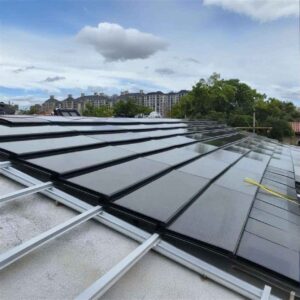
BAPV (Building-Applied Photovoltaics) is the rack-mounted solar panel on the roof. It sits on top of a completed building element. Remove it and the building still functions. It is additive.
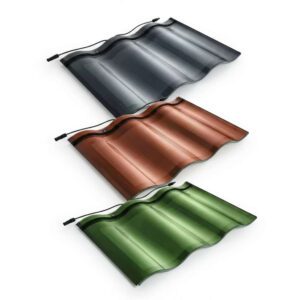
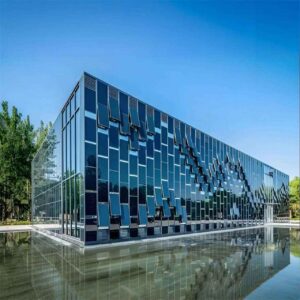
BIPV glass is structurally and functionally integrated into the building envelope. The PV glass panel is the curtain wall glazing. The BIPV tile is the weatherproofing membrane. Remove it and you have a gap in the building. It is substitutive — it replaces a conventional building material while adding energy generation as a second function.
This distinction has profound commercial implications that most EPC contractors and building material distributors have not fully priced into their proposals. When BIPV replaces glazing that was already in the project budget, the correct cost comparison is not “BIPV vs. nothing” — it is “BIPV vs. conventional glass + a separate solar system.” When you model it that way, the cost premium typically shrinks from a headline 200–300% down to a net incremental uplift of 30–60% above standard high-performance glazing, before incentives are applied.
Core Components of a BIPV Curtain Wall System
| Component | 機能 | Technical Note |
|---|---|---|
| PV Laminate | Generates DC electricity from solar irradiance | Crystalline silicon (most common), thin-film (CdTe, CIGS), or amorphous silicon |
| Glass Substrate | Structural support, weatherproofing, aesthetics | Typically laminated safety glass (2× heat-strengthened or tempered layers) |
| EVA/POE Encapsulant | Seals and protects PV cells within the laminate | POE (Polyolefin Elastomer) offers 40% better UV aging resistance than standard EVA |
| Junction Box | Electrical connection point per module | Mounted on rear face; must be accessible without dismounting glass |
| Curtain Wall Framing | Transfers structural and wind loads to the building | Stick-frame or unitized; requires conduit integration for DC wiring |
| String Inverter / Microinverter | Converts DC to AC for building use or grid export | Microinverters eliminate series-string shading loss; add ~$0.15–0.25/W |
| BMS Monitoring Interface | Tracks energy yield and flags faults | BACnet or Modbus integration for centralized energy dashboard |
The Dual Functionality Advantage
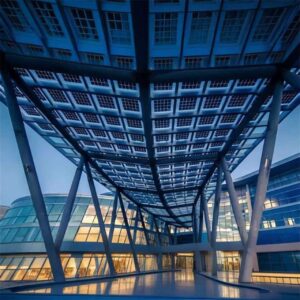
A BIPV curtain wall simultaneously delivers what two separate systems would otherwise provide: a building envelope component and a power generation system. On projects where facade renovation is already scheduled, this means the incremental cost of upgrading to BIPV — rather than replacing like-for-like with standard glass — is the only meaningful cost delta. The Bullitt Center in Seattle generated 30% more energy than it consumed over its first ten years using this logic applied at its most aggressive. For typical commercial projects, the goal is simpler: use the facade surface area that is already there to offset a meaningful portion of the building’s energy bill.
2. ROI Drivers: Where BIPV Glass Outperforms Traditional PV + Cladding

The moment a scheduled facade renovation becomes a revenue-generating asset is the moment BIPV starts making financial sense.
The Material Substitution Argument
The most persuasive financial case for BIPV is not the energy it generates in isolation — it is what it replaces. On a commercial project with a scheduled curtain wall replacement, the contractor and building owner are already committed to spending, say, $180–$280/m² on premium high-performance glazing. The incremental cost to upgrade to BIPV glass is typically $120–$280/m² above that baseline — not the full $410–$750/m² BIPV installation cost that often gets cited without context.
Over 25 years, that incremental investment generates:
- Energy revenue from electricity production (real-world facades in temperate climates: 80–160 kWh/m²/year)
- HVAC savings from reduced solar heat gain — well-specified semi-transparent BIPV glass achieves SHGC values of 0.15–0.30, compared to 0.86 for clear glass; an 18% reduction in lobby HVAC load is documented in the Algarve hotel case below
- Avoided capital cost of a separate rooftop or facade solar system that would otherwise be specified
Real-World Payback Data: Three Commercial Case Studies
Case 1 — Frankfurt Corporate Headquarters A 28-story office tower replaced 3,400 m² of standard double-glazed curtain wall with semi-transparent BIPV glass across south and west facades. The BIPV replacement was budgeted as part of a scheduled facade renovation — meaning the comparison was BIPV vs. standard high-performance glass, not BIPV vs. zero. Annual generation: 680,000 kWh. Annual energy cost reduction: €102,000. Payback period: 9.8 years on the net incremental investment. The building’s carbon intensity fell from 82 to 49 kg CO₂/m² — a metric that now anchors the tenant’s ESG annual report.
Case 2 — Netherlands University Campus A phased 5-year BIPV program combining roof-plane panels, PV glass skylights, and spandrel panel replacements across three faculty buildings brought total capacity to 1.8 MWp, generating 1.65 million kWh/year — covering 72% of total campus energy consumption. Net payback: 7.3 years with EU Cohesion Fund grant support covering 35% of project cost.
Case 3 — Algarve Luxury Hotel A bespoke BIPV glass installation across the lobby atrium (1,100 m²) and poolside pergola (600 m²) using custom bronze-tinted glass at 25% VLT generates 255,000 kWh/year. The shading effect cut lobby air conditioning demand by 18%. Annual combined savings: €76,000. Three additional resort properties in the same group are now under specification for identical systems.
Incentive Stacking: Making the Numbers Work
In the U.S., commercial BIPV installations qualify for the 30% Investment Tax Credit (ITC) under Section 48E of the Inflation Reduction Act, applicable through 2032. Combined with 5-year MACRS depreciation on the system cost, the combined after-tax benefit in Year 1 can reduce the effective net cost of a BIPV installation by 50–55% — before a single kilowatt-hour has been generated.
In Europe, national feed-in tariffs (Germany: €0.08–0.13/kWh for building-integrated systems), EU Cohesion Fund grants (up to 35–45% of eligible project cost in qualifying regions), and green bond financing create equivalent incentive stacks. Monitor the DSIRE database for current U.S. state-level incentives and net metering rules updated quarterly.
Carbon credits are an emerging additional revenue stream. EU ETS pricing now exceeds €65/tonne CO₂, and buildings generating verified renewable energy on-site are increasingly able to monetize avoided emissions through voluntary carbon markets — a factor that has entered developer pro formas in the Netherlands, France, and Germany.
ROI Comparison: BIPV Glass vs. Conventional Glazing + Separate PV
| Metric | Conventional Glass + Separate Rooftop PV | BIPV Glass Curtain Wall | Delta |
|---|---|---|---|
| Facade material cost (per m²) | $180–$280 (glass) + $120–$180 (rack PV, apportioned) | $410–$750 (integrated) | +$30–$290/m² net incremental |
| Labor (installation) | Two separate trades, two mobilizations | Single curtain wall trade, coordinated electrical | Typically 15–25% lower total labor |
| Annual energy yield (south facade, temperate) | Rooftop: 130–170 kWh/m²; Facade: 0 kWh/m² | 80–160 kWh/m² from facade surface area | Facade surface now earns revenue |
| HVAC cooling offset | None from glass | 15–35% solar heat gain reduction | Additional savings on top of energy generation |
| LEED EA credit potential | Rooftop PV contribution only | Facade + rooftop combined coverage | Higher credit point total achievable |
| 25-year total cost of ownership | Higher (two systems, two maintenance programs) | Lower (one system, unified warranty) | BIPV advantage at full lifecycle |
3. Performance Advantages: Efficiency, Durability, and Aesthetics
Energy Output: What the Numbers Actually Look Like
A south-facing BIPV glass facade in a temperate climate generates approximately 80–160 kWh per square meter per year, depending on cell density, transparency level, and local solar irradiance. A 2025 MDPI study of a full-scale BIPV facade confirmed 100 kWh/m²/year for a south-facing installation, with east and west facades yielding 60–70% of that figure.
For practical design planning, here are real-world output benchmarks by climate zone:
| Climate Zone | South Facade (kWh/m²/yr) | Roof Optimal Tilt (kWh/m²/yr) | Recommended VLT Range |
|---|---|---|---|
| Southern Europe (Spain, Portugal, Italy) | 120–160 | 160–220 | 20–40% |
| Central Europe (Germany, France, Benelux) | 80–120 | 130–170 | 15–35% |
| Northern Europe (UK, Scandinavia) | 70–110 | 110–150 | 10–30% |
| Southeast Asia (Singapore, Vietnam, Thailand) | 150–200 | 180–240 | 20–35% |
| Middle East (UAE, Saudi Arabia) | 160–210 | 200–260 | 15–25% |
| East Asia (China, South Korea, Japan) | 100–160 | 140–200 | 20–40% |
Worked example: A 2,000 m² south-facing facade in Frankfurt using semi-transparent BIPV glass at 120 Wp/m² delivers approximately 240 kWp installed capacity, generating an estimated 192,000 kWh/year. At a commercial electricity rate of €0.20/kWh, that is €38,400/year in energy value — before accounting for HVAC savings from reduced solar heat gain.
Thermal Performance: The Hidden Savings Nobody Talks About
This is where BIPV consistently outperforms the numbers on the data sheet. Because BIPV glass absorbs solar radiation that would otherwise enter the building as heat, it acts as a high-performance shading device simultaneously with power generation. A well-specified semi-transparent BIPV unit achieves:
- U-value of 0.28–0.5 W/m²K — equivalent to triple-glazed windows, compared to conventional curtain walls at 1.0–5.0 W/m²K
- SHGC (Solar Heat Gain Coefficient) of 0.10–0.30 — compared to 0.86 for standard clear glass
A ScienceDirect study on a BIPV facade in a temperate climate found an 18% reduction in overall annual electricity use when BIPV replaced clear glass — a figure that includes both the generation contribution and the reduced cooling load. For a 10,000 m² commercial office in Phoenix or Dubai, this is a HVAC cost reduction of $25,000–$45,000 per year on top of direct energy generation.
Durability Standards That Matter for High-Rise Commercial Projects
Quality BIPV glass manufactured to current standards is not fragile architectural glass with solar cells glued in. It is a structural safety glazing product. Key durability benchmarks:
- IEC 61215: Thermal cycling (-40°C to +85°C, 200 cycles), humidity-freeze, UV exposure, mechanical load, and hail resistance. This is the foundational performance durability certification.
- Wind load resistance: Up to 5,400 Pa (with 2.5× safety factor) — sufficient for high-rise facade applications per ASCE 7.
- Impact resistance: EN 12600 (European standard) — Class 1B1 for structural glazing applications, the same standard as conventional structural glass.
- 25-year power output warranty: Leading manufacturers including Jia Mao BIPV warrant ≥85% retained output after 25 years — a bankable performance guarantee.
Modern crystalline silicon cells degrade at approximately 0.3–0.5% per year — retaining 88–92% of their original output at Year 25. POE encapsulant technology (used by premium manufacturers in place of standard EVA) reduces UV-driven delamination risk and improves long-term moisture resistance.
Aesthetic Flexibility: The Design Argument That Closes Specifications
The most common barrier to BIPV specification is an architect’s mental image of a 1990s rooftop solar array. That reference is obsolete. Current BIPV glass is available with:
- VLT range of 10–90%: The design team specifies transparency per facade zone — more transparent where daylighting takes priority, denser where generation output matters more.
- Custom colors: Colored PVB interlayers, acid-etched substrates, screen-printed ceramic frits, and thin-film deposition tuning produce virtually any color palette, including custom RAL matches. Color-certified BIPV has been used on heritage facade retrofits in Belgium and Germany where conventional panels would have been rejected by conservation authorities.
- Panel sizes up to 3,000 × 2,000 mm: Enabling integration with standard curtain wall module grids without visible joints or adapters.
- Curved glass options: Thin-film BIPV on curved glass substrates is technically achievable for parametric facade designs, with lead times and cost premiums that should be confirmed with the manufacturer early in design.
4. Integration Strategies for Curtain Wall and Roofing Contractors
Structural Integration: Loading Your Frame Correctly
BIPV glass panels are heavier than standard IGUs. A crystalline silicon BIPV laminate in a 6+6 mm configuration weighs approximately 25–30 kg/m², compared to 18–22 kg/m² for a standard double-glazed unit. For retrofit projects, a structural engineer must assess whether the existing frame and floor edge details can support the additional dead load before any product order is placed.
For new construction, BIPV loads are incorporated from the structural design phase — this is the least costly path. For renovation projects, options include:
- Verifying existing anchor capacity (most modern curtain wall anchors have reserve capacity; a PE-stamped assessment takes 1–2 days)
- Substituting a lighter thin-film BIPV product (typically 20–25 kg/m²) where the standard crystalline option would exceed frame capacity
- Designing a new structural subframe attached to the existing building slab edge, bypassing the original curtain wall anchor system
Wind uplift design must be calculated to the adopted version of ASCE 7 (U.S.) or EN 1991-1-4 (Europe) for the specific building height and location — panels near roof edges and building corners face significantly higher uplift forces than field zones.
Waterproofing, Thermal Bridging, and Wind Load Compliance
Three interface conditions generate the majority of performance failures and warranty claims on BIPV curtain wall projects:
Waterproofing: The BIPV glass unit sits within the primary weatherproofing plane. Junction boxes on the module’s rear face must be located and sealed so that water cannot track behind the glass into the wall cavity. Use only manufacturer-approved silicone sealants — incompatible products can attack EVA or POE edge seals, causing moisture ingress and accelerated cell degradation. This is not an optional specification detail; it directly affects warranty validity.
Thermal bridging: Aluminum curtain wall mullions are excellent thermal bridges — they conduct heat from inside to outside, undermining the thermal performance of even well-specified BIPV glass. Thermally broken framing systems (polyamide thermal breaks in aluminum profiles) are mandatory for achieving the U-values that BIPV glass makes possible. Specifying BIPV glass in thermally unbroken framing is a common error that negates 30–50% of the thermal performance advantage on paper.
Wind load compliance: The BIPV glass manufacturer must provide project-specific or system-certified wind load data in the format required by your structural engineer — typically a rated design pressure in Pa, a safety factor confirmation, and the specific fixing/anchor configuration for which the rating applies.
Collaboration Protocol Between Cladding and Electrical Teams
The most consistent source of rework cost on BIPV projects is the undefined boundary between the curtain wall contractor’s scope and the electrical subcontractor’s scope. Before shop drawings are issued, the following must be in writing:
- Who installs conduit sleeves through mullions?
- Who makes the junction box connections at each panel?
- Who performs post-installation Voc/Isc string testing?
- Who is responsible for the DC home-run cabling from the array to the inverter room?
- Who provides the as-built electrical drawings required for the utility interconnection application?
Define this in the subcontract scope matrix before award. Ambiguity at this boundary is the most reliably expensive risk on a BIPV project.
5. EPC Workflow Optimization: Streamlining Design, Procurement, and Installation
The BIPV-Integrated Project Lifecycle
A BIPV project that runs smoothly is almost always the product of early-stage coordination. The workflows that generate corrections, delays, and rework are the ones that treat BIPV as a late-stage specification add-on rather than a Day 1 design parameter.
Stage 1 — Schematic Design (Weeks 1–6) The energy consultant runs a facade irradiance analysis using PVsyst or equivalent. This produces zone-by-zone output estimates by facade orientation — the data the architect needs to make informed decisions about VLT and cell density before locking in the aesthetic. The structural engineer confirms dead load capacity and identifies any reinforcement needs. The MEP engineer confirms the inverter room location and conduit routing strategy.
Stage 2 — Design Development (Weeks 7–16) BIPV manufacturer technical representative issues preliminary product data — module dimensions, weight, electrical characteristics, and available VLT/color options — for incorporation into structural, thermal, and energy models. BIM model is updated with BIPV component families. Conduit routing is clash-detected against structural framing and MEP services.
Stage 3 — Procurement (Weeks 10–26) Custom BIPV glass requires 12–20 weeks fabrication lead time from confirmed purchase order. This is almost always on the critical path. The EPC firm or contractor who places the order after design is “complete” has already slipped the installation schedule by months. Issue a Letter of Intent to the manufacturer at design development completion to reserve fabrication capacity while final specifications are confirmed.
Stage 4 — Installation (Weeks 24–40) Pre-fabricated unitized BIPV panels — factory-assembled with integrated electrical connections — consistently outperform site-assembled stick-built systems in quality control and program predictability. The on-site interface between curtain wall installation and electrical connection is the highest-risk phase; daily coordination between the glazing and electrical crews is mandatory, not optional.
Stage 5 — Commissioning and Handover (Weeks 38–44) Full commissioning includes IV-curve tracing, insulation resistance testing, Voc/Isc verification for each string, IR thermography, and performance ratio confirmation (target: PR ≥ 0.75). The commissioning report is a contractual handover deliverable and a prerequisite for the building owner’s ITC filing.
Early-Stage Architect Coordination: The Moves That Save the Most Money
Coordination gaps discovered at 90% design cost 5–10× more to resolve than the same gaps found at 30% design. Three specific early-stage actions consistently produce the highest ROI:
- Facade irradiance analysis before VLT is specified: Different transparency levels in different zones produce meaningfully different outputs. A single analysis session that identifies the south facade as the primary generation zone and the north facade as a transparency-priority zone saves wasted engineering hours on off-target specifications.
- Inverter room confirmed before MEP design is locked: Inverter rooms in BIPV projects are larger than those in standalone rooftop solar — the DC home-run cables from multiple facade zones converge here. Discovering there is no suitable location after MEP design is complete is a costly mistake.
- Supply chain confirmation before design is complete: BIPV products with non-standard dimensions, VLT specifications, or colors may have lead times of 20+ weeks and minimum order quantities. Confirming product availability before the specification is finalized avoids design rework when a specified product turns out not to be available in the required configuration.
6. Overcoming Common Installation Challenges
Alignment Tolerances: Tighter Than Standard Glazing
BIPV glass panels with visible cell patterns have zero tolerance for misalignment. A 2 mm offset between adjacent panels is invisible in standard glazing — it is immediately noticeable when the cell grid pattern breaks across a panel joint. This means:
- Shop drawings must specify joint widths and panel positions to ±1 mm tolerance, not the ±3–5 mm typical of standard glazing
- Setting-out stakes on the structural frame must be verified by survey before panel installation begins, not assumed to be within tolerance
- The first row of panels on each facade zone must be installed under direct supervision and signed off before the crew proceeds with subsequent rows
Electrical Interconnection in Complex Facades
For EPC contractors and electrical subcontractors unfamiliar with DC string design in curtain wall applications, three practical guidelines prevent the most common interconnection failures:
Pre-wired junction boxes — order panels with factory-fitted junction boxes and pre-terminated DC leads rather than making all connections on-site. The quality of factory-made electrical connections in controlled conditions is substantially higher than site-made connections at height in variable weather.
Standardized MC4 connectors — specifying a single connector type throughout the project (MC4 is the commercial standard) eliminates compatibility failures when panels from different production batches are installed in the same string.
String configuration planning — shading analysis must be completed before string architecture is designed. A string that combines panels from a well-shaded lower facade zone with panels from an unshaded upper zone will generate to the level of the worst-performing panel in the string — a common cause of underperformance that is entirely preventable at design stage.
On-Site Cutting Limitations
BIPV glass cannot be cut on-site. The cells are embedded within the laminate — any field cut destroys the panel and creates electrical hazards. This means:
- Non-standard panel dimensions must be identified during design, communicated to the manufacturer, and priced before contract award
- Window openings, service penetrations, and architectural features that conflict with the standard panel grid must be resolved in shop drawings, not on-site
- A buffer quantity of spare panels (typically 3–5% above the net required area) should be ordered with the original batch to cover breakage during installation — reordering custom panels mid-project adds 12–20 weeks to the schedule
Crew Training: The Investment That Pays Back Immediately
A curtain wall crew experienced with standard glazing can install BIPV glass — but they need specific training in DC electrical safety before they touch a BIPV system under daylight conditions. BIPV panels in a completed array are electrically live whenever sunlight hits them. There is no “off switch” until the circuit is broken at the combiner box level.
Mandatory training content for BIPV installation crews:
- DC electrical hazard identification and safe working distances (different from AC systems)
- Arc flash assessment for the installed DC string voltage (typically 600–1,000V DC in commercial systems)
- Temporary shading procedures for work on partially completed arrays
- Proper use of insulated tools and personal protective equipment for DC work
Reputable BIPV manufacturers including Jia Mao BIPV provide on-site crew training as part of their technical support package. A single half-day training session before installation begins is the highest-ROI investment available at this stage.
7. Compliance, Certification, and Building Code Alignment
Key International Standards for BIPV Glass
| Certification | Scope | What It Means in Practice |
|---|---|---|
| IEC 61215 | Design qualification for crystalline silicon modules | Validates durability: thermal cycling, humidity-freeze, UV, hail, mechanical load |
| IEC 61646 | Design qualification for thin-film modules | Same purpose as IEC 61215 for CdTe, CIGS, and amorphous silicon BIPV |
| IEC 61730 | PV module safety qualification | Required by NEC 690 (U.S.) and most AHJs for building permit acceptance |
| UL 7103 | BIPV system testing (roofing applications) | Required by 2021 IBC/IRC for roofing-integrated BIPV in the U.S. |
| NFPA 285 | Exterior wall fire propagation test | Required for buildings over 40 feet in the U.S. — must be confirmed for the specific BIPV assembly configuration |
| EN 13501 | European fire classification for construction products | Required for EU market compliance |
| CE marking | European product conformity declaration | Mandatory for all products sold into EU markets |
| IEC 63092-1 | BIPV-specific standard covering both PV and building performance | The emerging comprehensive standard for BIPV products — increasingly required by specifiers |
Always request the actual test certificates, not just a statement of compliance. Verify that the certificate covers the specific product configuration being supplied — a certificate for a 6+6 mm laminate does not automatically cover a 4+6 mm configuration of the same product.
Fire Safety: The Non-Negotiable
For buildings over 40 feet in the United States, the facade assembly must pass NFPA 285 fire propagation testing. This test covers the complete assembly — not just the glass unit in isolation. If your BIPV manufacturer has NFPA 285 documentation for the specific curtain wall assembly configuration you are installing, that documentation must accompany the permit submission. If they do not, this is a design issue that must be resolved before the product order is placed.
In European markets, EN 13501 classification of the exterior wall assembly is the equivalent requirement. Products rated B-s2, d0 or better satisfy the requirements of the EU Construction Products Regulation for use in commercial building facades.
Green Building Certification Pathways
| Certification | Relevant Credits | How BIPV Contributes |
|---|---|---|
| LEED v4.1 | EA: Optimize Energy Performance (up to 18 pts) | On-site renewable generation reduces regulated energy cost toward 100% offset target |
| LEED v4.1 | MR: Building Product Disclosure (up to 3 pts) | EPD-certified BIPV glass contributes to material transparency requirements |
| ブリーアム | Ene 04: Low/Zero Carbon Technologies | On-site generation directly earns credits; high-value measure for Outstanding rating |
| WELL Building Standard | Light Concept: Daylighting | Semi-transparent BIPV glazing (VLT >40%) contributes to WELL Light credit requirements |
| UK Part L / EU EPBD NZEB | Regulated energy target | On-site generation reduces the Target Emission Rate toward near-zero-energy compliance |
| Singapore Green Mark | Energy Efficiency Section | BIPV generation counts toward on-site renewable energy requirements |
For contractors working on LEED projects: the architect and energy modeler need the BIPV product’s EPD (Environmental Product Declaration) — a third-party verified lifecycle environmental data sheet — for MR credit documentation. Source this from your manufacturer before bid stage, not after award.
8. Collaborating with Architects and Design Institutes: Speaking Their Language
Watch: BIPV Glass — Engineering Principles for Curtain Wall Integration
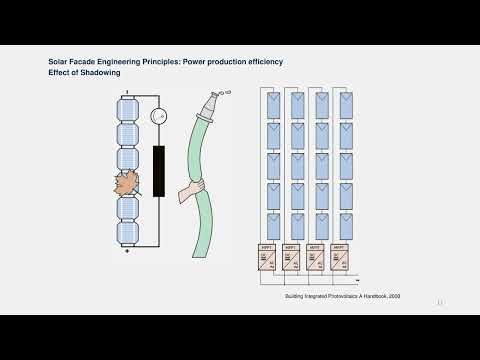 This video covers the structural safety, electrical integration logic, and key design principles for BIPV curtain wall systems — a useful reference for team briefings with architects and engineers unfamiliar with BIPV.
Talking Points That Resonate With Architects
Architects reject BIPV specifications for two reasons above all others: they don’t trust the aesthetics, and they don’t trust the performance data. Your job as an EPC contractor or technical partner is to eliminate both concerns before the spec review meeting, not during it.
On aesthetics: bring physical samples. A 300 × 300 mm sample of BIPV glass at the specified VLT and cell pattern, held up to daylight in a real context, resolves more objections in 60 seconds than 30 minutes of presentation slides. If a custom color is being considered, obtain a color-matched sample from the manufacturer. Color consistency across large facade areas requires production batch management — communicate this requirement to the architect and the manufacturer simultaneously.
On performance: bring site-specific data, not generic brochures. A PVsyst simulation report run specifically for the project’s building orientation, location, and facade geometry demonstrates analytical rigor that architects and building owners respond to. Generic “up to 150 kWh/m²/year” claims without context generate skepticism; a project-specific model showing “this south facade, this location, this orientation, generates X kWh and offsets Y% of your base-building load” generates decisions.
BIM-Ready Models and Design Support Tools
The workflow that moves BIPV from “considered” to “specified” fastest is the one that makes it easy for the architect and structural engineer to incorporate the product into their BIM model without additional work.
Leading BIPV manufacturers provide:
- Revit families for their BIPV product lines — curtain wall panel families with correct dimensions, weight, and visual representation configurable by VLT and cell pattern
- Thermal and structural data sheets in the format required by facade engineers — U-value, g-value, weight per m², wind load rating, and the specific framing configurations tested
- PVsyst model files — pre-built component data allowing the energy modeler to run project-specific simulations without manually entering module characteristics
Jia Mao BIPV provides technical documentation packages including BIM component files, structural load data, PVsyst component files, and NFPA 285 fire test documentation for commercial project submissions. Request these at schematic design stage, not at permit submission — the time saving is substantial.
Co-Developing Repeatable Typologies
The most efficient path to scale in BIPV is standardization. An EPC firm that develops two or three pre-engineered BIPV curtain wall typologies — a south facade standard configuration, an atrium skylight standard, and a spandrel panel standard — can deploy those typologies across multiple projects with minimal re-engineering. The first typology development takes full engineering effort; subsequent deployments on similar projects take 20–30% of that effort.
Work with your BIPV manufacturer and your facade engineering partner to develop these typologies before you need them. A pre-engineered package with BIM models, structural calculations, commissioning protocols, and LEED documentation templates is a commercial differentiator that your competitors who start from scratch on every project cannot easily replicate.
9. Partnering with Building Material Brands and Distributors

How Distributors Create Value in the BIPV Supply Chain
The BIPV market is a specification-led, relationship-dependent business. The decision-making chain involves architects, facade engineers, energy consultants, building owners, and procurement teams — and a distributor who can navigate that chain credibly operates in a fundamentally different commercial environment than a commodity panel reseller.
その solar supply chain dynamics for BIPV distributors differ from standard PV in one critical way: the specification is usually locked 12–18 months before procurement. The distributor who gets into the specification at design stage effectively controls the supply chain by the time the contractor goes to tender.
Joint Marketing and Technical Training Initiatives
Distributors who build durable market positions in BIPV invest in two activities that commodity distributors typically skip:
CPD (Continuing Professional Development) presentations to architecture and engineering practices — typically a 45–60 minute session covering BIPV technology, performance data, code compliance, and available product options. Architects who attend CPD sessions from a specific distributor are significantly more likely to include that distributor’s product range in a subsequent specification.
Co-branded case study development — working with the EPC contractor and the building owner to document real project outcomes with hard numbers. A case study showing “this facade, this building type, this city, this electricity tariff, generated this kWh, saved this amount, with this payback period” is more persuasive to the next prospect in the same sector than any product specification sheet.
Long-Term Supply Agreements for Large-Scale Projects
Custom BIPV glass for a single large project — say, 5,000 m² of bespoke-dimension, specific-VLT panels — may represent an entire production run at the manufacturer’s facility. Price, lead time, and quality consistency for that volume are negotiable in ways that spot-order pricing is not.
For distributors and EPC firms managing multiple projects or multi-phase contracts, a framework supply agreement covering projected volumes over 12–24 months provides:
- Price certainty against raw material (glass, silver paste, encapsulant) cost volatility
- Production slot reservation — securing fabrication capacity before lead times extend during market demand peaks
- Priority technical support — manufacturer engineering resources allocated to framework clients ahead of spot buyers during design coordination phases
10. Future-Proofing Projects: Scalability, Smart Integration, and Energy Resilience
Integration with Energy Storage and Smart Grids
A BIPV glass facade that generates 500,000 kWh/year but exports most of that during low-tariff hours is delivering a fraction of its potential financial value. The combination of BIPV with battery energy storage systems (BESS) — sized to absorb daytime generation and discharge during peak-tariff evening hours — is the configuration that consistently delivers the shortest payback periods.
A 650-bed UK hospital installed 480,000 kWh/year of BIPV generation paired with a 1.2 MWh battery storage bank. The result: a 4-hour full-critical-load backup capability without diesel, and a reduction in grid dependency during daytime operations from 100% to 67%. The hospital’s energy resilience score improved from Red to Green under NHS infrastructure compliance — and no elective surgery cancellations due to power issues have occurred since commissioning.
For commercial offices and retail, the BESS configuration should be modeled against the time-of-use tariff structure in the specific market. In markets with significant peak/off-peak tariff differentials (California, parts of Europe, Australia), BESS adds 15–30% to the financial value of BIPV generation without adding to the facade area or structural requirements.
Building Energy Management Systems (BEMS) Integration
Definition — BEMS (Building Energy Management System): A software platform that monitors and controls a building’s energy-consuming systems — HVAC, lighting, lifts, plug loads — in real time, typically using BACnet or Modbus communication protocols.
BIPV glass integrated with a BEMS creates a feedback loop: the BEMS knows when the facade is generating above expected output (reduce grid import), when generation drops due to cloud cover (pre-charge BESS if tariff is low), and when demand peaks are approaching (shift controllable loads away from the peak window). This active energy management layer — requiring no additional hardware beyond monitoring sensors and a BEMS with a renewable energy module — has been shown to improve the financial value of BIPV generation by 12–20% compared to passive grid-tied operation.
The communication interface between the BIPV monitoring system and the BEMS must be specified and coordinated before installation. Standard protocols — BACnet/IP, Modbus TCP, MQTT for IoT applications — are supported by all major inverter manufacturers. Confirm the BEMS platform in use by the building owner at design stage, not at commissioning.
Positioning BIPV as a Core Component of Net-Zero Buildings
The regulatory trajectory in every major construction market is moving toward buildings that generate as much energy as they consume — net-zero energy buildings (NZEBs). The EU’s EPBD recast requires all new buildings to be zero-emission by 2030. California’s Title 24 already requires on-site solar generation for new commercial construction. UK Part L (2021) requires a 27% reduction in carbon emissions versus the 2013 baseline, with further tightening planned.
In this regulatory environment, BIPV glass is not a green premium — it is a compliance pathway. A building with a BIPV facade can satisfy on-site renewable generation requirements simultaneously with its envelope replacement or construction budget, without requiring a separate rooftop PV system on a roof that may have structural, access, or planning constraints.
Designing for Adaptability: Panel Replacement and Future Upgrades
BIPV glass has a 25–30 year product life — but the technology is improving rapidly. Perovskite-silicon tandem cells, currently achieving certified laboratory efficiencies of 34.85% (LONGi, NREL-certified April 2025), are projected to reach commercial module efficiencies of 28–30% within the 2027–2028 timeframe. That represents a 25–35% improvement over today’s best commercial crystalline silicon BIPV.
Designing for future module replacement means:
- Unitized curtain wall panels: Unitized systems allow individual panel replacement without scaffold mobilization for the entire facade — a maintenance and upgrade cost reduction of 60–70% per replacement event compared to stick-built systems
- Oversized junction box access pockets: Design the access detail for the junction box to accommodate the connector format of the next generation of products, not just the current specification
- Inverter room spare capacity: Size the inverter room and DC cabling for 120% of the current installed capacity — the cost of this spare capacity at construction stage is negligible; the cost of a retrofit at Year 10 is substantial
Performance Snapshot: BIPV Glass by Product Type
| BIPV Product Type | Installed Cost (USD/m²) | 出力 | ブイエルティー | Annual Yield (Temperate) | Typical Application |
|---|---|---|---|---|---|
| Semi-transparent crystalline | $410–$750 | 80–150 Wp/m² | 10–40% | 72–135 kWh/m²/yr | Vision zones, atria, skylights |
| Opaque crystalline (spandrel) | $355–$640 | 150–220 Wp/m² | 0% | 100–175 kWh/m²/yr | Spandrel panels, roofing, solid cladding |
| Colored BIPV (custom tint) | $480–$850 | 70–130 Wp/m² | 10–35% | 60–115 kWh/m²/yr | Luxury facades, brand-specific projects |
| Thin-film (amorphous/CIGS) | $280–$520 | 40–100 Wp/m² | 10–70% | 35–90 kWh/m²/yr | Low-light climates, curved glass, high-VLT zones |
| Curved BIPV glass | $650–$1,200+ | 50–120 Wp/m² | 15–40% | 45–105 kWh/m²/yr | Parametric facades, canopies, signature architecture |
Sources: Metsolar BIPV cost analysis (2024); SolarTechOnline BIPV facade guide; Jia Mao BIPV technical specifications; Terli BIPV complete guide.
よくある質問
1. How does BIPV glass compare in cost to traditional PV + facade systems?
The correct comparison is BIPV glass cost versus conventional glazing cost plus a separate solar installation plus the labor for two separate trades. When you run that comparison, the net incremental cost of BIPV is typically 30–60% above standard high-performance glazing — not the headline figure of $410–$750/m² that appears when BIPV is compared to zero. On a facade renovation already in the project budget, payback periods of 7–12 years are achievable in temperate European climates; 5–10 years in U.S. high-irradiance markets with ITC applied.
2. Can BIPV glass meet structural and safety standards for high-rise buildings?
Yes, when correctly specified and certified. For U.S. high-rise buildings (over 40 feet), the complete facade assembly must pass NFPA 285 fire propagation testing — this covers the glass unit, framing, insulation, and cladding as an integrated system. In European markets, EN 13501 classification is the equivalent requirement. Structural wind load compliance is governed by ASCE 7 (U.S.) or EN 1991-1-4 (Europe). Products from manufacturers like Jia Mao BIPV carry IEC 63092-1, IEC 61215, and IEC 61730 certifications, with wind load ratings up to 5,400 Pa — sufficient for most commercial high-rise applications.
3. What is the energy efficiency and power output of BIPV glass compared to standard solar panels?
Semi-transparent BIPV glass achieves 8–12% module efficiency — lower than standard rack-mounted monocrystalline panels at 20–23%, because some of the cell area is replaced by transparent gaps between cells. Opaque BIPV spandrel panels achieve 15–22% efficiency, approaching standard panel performance. The critical point is that BIPV activates facade surface area that standard rack-mounted panels cannot reach — a 2,000 m² south facade generating 80–150 kWh/m²/year represents 160,000–300,000 kWh of annual production from a surface that was previously generating nothing.
4. How do I handle electrical interconnection in complex curtain wall designs?
Use pre-wired junction boxes with factory-terminated DC leads, standardized MC4 connectors throughout, and complete the string configuration design — including shading analysis — before any panel orders are placed. The string architecture must coordinate with the curtain wall grid: every panel in a string should face the same orientation and shade profile. For large or geometrically complex facades, microinverters or power optimizers at each panel eliminate the worst-case string shading problem at a cost of $0.15–0.25/W additional.
5. Is maintenance more difficult with BIPV glass than conventional glazing or rooftop PV?
Maintenance for BIPV glass follows the same protocols as standard curtain wall glazing — BMU (building maintenance unit) access for periodic cleaning, sealant joint inspection every 3–5 years, and glass surface cleaning frequency determined by local pollution levels (quarterly for urban environments, semi-annual for low-pollution sites). The electrical system requires annual string voltage checks and inverter diagnostics — adding approximately half a day of work per year per 100 kWp installed. Anti-fouling coatings on quality BIPV glass reduce cleaning frequency requirements by approximately 30% versus standard glass.
6. Can BIPV glass be customized for specific architectural designs?
Yes, in custom sizes up to 3,000 × 2,000 mm, custom VLT from 10–90%, custom colors via colored PVB interlayers or ceramic frit patterns, and curved glass forms for parametric facades. Color consistency across large facade areas requires production batch management — entire facade zones should be ordered in a single production batch from a single manufacturing run. For projects with tight color matching requirements, request a pre-production color sample for sign-off before the full order is placed.
7. What certifications should I look for when sourcing BIPV glass?
The minimum set for commercial U.S. projects: IEC 61215 (performance durability), IEC 61730 (safety qualification), UL 7103 (for roofing BIPV under 2021 IBC), NFPA 285 documentation for the specific assembly, and EPD for LEED MR credits. For European projects: IEC 61215/61730, CE marking, EN 13501 fire classification, and EPD. IEC 63092-1 — the dedicated BIPV standard covering both PV and building performance requirements — is increasingly required by specifiers and should be on your checklist for any project after 2024. UL’s BIPV testing and certification services cover the full compliance pathway for U.S. markets.
8. How long does BIPV glass installation take compared to traditional systems?
With unitized prefabricated BIPV panels — factory-assembled with integrated electrical connections — installation rates match or exceed standard unitized curtain wall. A typical high-rise commercial project installs 200–400 m²/week of unitized BIPV panel per crane and crew. The schedule risk is not installation pace — it is the 12–20 week fabrication lead time for custom-specification glass. Projects that order early (at design development completion, not at construction start) consistently deliver on program.
9. Are there risks of thermal stress or shading losses in facade-integrated BIPV?
Thermal stress is managed through correct panel sizing — BIPV glass laminate dimensions must account for thermal expansion in the frame; standard curtain wall clearances are generally adequate. Shading loss in a poorly designed string configuration can reduce annual output by 15–25% compared to the design model; avoid this by completing shading analysis before finalizing the string architecture, and using power optimizers or microinverters where shading variability across a string is unavoidable. Thermal performance of the cells is actually better in curtain wall applications than in rack-mounted systems, because the ventilation gap behind the panel keeps module temperatures 5–15°C lower than unventilated roof-mounted panels.
10. How can I convince developers or building owners to choose BIPV over cheaper alternatives?
Lead with lifecycle cost, not upfront cost. The 25-year total cost comparison — conventional glass plus energy cost plus a separate solar system, versus BIPV glass with unified warranty and combined savings — consistently favors BIPV for buildings with significant south-facing facade area. For ESG-driven clients, the carbon intensity reduction (documented at 82→49 kg CO₂/m²/year in the Frankfurt case study) is a board-level reporting metric, not just an engineering stat. For developers, the 4–15% property value premium documented in commercial real estate research translates to a material valuation differential on a large project — a number that appears on the asset manager’s balance sheet, not just the energy consultant’s report.
11. Does BIPV glass work in low-light or northern climates?
Yes. The Powerhouse Brattrkaia in Trondheim, Norway (63°N latitude) generates over 500,000 kWh/year from approximately 3,000 m² of BIPV panels — more than twice the building’s annual electricity consumption. The design strategy was an aggressively angled south-facing roof surface maximizing panel angle for low winter sun angles. Thin-film amorphous silicon BIPV performs particularly well under diffuse irradiance conditions (overcast skies), making it the preferred technology for Northern European and Pacific Northwest applications. Low-light performance should be confirmed with the manufacturer by reviewing the product’s fill factor and low-irradiance efficiency data, not just the STC rating.
12. Can BIPV be combined with rooftop solar for maximum energy yield?
Yes — and hybrid systems are the optimal configuration for buildings with both usable roof area and significant south-facing facade area. The Frankfurt corporate headquarters case combined a BIPV curtain wall facade with rooftop panels, reaching 40% energy cost reduction. Architecturally, the roof panels are not visible; the facade panels contribute the architectural character. From the electrical system design standpoint, roof and facade arrays are typically configured as separate strings to their respective inverters, then combined at the AC bus — a straightforward configuration for any competent electrical engineer familiar with multi-array PV design.
13. What training or support do BIPV manufacturers offer for contractors?
Reputable BIPV manufacturers offer on-site crew training before installation begins (typically half-day sessions covering DC electrical safety and panel handling procedures), detailed installation manuals with torque specifications and interface details, Revit BIM component families for design coordination, and technical hotlines for field questions during installation. Jia Mao BIPV’s technical installation and design guide is a publicly available reference for installation teams. For complex commercial projects, request a manufacturer technical representative on-site for the first week of panel installation — the cost is typically absorbed into the project support package for qualifying order volumes.
14. How do I ensure warranty coverage across both building and electrical components?
The cleanest warranty structure is a unified product warranty from a single manufacturer covering both the glass component performance and the electrical output — this is what leading BIPV glass manufacturers provide. Where the glazing and electrical components come from separate suppliers, define the warranty responsibility boundary in writing before award: the glass manufacturer warrants the laminate integrity and visible-light performance; the inverter manufacturer warrants the electrical conversion equipment; the EPC contractor warrants the installation workmanship and system commissioning. The most common warranty dispute on BIPV projects is moisture ingress through a junction box — pre-empt this by specifying IP67-rated junction boxes and confirming the sealant compatibility in writing with the glass manufacturer before installation.
15. Is BIPV suitable for retrofit projects or only new construction?
BIPV glass is viable for retrofit projects when two conditions are met: the existing curtain wall frame has sufficient reserve structural capacity to support the additional weight (assessable by a PE in 1–2 days), and there is an accessible route for DC cabling from the facade to the inverter room. The commercially attractive retrofit scenario is a building with glazing at or approaching end-of-life — where the replacement cost is already committed, and the upgrade to BIPV glass represents a net incremental investment rather than the full BIPV ticket price. The Frankfurt case study and the rail station case were both retrofit projects. Modular BIPV systems with standard-dimension panels and 4–8 week lead times (versus 12–20 weeks for custom glass) are increasingly available and specifically designed for time-sensitive retrofit programs.
The Three Moves That Separate the Leaders From the Rest
The BIPV market is not approaching mainstream — it is already there. The global BIPV market at USD 23.4 billion in 2025 is projected to exceed USD 98 billion by 2034. Regulatory mandates in the EU, California, Singapore, and an expanding list of markets are effectively requiring on-site renewable generation for new commercial construction. The professionals who are building their BIPV capability now — technical knowledge, certified supplier relationships, workflow tools, and reference project portfolios — are the ones who will own the market when the volume scales.
Three immediate actions deliver the highest ROI on that investment:
First, run a facade irradiance analysis on your next commercial project before VLT is specified. A half-day of energy modeling at schematic design stage identifies the zones where BIPV generates meaningful output, informs the transparency specification, and produces the site-specific energy data that architects and building owners respond to.
Second, establish a technical relationship with a BIPV manufacturer who provides the complete documentation package — BIM files, structural data, IEC certifications, NFPA 285 fire test documentation, and EPDs — before you need them for a bid. Jia Mao BIPV’s product range covers the full spectrum from semi-transparent vision glass to opaque spandrel panels and curved glass applications, with 3 GW annual production capacity and a technical support team available for commercial project consultation.
Third, build your first BIPV reference project into a documented case study with real kWh numbers, real savings figures, and a real client testimonial. That document — specific to your market, your building type, your climate — is the most effective sales tool you will ever produce. It compounds over time, and it is the foundation of the competitive position that early market leaders in every technology category convert into durable market share.
Glossary of Key Terms
BIPV (Building-Integrated Photovoltaics): Solar components embedded directly into building envelope materials — glazing, roofing, cladding — that replace conventional materials while generating electricity.
BAPV (Building-Applied Photovoltaics): Rack-mounted solar panels applied to a completed building surface. Additive, not substitutive.
VLT(可視光線透過率): The percentage of visible light that passes through the glazing. 30% VLT = 30% of visible daylight transmitted. Higher VLT means more daylight, less power per m².
SHGC(日射熱取得率): The fraction of solar radiation that enters a building through the glazing as heat. Lower SHGC = better shading performance and lower cooling loads.
Performance Ratio (PR): The ratio of actual energy yield to theoretical maximum energy yield. PR ≥ 0.75 is the commissioning acceptance standard for well-designed BIPV systems.
ITC (Investment Tax Credit): U.S. federal tax credit equal to 30% of the eligible installed cost of a solar energy system, including BIPV, under Section 48E of the Inflation Reduction Act.
MACRS (Modified Accelerated Cost Recovery System): U.S. depreciation system allowing solar system costs to be depreciated over 5 years, creating significant Year 1 tax benefit when combined with ITC.
EPD (Environmental Product Declaration): ISO 14025-compliant, third-party verified document quantifying the lifecycle environmental impact of a building product. Required for LEED Materials & Resources credits.
BEMS (Building Energy Management System): Software platform that monitors and controls a building’s energy-consuming systems in real time, typically using BACnet or Modbus communication protocols.
POE (Polyolefin Elastomer): Advanced encapsulant film used in premium BIPV glass laminates. Offers 40% better UV aging resistance than standard EVA and significantly reduces delamination risk over the product’s 25-year life.
For the full Jia Mao BIPV product range for curtain wall and roofing applications, visit the BIPV product catalogue. For real-world BIPV case studies with energy output data and ROI timelines across 10 building types, see the photovoltaic glass case study library.