How Specialized Contractors Can Optimize Photovoltaic EPC Projects with Glass Panels
The Complete Technical and Commercial Guide for EPC Firms, Curtain Wall Contractors, Roofing Specialists, Building Material Distributors, and Design Professionals
The contractors and EPC firms consistently winning photovoltaic glass projects are not the ones with the lowest price. They are the ones whose teams understand the coordination requirements across structural, glazing, and electrical disciplines — and plan for those requirements before mobilization, not after.
1. Strategic Integration of BIPV Glass Panels in EPC Workflows
Every photovoltaic EPC project that runs smoothly has one thing in common: the solar glass integration was treated as a design decision, not a procurement event. The projects that generate expensive change orders, delayed completions, and client disputes are, without exception, the ones where PV glass was added to the scope after the structural, mechanical, and electrical drawings were already complete.
This is the foundational insight that separates contractors who consistently deliver profitable BIPV projects from those who absorb cost overruns on every one.
What is a BIPV EPC workflow? EPC stands for Engineering, Procurement, and Construction — the three interdependent functions a contractor or consortium takes full responsibility for when delivering a building-integrated solar project. In a BIPV glass context, this means the EPC team is responsible for the engineering design of how the PV glass integrates into the building structure, the procurement of certified glass panels within the project schedule constraints, and the installation and commissioning of a working electrical system embedded in the building envelope.
Aligning BIPV Glass Integration with Project Timelines
The NREL Solar Benchmarking analysis consistently identifies design change orders after construction mobilization as costing an average of 3.2× more to implement than the same change made at the design stage. For curtain wall BIPV projects, this multiplier is even higher — because structural framing fabricated without BIPV glass load data cannot be economically modified after delivery.
The correct integration timeline puts BIPV glass decisions at schematic design (SD) — the earliest formal design phase — where three foundational decisions can be made simultaneously with minimal cost impact:
- Glazing zone designation: Which facade or roof zones will receive PV glass, which will receive conventional glazing, and what the VLT (Visible Light Transmittance — the percentage of visible light that passes through the glazing) requirement is for each zone.
- Structural parameter input: BIPV glass dead load figures (typically 25–45 kg/m² for laminated safety glass units) input to the structural engineer’s initial calculations, before framing members are sized.
- Electrical routing conceptual layout: Inverter location, conduit pathways through framing cavities, and junction box positions established in the building section — before architectural elements that will contain them are designed in detail.
Coordinating Structural, Electrical, and Architectural Teams
On a commercial curtain wall BIPV project in Austin, Texas, the facade contractor, electrical contractor, and structural engineer held a Facade-Electrical Interface Meeting at design development — resolving cable routing through mullions and junction box placement before curtain wall shop drawings were produced. The project manager estimated that this single two-hour meeting eliminated what would have been $60,000–$90,000 in change orders if those conflicts had been discovered during installation.
That outcome is not exceptional. It is what early coordination consistently produces.
ジャ・マオ・ビップフ provides technical documentation packages — including structural load data, BIM-compatible component files, electrical schematic drawings, and certification documentation — designed to be incorporated directly into project specification documents at the design stage, reducing the coordination burden on the project team and improving first-time permit approval rates. Their BIPV facade design and electrical integration guide is the starting point for EPC firms specifying BIPV glass for the first time.
Retrofit Integration: The Commercial Curtain Wall Case
Retrofit BIPV projects — replacing end-of-life curtain wall glazing with PV glass — follow a different workflow than new construction. The existing framing system is a fixed parameter, and the BIPV glass specification must work within its constraints rather than being designed to the glass.
The critical retrofit assessment questions are: Does the existing framing’s dead load capacity accommodate the heavier BIPV glass unit (verify through a PE-stamped structural review)? Can DC cable routing be achieved through the existing mullion cavity without destructive modification? Is the existing electrical service panel sized to accommodate the new solar generation connection?
A facade renovation on a 40-story Phoenix office tower that replaced 9,200 m² of standard clear curtain wall glazing with high-performance solar control glass documented an annual HVAC energy reduction of 41% — approximately $380,000 per year — as the primary measurable outcome. The retrofit was completed floor-by-floor on a 16-week installation schedule with no building-wide disruption to tenants. This is the scale of outcome that makes BIPV retrofit a genuinely compelling offering for contractors who understand how to execute it.
2. Advanced Installation Techniques for Solar Glass in High-Performance Envelopes
The installation of photovoltaic glass on vertical and sloped building surfaces combines three distinct technical disciplines that rarely sit in the same subcontractor’s scope: structural glazing, roofing system weatherproofing, and electrical installation. The specialist who is expert in one of these and competent in the others is rare. The contractor who manages the interface between specialists in all three, with a coordinated execution plan, is the one who delivers these projects without the expensive surprises.
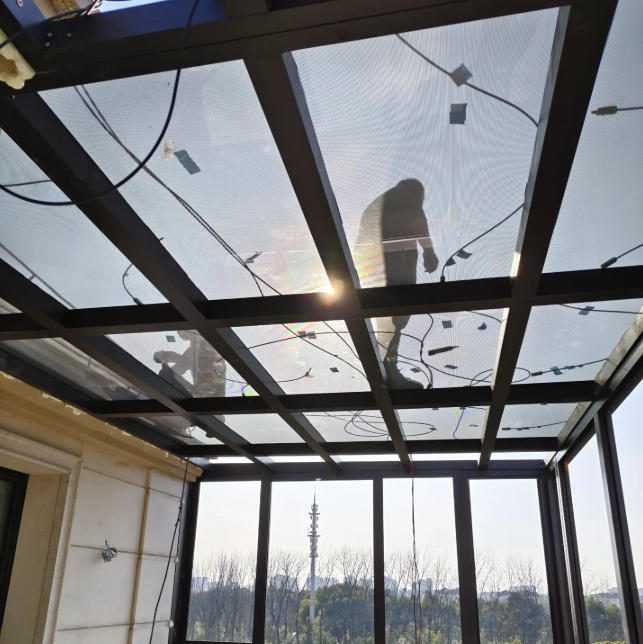
PV glass installation on a curtain wall facade requires coordinated sequencing between glazing, roofing, and electrical trades. Firms that separate these disciplines into sequential phases — rather than coordinated concurrent phases — consistently encounter the most expensive interface failures.
Mounting and Sealing: Getting the Critical Details Right
For curtain wall applications: PV glass panels are typically installed in pressure-plate or structural silicone glazed (SSG) curtain wall systems. The dead load of laminated BIPV glass — 25–45 kg/m² compared to 15–20 kg/m² for standard IGU units — must be transferred through the bracket system to the primary building frame with connections rated by a licensed structural engineer, not field-improvised to match the existing bracket layout.
At the panel perimeter, specify silicone sealant systems rated to –40°C to +85°C with UV resistance confirmed over 25-year service life. BIPV glass generates heat during operation — surface temperatures routinely reach 60–75°C on summer afternoons — creating thermal movement in the glazing frame that exceeds conventional glass by 10–25%. The movement joint at the panel perimeter must accommodate this additional thermal range without allowing the sealant to crack or debond.
For sloped roof and skylight applications: Every roof penetration — including the DC cable grommet penetration through the frame of each BIPV glass panel — is a potential moisture infiltration point. Use manufacturer-specific flashing kits, not generic sheet metal flashing cut to fit. The flashing kit maintains the roofing system’s warranty coverage and has been factory-tested with the specific glass frame geometry — neither of which is true for field-fabricated alternatives.
Wind Load Compliance: Where Installations Fail Under Inspection
Wind uplift forces govern the connection design on the vast majority of BIPV glass installations. At building upper stories and corners, design wind pressures under ASCE 7-22 can exceed 3.0 kPa — a load level that undersized or incorrectly spaced connections will not resist. The failure mode is typically not catastrophic collapse; it is progressive connection loosening under repeated wind cycles, which creates vibration, sealant fatigue, and eventually water infiltration at the worst point in the building’s weather exposure.
The specific requirement that distinguishes professional BIPV installation from sub-standard work: bracket and anchor connections must be designed and documented by a licensed PE using the project-specific design wind pressure, not generic catalog load ratings. Request the PE-stamped structural calculation package from the curtain wall engineer before approving the shop drawing submittal.
Collaboration with Glazing and Roofing Subcontractors
The most consistent source of costly interface failures on BIPV projects is the assumption that the glazing subcontractor’s scope ends at the glass and frame, and the electrical subcontractor’s scope begins at the junction box — with nobody responsible for the DC cable path between them.
Define the interface responsibility explicitly in the subcontract documents before trade mobilization. A written Interface Responsibility Matrix — a single-page table specifying which trade installs each component, which trade provides the material, and which trade is responsible for inspection — eliminates the “that’s not our scope” disputes that become change orders.
3. Performance Optimization Through Material Selection and Technology Pairing
The output of a BIPV glass system over its 25-year service life is primarily determined by three decisions made at the specification stage: the PV glass technology selected, the power electronics architecture chosen, and the glass surface treatment specified. Getting these right at design stage costs nothing. Redesigning them at installation stage costs significantly.
Comparing PV Glass Types: Energy Yield vs. Architectural Function
The selection between transparent, semi-transparent, and colored/opaque PV glass is not purely an aesthetic decision — it is a simultaneous optimization across four variables: energy yield, daylighting quality, thermal performance, and architectural compliance.
| Glass Type | VLTレンジ | Power Density (Wp/m²) | Annual Yield — South Facing (kWh/m²) | ベスト・アプリケーション |
|---|---|---|---|---|
| Opaque BIPV glass (spandrel) | 0% | 140–190 | 140–200 | Curtain wall spandrel, blind zones |
| Semi-transparent (medium) | 20–50% | 80–130 | 90–145 | Skylights, atrium roofing, canopies |
| Semi-transparent (high VLT) | 50–70% | 50–90 | 55–100 | Vision glazing, office facades |
| Colored/pattern PV glass | 0–30% | 90–160 | 100–175 | Architectural feature facades |
| Thin-film on metal substrate | 0–15% | 60–120 | 65–130 | Curved roofing, standing seam metal |
Sources: Jia Mao Bipv product technical data; Fraunhofer ISE Photovoltaics Report 2025; IEA PVPS BIPV Technical Guidebook 2025.
Industry insight: For facade applications where occupant daylight quality matters, the VLT specification should be confirmed by a licensed lighting designer before the glass is ordered — not after the first floor has been glazed and an occupant complains about light levels. A daylight illuminance simulation using the actual BIPV glass spectral transmission data takes 2–4 hours of modeling time and prevents redesigns that cost 100× more.
Integrating MLPE with BIPV Glass Panels
MLPE — Module-Level Power Electronics — refers to microinverters or DC power optimizers installed at each individual glass panel. They are not optional on BIPV installations: NEC Article 690.12 requires that all DC conductors inside a building be de-energized to 30V or less within 30 seconds of rapid shutdown initiation. On facade systems where conductors necessarily run inside the building envelope, MLPE devices are the standard-compliant solution.
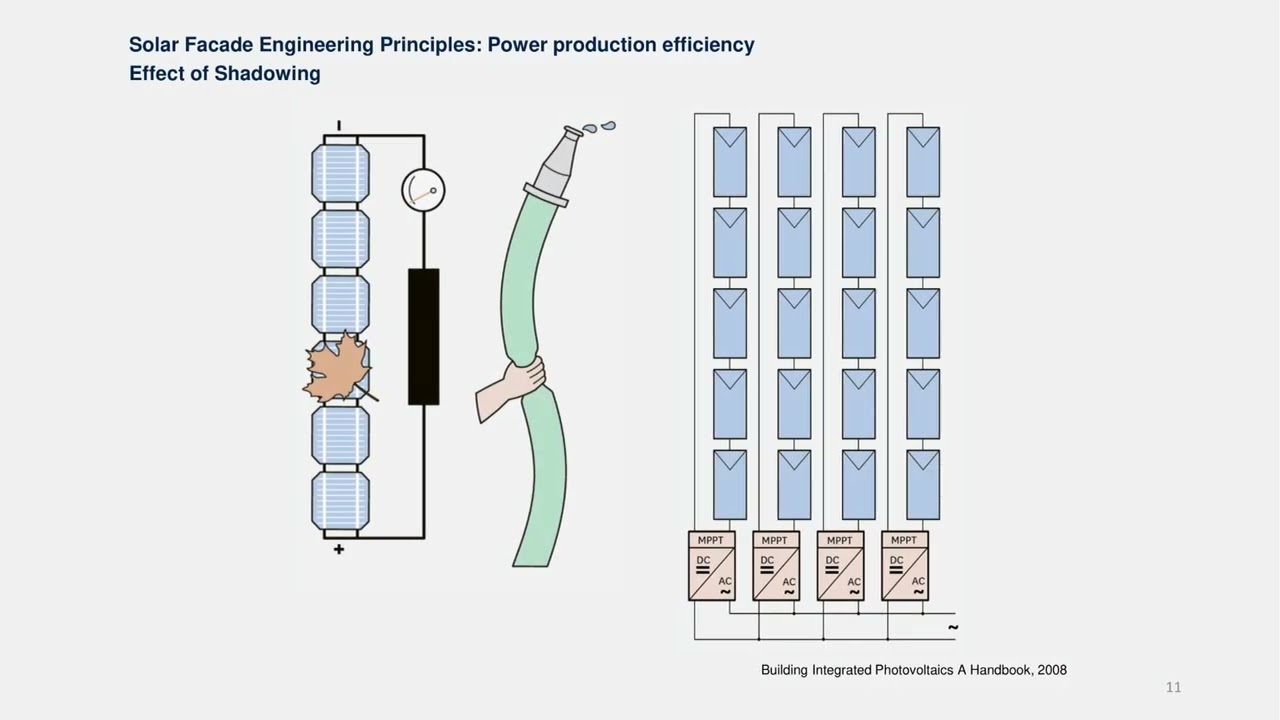
Beyond code compliance, MLPE provides two performance advantages that are particularly valuable in BIPV applications. First, partial shading of one panel — from a projecting slab, adjacent parapet, or neighboring building — does not reduce the output of the entire string (as it would in a string-inverter configuration). Second, module-level monitoring identifies underperforming panels within minutes of deviation, enabling targeted maintenance rather than system-wide troubleshooting.
The cost premium of MLPE over string inverters is typically $0.20–$0.50/W. On a shaded or geometrically complex facade, the production gain from eliminating shading mismatch losses typically recovers this premium within 2–3 years.
Surface Treatments That Improve Field Performance
Anti-reflective (AR) coatings reduce the reflective losses at the glass-air interface by approximately 3–5% in absolute terms. On standard glass, reflective losses account for approximately 8% of incident light. AR coating brings this to 3–5%, increasing light transmission to the solar cells by a proportional amount. For BIPV glass with light-transmitting requirements (skylights, vision glazing), AR coating also improves visible light quality for occupants by reducing glare.
Self-cleaning hydrophobic coatings reduce water contact angle to below 20° (super-hydrophilic) or increase it above 150° (super-hydrophobic — the “lotus effect”), both of which cause water to sheet off the glass surface carrying particulate soiling with it. In urban environments where facade access for cleaning is expensive, self-cleaning coatings extend effective cleaning intervals by 30–50%. Request the manufacturer’s field performance data — not just laboratory contact angle measurements — for the specific coating on the specific glass substrate you are specifying.
Low-iron glass significantly improves solar cell efficiency. Standard float glass has an iron content that creates a greenish tint and absorbs approximately 3–5% of incident light. Low-iron glass (iron content below 0.02%) achieves near-colorless transmission and reduces this absorption loss. For any BIPV application where maximum power output is a priority, low-iron glass is the correct specification — the price premium of approximately $3–$8/m² is recovered within 1–2 years through incremental generation.
4. Design Collaboration Between Architects and EPC Contractors
The productivity gap between BIPV projects that deliver at specification and those that fall short is consistently traced back to when the EPC contractor first engaged with the design team. Projects where the EPC was involved at schematic design — shaping the energy model, the glazing zone layout, and the electrical infrastructure concept — consistently outperform projects where the contractor was brought in to “install what was drawn.”
This is not a complaint about architects. It is a recognition that most architectural practices do not have the BIPV-specific engineering knowledge to specify these systems optimally without EPC input, and most EPC contractors do not have the client relationships to enter projects at schematic design without a deliberate business development strategy.

Leveraging BIM and Digital Twins for BIPV Projects
BIM (Building Information Modeling) — a coordinated 3D digital model integrating structural, architectural, and MEP (Mechanical, Electrical, Plumbing) information — is the standard tool for clash detection and construction coordination on commercial building projects. For BIPV glass integration, the BIM model must include the PV glass panels as active parametric objects — not just surfaces — with accurate weight data, frame dimensions, electrical connection point locations, and rated performance characteristics.
Research published by IEA PVPS in their BIM for BIPV technical report (2024) demonstrates that BIM-coordinated BIPV projects achieve 40–60% fewer field conflicts than equivalent projects designed without coordinated BIM. The specific conflict categories most frequently eliminated: conduit routing through occupied structural cavities, junction box placements that violate NEC working space clearances, and glass panel dimensions that do not align with the framing grid established by the structural engineer.
Digital twins — real-time operational models that mirror the physical building and update with live sensor data — are extending this coordination benefit into the operational phase. A BIM-based digital twin for a BIPV facade continuously compares actual energy generation (from the monitoring system) with predicted generation (from the energy model), flagging deviations that indicate underperformance before they become warranty disputes.
Relevant research from Fraunhofer ISE and IEA PVPS’s BIPV Task 15 reports confirms that BIM-to-digital-twin workflows for BIPV facades are commercially available from specialized software providers, with documented case studies in Germany, Netherlands, and Australia showing performance variance detection within 3–5 days of occurrence.
Meeting LEED, BREEAM, and Net-Zero Targets
BIPV glass contributes to certification credits across multiple categories simultaneously — an efficiency that single-purpose sustainability measures cannot match. For LEED v4.1 projects, BIPV glass in curtain wall and roofing applications contributes to: EA Credit Renewable Energy Production (1–5 points), EA Credit Optimize Energy Performance (up to 18 points through demand reduction via SHGC management plus supply addition via generation), and SS Credit Heat Island Reduction (where BIPV roofing satisfies the reflectance or vegetation criteria).
For architects and consultants preparing LEED submission documentation: the energy model must differentiate the demand reduction contribution of the BIPV glass (SHGC improvement over baseline glazing) from the generation contribution (kWh produced annually). Both effects contribute to the energy cost reduction percentage that drives EA credit points — but the calculation methodology must follow ASHRAE 90.1 Appendix G procedures. An energy modeler with BIPV-specific experience is a prerequisite for accurate credit documentation.
5. Compliance, Certification, and Building Code Alignment
This is the section where BIPV proposals most commonly stall — not because products do not comply, but because the project team does not have a structured compliance roadmap before permit submission. Knowing the exact certifications required, and having them in the documentation package, is the difference between a 2-week permit approval and a 12-week back-and-forth review cycle.
Fire Safety: The Most Frequently Missed Requirement
For commercial buildings in the US exceeding 40 feet in height, exterior wall assemblies must comply with NFPA 285 — the Standard Fire Test Method for Exterior Non-Load-Bearing Wall Assemblies. This is an assembly-level test, not a product certification. The tested assembly includes the BIPV glass panel, framing system, insulation layer, and air/weather barrier in the specific configuration used on the project.
Requesting a manufacturer’s NFPA 285 test report is necessary but not sufficient. Verify that the test report covers the specific assembly configuration — glass type, framing system brand and model, insulation type and thickness, and panel-to-panel junction detail — proposed for the project. A different framing system than the tested assembly requires a code analysis by a qualified fire protection engineer, not just a swap in the specification.
Under ASTM E84, all PV glass in building exterior applications must achieve Class A fire rating (flame spread index ≤25, smoke development index ≤450). Laminated tempered safety glass configurations used in commercial BIPV products typically exceed this standard — but confirm with the manufacturer’s specific test certificate for the actual laminate configuration being specified.
The Complete Certification Matrix
| Standard | Scope | Required For | Where to Verify |
|---|---|---|---|
| IEC 61215 | PV module electrical performance & durability | All commercial BIPV glass | IEC certification body registry |
| IEC 61730 | PV module electrical safety | All commercial BIPV glass | UL/TÜV/Bureau Veritas registry |
| IEC 63092-1:2020 | BIPV combined building + PV standard | All building-envelope BIPV | IEC certification body registry |
| EN ISO 12543 | Laminated safety glass | All laminated BIPV glass | CE marking documentation |
| NFPA 285 | Full assembly fire test | US commercial, high-rise | Test lab report for specific assembly |
| ASTM E84 | Surface burning classification | US facade and roofing applications | Test lab certificate |
| NEC Article 690 | PV electrical installation | All US grid-connected installations | AHJ plan check approval |
| IEEE 1547-2018 | Grid interconnection | All US utility-connected systems | Inverter compliance documentation |
| EN 13501-1 | EU fire classification | EU facade applications | CE marking documentation |
| UL 61730 | US PV module safety | US commercial projects | UL product listing database |
Documentation Strategy for Permit Approvals
The permit package for a commercial BIPV glass project requires coordination between four discipline engineers — structural, electrical, facade/glazing, and fire protection — and the single most common cause of permit re-reviews is missing or inconsistent information between disciplines.
Assign one team member as the permit package coordinator. Their responsibility is not to produce technical content — it is to verify that all documents cross-reference each other correctly: the single-line diagram matches the inverter specifications, the structural calculations address the specific glass weight listed in the glazing schedule, and the fire protection narrative references the actual NFPA 285 test report in the package.
For interconnection documentation specifically, submit the utility interconnection application concurrent with the building permit, not after permit approval. These two review processes can run in parallel, compressing the overall pre-construction timeline. On commercial projects where interconnection may require a system impact study (typically systems over 200 kW–2 MW depending on the utility), starting the interconnection application 6–8 months before planned construction start is the standard that eliminates schedule risk.
6. O&M Strategies Specific to Photovoltaic Glass Systems
A BIPV glass system that is not actively monitored is not an asset — it is a liability that depreciates silently. A system running at 12% underperformance for three months due to a failed optimizer or a soiled surface has cost the building owner more in lost energy value than a professional O&M contract would cost for a full year.
Predictive Maintenance Using IoT and Remote Monitoring
Modern IoT-based monitoring for commercial BIPV installations provides string-level performance data updated every 5–15 minutes, with automatic alerts when string output deviates from the performance model by a user-defined threshold (typically 5% over a rolling 7-day period). The value of this monitoring is not the dashboard — it is the early warning that dispatches a technician to resolve a $200 connection issue before it becomes a $3,000 module replacement.
Research published in Sustainability (MDPI, 2025) on distributed IoT predictive maintenance for PV systems found that IoT-enabled systems detected 85–90% of developing faults within days of onset — compared to quarterly manual inspections which typically detected the same faults 6–12 weeks later, by which time performance degradation was measurably larger. For EPC firms offering O&M contracts, this detection speed advantage is the foundation of a service guarantee: “We identify and resolve performance issues within [X days], or we credit your account.”
Drone-based thermal imaging is now a standard tool for annual comprehensive inspections of commercial BIPV facade installations. Thermal cameras identify hotspots — localized high-temperature zones caused by defective cells, partial shading, or connection faults — that are invisible to visual inspection. A published IoT-based thermal imaging study (MDPI Sensors, 2023) demonstrated automated hotspot detection accuracy of 94% using combined drone imagery and AI classification, compared to 78% for manual thermal inspection.
For facade installations where scaffold or rope access is expensive, drone inspection reduces the annual inspection cost by 40–65% while improving defect detection coverage to 100% of the facade area — compared to approximately 30–40% coverage achievable in a typical rope-access spot inspection at the same cost.
Cleaning Protocols That Do Not Damage PV Coatings
This is where well-intentioned maintenance causes damage. Standard window cleaning chemicals — particularly those containing alkaline compounds, hydrofluoric acid derivatives, or abrasive scrubbing agents — can degrade the anti-reflective coating on BIPV glass, permanently reducing light transmission and output.
The correct protocol for commercial BIPV glass cleaning:
- Water pH range: 6–8 (neutral). Confirm with a simple pH strip before each cleaning event.
- Detergent: pH-neutral, non-abrasive, certified safe for coated glass — request the manufacturer’s approved cleaning product list.
- Applicator: Soft microfiber mop or squeegee with rubber blade. No metal scrubbing pads, no abrasive brushes, no high-pressure water above 40 psi at the glass surface.
- Frequency: Every 6–12 months in urban environments; every 3–6 months in coastal, industrial, or high-dust regions.
- After-cleaning inspection: Record cleaning date, weather conditions, and any visible damage observations in the maintenance log — this log is the evidentiary baseline for any future warranty claim.
Monitoring Degradation and Hotspot Detection
Annual power output degradation for certified commercial BIPV glass runs 0.4–0.7%/year for established thin-film products — slightly above the 0.3–0.5%/year typical of premium monocrystalline silicon panels. Over a 25-year life, this difference amounts to approximately 2–5% lower cumulative output, well within the range offset by the material dual-function value of BIPV glass.
However, accelerated degradation — output loss significantly above the warranted rate — is a warranty claim trigger that requires systematic documentation. The correct O&M protocol for tracking degradation against warranty thresholds:
A PR below 0.78 at commissioning or dropping more than 2 percentage points in a single year warrants investigation and manufacturer notification. Maintain a monthly PR log from commissioning — this is the core document for any warranty claim involving performance shortfall.
7. Cost Management and ROI Enhancement for Clients
The single most effective change an EPC firm or contractor can make to its win rate on BIPV glass projects is to arrive at the client conversation with a defensible 25-year financial model — not just a per-square-foot price.
Clients who receive only a material cost figure make decisions based on price comparison with conventional glazing. Clients who receive a lifecycle financial analysis make decisions based on value comparison with their building’s energy cost baseline. These are structurally different conversations, and only one of them consistently results in BIPV glass being specified.
Lifecycle Cost Analysis: PV Glass vs. Conventional Cladding
The lifecycle cost model for BIPV glass versus conventional curtain wall cladding has four components that must all be quantified:
どこで r is the annual electricity price escalation rate (3–5% historically) and d is the discount rate (typically 6–8% for commercial real estate).
Worked example — 800 m² south-facing commercial facade in Los Angeles:
| Line Item | 価値 |
|---|---|
| BIPV opaque spandrel glass (800 m² @ 150 Wp/m²) | 120 kWp installed system |
| Gross installed cost of BIPV glass system | $420,000 |
| Avoided conventional spandrel cladding cost (800 m² @ $150/m²) | –$120,000 |
| Federal ITC (30% of eligible cost) | –$126,000 |
| Net effective cost after incentives and material offset | $174,000 |
| Annual energy generation (LA: 5.5 peak sun hours, vertical south facade: ~0.65 factor) | ~142,000 kWh/yr |
| Annual energy value at $0.25/kWh commercial rate | $35,500/yr |
| Simple payback on net effective cost | 4.9 years |
| 25-year cumulative savings (3% escalation, 6% discount) | ~$580,000 |
This calculation — which most conventional glazing contractors are not presenting to their clients — transforms the BIPV discussion from “that’s expensive glass” to “that’s a 4.9-year payback commercial investment.”
Accessing Incentives, Tax Credits, and Green Financing
Federal Investment Tax Credit (ITC): Under IRS Section 48E, qualifying solar energy systems receive a 30% direct tax credit on total installed cost. For commercial BIPV glass projects, eligibility requires that electricity generation is the primary function of the installed system. According to SEIA’s current tax policy guidance, the 30% rate is confirmed through at least 2032 under the Inflation Reduction Act framework.
179D Commercial Buildings Energy Efficiency Tax Deduction: Provides up to $5.00/sq ft in deductions for commercial buildings achieving specified energy performance improvements. BIPV glass contributing to SHGC reduction and on-site generation simultaneously can qualify — stack this with the ITC for maximum incentive capture.
PACE Financing (Property Assessed Clean Energy): Allows commercial property owners to finance BIPV installations through a property tax assessment, repaid over 10–25 years and transferable upon property sale. PACE eliminates the payback period objection for owners with shorter hold periods.
Green bonds and sustainability-linked loans: Available to commercial real estate owners with documented on-site renewable generation, typically at 25–75 basis points below market borrowing rate. Include BIPV generation documentation in the green finance application package.
State and utility-specific incentives are tracked in the DSIRE incentive database — the authoritative source for jurisdiction-specific programs updated in real time.
8. Supply Chain and Logistics for Specialized Glass Panels
Custom-specification BIPV glass panels are not commodity products. They are engineered building components manufactured to project-specific dimensions, transparency specifications, electrical configurations, and glass make-up requirements. Managing their procurement with the same approach used for standard silicon panels reliably produces the most expensive problems in BIPV project delivery.

Lead Times and When to Place Orders
Custom BIPV glass lead times in 2025 run from 8–14 weeks for standard configurations from established manufacturers and 14–20 weeks for fully custom-dimensioned, special-transparency, or architectural-pattern glass. These are manufacturing lead times from confirmed PO to factory dispatch — add 3–6 weeks transit for European or North American delivery.
The professional procurement standard that experienced BIPV EPC firms follow: issue purchase orders at 60–70% construction documents — before full design is complete — with a performance specification that allows minor field adjustments without a change order. Waiting for 100% CD approval before ordering BIPV glass and then discovering a 14-week lead time is the mistake that puts the glazing package on the construction critical path and exposes the project to liquidated damages.
Partnering with Distributors and Certified Manufacturers
For contractors new to BIPV glass, the relationship with a distributor or manufacturer that provides technical support — not just product — is the competitive asset that separates successful first projects from expensive learning experiences. Technical support at the procurement stage should include: confirmation of glass make-up compatibility with the specified framing system, structural load data formatted for the project’s structural engineer, certification documentation formatted for the permit package, and glass BIM families for the project’s Revit model.
Jia Mao Bipv — operating at 3 GW annual production capacity with certifications covering IEC 63092-1, IEC 61215, IEC 61730, and B1-grade flame retardancy — provides exactly this level of pre-purchase technical engagement for EPC contractor clients. Their BIPV product range covers transparent, semi-transparent, colored, and specialty configurations, with project-specific technical data packages available before purchase order submission.
Quality Control on Delivery
Every BIPV glass delivery should include a receiving inspection protocol before the panels are moved from the staging area:
- Visual inspection of all panels for transport damage: check edges, corners, and glass surfaces for chips, cracks, or delamination visible at the perimeter seals.
- Carton count and serial number verification against the packing list.
- Electrical connectivity check: test DC open-circuit voltage on a 10% sample using a calibrated multimeter — a panel with damaged cells will show reduced Voc.
- Certification documentation verification: confirm IEC and fire rating certificates are present in the delivery documentation, in the version cited in the permit package.
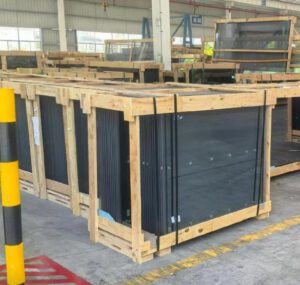
Document all receiving inspections with photographs and a signed inspection report. This documentation is the baseline for any subsequent warranty claim related to shipping damage.
9. Risk Mitigation in Design-Build and Turnkey EPC Contracts
BIPV glass EPC contracts carry risks that standard solar installation agreements were not written to address — and the contractors who have learned this the hard way have done so expensively. Performance shortfall disputes, glass breakage liability, and warranty claim ambiguity are the three most common sources of post-completion conflict on BIPV projects.
Allocating Performance Guarantee Responsibilities
P50 and P90 performance estimates — the median expected annual output and the more conservative output exceeded 90% of years — are the standard metrics for commercial solar performance guarantees. For BIPV glass systems on vertical facades, the energy model must be developed using irradiance data specific to the facade orientation (not horizontal global irradiance), confirmed VLT and SHGC for the specified glass, and system loss assumptions validated against the MLPE manufacturer’s specification.
According to Climate Solutions Law’s analysis of solar EPC performance guarantee structures, well-structured performance guarantee provisions in EPC contracts include: a P50 performance target that defines the expected annual output, a P90 floor that defines the minimum guaranteed output before liquidated damages apply, an annual measurement and verification protocol specifying how actual output is measured and compared, a specific cure period (typically 60–90 days) before liquidated damages commence, and a cap on total liquidated damages exposure (typically 15–25% of contract value).
Warranty Matrix: Who Owns Which Failure
| Failure Type | Responsible Party | Required Documentation |
|---|---|---|
| Module power output below warranted level (IEC test conditions) | Glass module manufacturer | IV curve trace, irradiance data, temperature log at time of measurement |
| Glass delamination or seal failure | Module manufacturer | Photographs with timestamps, humidity and temperature records |
| Electrical output below P90 guarantee | EPC contractor (workmanship) | Monthly monitoring data, performance model comparison, site conditions log |
| Roof/facade water leak at electrical penetration | Installing contractor | Installation photos, sealant specification, flashing installation records |
| Racking/framing corrosion | Manufacturer + installer (depends on specification compliance) | Torque records, material specification compliance documentation |
| Glass breakage during installation | Contractor | Incident report, handling procedure compliance record |
Contractual Frameworks for EPC-Glazing Joint Ventures
When a photovoltaic EPC firm and a curtain wall contractor collaborate on a BIPV project under a single design-build or turnkey contract, the joint venture agreement must clearly address: which party holds the prime contract with the building owner, how performance guarantee risk is shared between parties, which party manages the manufacturer warranty on the BIPV glass, and how cost overruns caused by design changes are allocated.
その Akin Gump bankable solar EPC contract checklist provides a useful framework for the core contractual provisions — adapt it specifically for BIPV glass applications by adding explicit provisions for glass breakage liability, facade warranty coordination, and electrical-structural interface responsibility.
10. Future-Proofing Projects: Smart Glass and Energy Storage Integration
The BIPV glass system you install today will be part of a building that operates for 30+ years. The building’s energy infrastructure will evolve — battery storage, EV charging, demand response, adaptive facades — and the BIPV installation you complete now either enables or limits that evolution.
The professionals who consistently win repeat business from institutional clients are those who design the first project with the second and third projects already in mind.
Pre-Wiring for Battery Storage and EV Charging
The incremental cost of pre-wiring for battery storage and EV charging at the time of initial BIPV installation is a fraction of the retrofit cost. The specific design decisions that preserve future expansion capability:
Inverter capacity headroom: Size the inverter system for 120–130% of the initial array capacity. The marginal cost of additional inverter capacity at initial installation is low; the cost of replacing an undersized inverter when battery storage is added later is high.
Conduit spare capacity: Install one additional conduit run of the appropriate size for future battery storage connection between the inverter location and the electrical service room. The conduit costs approximately $2–$5 per linear foot; the excavation or in-wall drilling to add it later costs $50–$200 per linear foot.
Sub-metering infrastructure: Install revenue-grade sub-meters at each major energy-use category (HVAC, lighting, EV charging, solar generation) at initial installation. The data these meters generate is the foundation for LEED measurement and verification, utility rate optimization, ESG reporting, and the energy savings documentation that justifies future capital investments.
Planning for Adaptive Facades with Switchable Glass Technologies
Electrochromic smart glass — glazing that dynamically tints under electrical control to modulate solar heat gain — is available commercially today from manufacturers including View, Sage Electrochromics, and others. Combined electrochromic-PV glass (dynamic tinting plus power generation) is in commercial pilot in Germany and Singapore as of 2025, with mainstream availability expected within 3–7 years.
Projects installing curtain wall framing today should confirm that the framing system’s electrical and data raceway capacity can accommodate the thin-film bus bars and control wiring required by electrochromic glazing. This requires no additional material cost at installation — only a design review of the mullion cavity cross-section to confirm compatibility.
Grid-Interactive and Demand-Response Readiness
Grid-interactive buildings — those that can modulate energy consumption or generation in response to grid signals — are the target of major policy programs in the US, EU, and Australia. Buildings with BIPV generation plus battery storage are the primary candidates for demand-response programs that pay building owners for the flexibility to modulate load and generation during grid stress events.
Specifying inverters with IEEE 2030.5 or IEEE 1547.1 communication capability at initial installation costs nothing extra and enables the building to participate in utility demand-response programs that may not exist yet in the local market but are being mandated in leading jurisdictions. This is the definition of future-proofing: a specification decision that costs nothing today and preserves access to value streams that will exist in the future.
For EPC firms, offering a “grid-readiness package” — which includes the pre-wiring, sub-metering, and communication-ready inverter specification described above — as a defined project option positions your firm as the technically sophisticated partner that clients return to for the next project. The package typically adds $15,000–$35,000 to a commercial BIPV project budget, and it is the item that distinguishes an experienced BIPV EPC from a contractor who installs glass and moves on.
Watch: BIPV Glass Installation — Structural and Electrical Integration in Practice
 This video provides a practical overview of BIPV curtain wall installation — covering structural attachment, electrical cable routing, rapid shutdown compliance, and commissioning protocols. Essential viewing for EPC project teams preparing for their first BIPV glass installation or reviewing execution standards on a current project.
Glossary of Key Terms
BIPV (Building-Integrated Photovoltaics): Solar modules that replace conventional building materials — glazing, facade cladding, roofing tiles — while simultaneously generating electricity. The key distinction from BAPV (Building-Applied PV), which adds solar elements on top of existing building materials.
EPC (Engineering, Procurement, and Construction): A project delivery model where a single contractor or consortium takes full responsibility for designing the system, sourcing components, and building to specification. On BIPV projects, this scope spans structural, glazing, and electrical disciplines.
VLT (Visible Light Transmittance): The percentage of visible light (380–780 nm wavelength) that passes through glazing. A VLT of 50% means half of visible light passes through — comparable to standard tinted commercial glazing.
SHGC (Solar Heat Gain Coefficient): The fraction of solar energy that passes through glazing and enters the building as heat. SHGC 0.25 means 25% of incident solar energy becomes interior heat load. Lower SHGC = better performance in hot climates; higher SHGC preferred in cold climates for passive solar heating.
MLPE (Module-Level Power Electronics): Microinverters or DC power optimizers installed at each individual solar module. Required by NEC 690.12 for rapid shutdown compliance, and improves system performance by preventing shading on one module from reducing the entire string output.
P50 / P90: Statistical production estimates. P50 is the median expected annual output (exceeded 50% of years). P90 is the more conservative estimate exceeded 90% of years. Used in performance guarantee contracts and financial modeling.
Performance Ratio (PR): The ratio of a solar system’s actual output to its theoretical output based on measured irradiance. A well-commissioned commercial system shows PR of 0.78–0.85. PR decline over time indicates system degradation or maintenance issues.
IGU (Insulated Glass Unit): A sealed multi-pane glass assembly. In BIPV applications, the PV semiconductor layer is laminated into one pane of the IGU, creating a single unit with combined thermal, optical, and electrical function.
NEC Article 690: The section of the US National Electrical Code governing solar PV system installation, including DC circuit design, grounding, labeling, rapid shutdown, and inverter requirements.
IEC 63092-1:2020: The International Electrotechnical Commission’s dedicated BIPV standard, combining PV electrical performance requirements with building material structural and safety requirements. The current authoritative standard for commercial BIPV glass specification.
PACE Financing: Property Assessed Clean Energy — a financing mechanism for solar and energy efficiency improvements, repaid through a property tax assessment over 10–25 years and transferable to new owners upon property sale.
Hotspot: A localized high-temperature zone in a PV cell or module caused by cell defects, partial shading, or contamination. Hotspots accelerate cell degradation and can cause safety risks if undetected. Identified through thermal imaging inspection.
ITC (Investment Tax Credit): The US federal tax credit for qualifying solar energy systems, currently 30% of total installed cost under IRS Section 48E. Applicable to BIPV glass installations where electricity generation is the primary system function.
よくある質問
1. What are the key differences between standard solar panels and photovoltaic glass panels for commercial projects?
Standard solar panels are opaque, rack-mounted modules optimized for maximum power output — they add solar to a building without integrating into the building fabric. Photovoltaic glass panels are laminated glazing products that simultaneously serve as the building’s window, skylight, facade cladding, or roofing element while generating electricity. The practical consequence for EPC contractors: PV glass projects require coordination between glazing, structural, and electrical disciplines under a unified installation plan — not sequential handoffs between separate trade contractors. The efficiency difference (standard panels at 20–23% versus BIPV glass at 8–19% depending on transparency level) is real but contextually less important than the dual-function value in applications where both energy generation and building material function are required.
2. How do I ensure PV glass meets both energy code and facade performance requirements simultaneously?
The dual-compliance path for commercial BIPV glass requires three specific inputs to the energy model: the confirmed SHGC of the installed glass unit (from the manufacturer’s NFRC-rated performance data), the U-value of the complete glazing assembly (including frame), and the annual kWh generation projected for the facade zone using location-specific irradiance data. The energy model must show that the combined effect — reduced cooling load from SHGC improvement plus added generation from PV output — achieves the performance path required by ASHRAE 90.1-2022 or the local energy code. Work with an energy modeler who has completed at least one BIPV project under the specific code in your jurisdiction — generic commercial energy modeling experience is not sufficient for the BIPV compliance calculation.
3. Can solar glass be safely used in high-rise curtain wall applications above 40 floors?
Yes — with appropriate engineering and certification. BIPV glass for high-rise curtain wall applications must meet the structural glazing requirements for the specific building height and exposure category under ASCE 7-22, pass the NFPA 285 assembly-level fire test in the configuration specified for the project, and be installed as part of a facade system that has been structurally engineered for the design wind pressures at the project location. At extreme heights (above 30 stories in many markets), wind design pressures exceed 3.0 kPa — requiring PE-stamped glass thickness calculations and connection designs that use larger or more closely spaced anchors than lower-story installations. The engineering is straightforward; the requirement is that it must be done, not assumed from lower-building experience.
4. What are realistic efficiency expectations for transparent PV glass versus standard modules on a commercial EPC project?
Semi-transparent thin-film BIPV glass in commercial specification achieves 8–13% module efficiency and 70–130 Wp/m² power density, compared to 20–23% efficiency and 175–220 Wp/m² for premium monocrystalline panels. For annual energy yield on vertical south-facing facades, expect 70–145 kWh/m²/year for semi-transparent BIPV glass, compared to 140–200 kWh/m²/year for optimally tilted rooftop panels in the same climate. The yield gap is partially offset by the much larger available facade surface versus rooftop surface on multi-story commercial buildings. Use NREL PVWatts with the actual facade coordinates, tilt, and azimuth for site-specific estimates — generic efficiency-based projections consistently overshoot or undershoot actual performance in BIPV facade applications.
5. How should EPC teams and glazing contractors coordinate electrical installation on BIPV curtain wall projects?
Hold a Facade-Electrical Interface Meeting at design development — before shop drawings are produced by either trade. At this meeting, resolve: which trade installs the DC cable through the mullion cavity (typically the glazing contractor, since the cavity is closed once panels are installed), where junction boxes are located (accessible without removing glass panels, compliant with NEC 690 working space clearances), how the conduit run from junction boxes to the inverter room is routed and which trade installs it, and what the commissioning verification protocol is for each panel’s electrical connection. Document these decisions in a written Interface Responsibility Matrix and incorporate it into both subcontract documents. A 2-hour coordination meeting at this stage prevents 2–4 weeks of field conflict resolution during installation.
6. Are there standardized mounting systems for PV glass in commercial curtain wall and roofing applications?
Yes, with the qualification that “standard” means different things for different applications. For pressure-plate curtain wall systems, most major curtain wall manufacturers (Kawneer, Oldcastle, Schuco) offer BIPV-compatible framing systems that have been tested with specific PV glass product families. For SSG (structural silicone glazed) systems, PV glass must be compatible with the specific silicone bond structural capacity required for the glass weight at the design wind pressure. For roofing applications, mounting systems must be selected per roofing type — standing seam metal roofing uses specific clip systems compatible with the seam profile, while low-slope membrane roofing typically uses ballasted or adhered racking systems with waterproofing details that match the membrane manufacturer’s specifications. Request the mounting system manufacturer’s tested compatibility documentation for the specific PV glass product before specifying any combination.
7. What is the appropriate maintenance schedule for PV glass on an urban commercial facade in a harsh climate?
A professional O&M program for urban commercial BIPV glass has four components scaled by climate and exposure: monthly remote performance monitoring with automated alert thresholds (all climates); quarterly visual inspection for sealant condition, frame corrosion, and glass surface damage (all climates, more critical in coastal and industrial environments); semi-annual cleaning in standard urban environments (more frequent in coastal salt-spray, high-particulate industrial, and arid dust-prone locations); and annual comprehensive inspection including thermal imaging for hotspot detection and electrical connection verification. In coastal environments specifically, frame and fastener corrosion inspection every 6 months is the professional standard — salt spray corrosion progresses faster than the annual inspection cycle in harsh marine exposure zones.
8. How do I guarantee power output when using semi-transparent glass with inherently variable shading from the building structure?
Semi-transparent BIPV glass on facades with inter-floor shading from projecting slabs requires energy yield modeling that explicitly accounts for the shading geometry — not generic irradiance-to-power conversion factors. Use PVsyst or BIMsolar with a 3D shading model of the actual building geometry, confirmed VLT and SHGC from the specific glass product, and MLPE system loss assumptions that reflect the optimizer’s shading mitigation performance. P50 and P90 outputs from this model form the basis of the performance guarantee. For the guarantee itself, warrant the P90 output (exceeded 90% of years) rather than the P50 — the P90 guarantee is more conservative, and therefore more defensible if annual weather variation causes a below-P50 year.
9. What warranties cover photovoltaic glass panels, and how is responsibility divided between manufacturer and installer?
Commercial BIPV glass carries two distinct warranty layers: the product and power output warranty from the glass manufacturer (typically 80–85% of rated power output at year 25, with 10–25-year product structural warranty covering delamination and seal failure), and the workmanship warranty from the installing contractor (typically 1–5 years, covering installation quality issues including water infiltration at electrical penetrations, improper sealant application, and incorrect electrical connections). For building-integrated systems, there is additionally the building envelope warranty issued by the glazing contractor covering weathertightness of the complete facade assembly. The most common post-installation dispute arises when a water infiltration event occurs and the glass manufacturer, installing contractor, and glazing subcontractor each attribute the failure to another party’s scope. Prevent this by defining in writing before installation which party holds responsibility for each specific failure mode — use the warranty matrix structure in Section 9 as a starting template.
10. Can existing commercial buildings be retrofitted with photovoltaic glass without full structural modification?
Yes, in most cases — but a PE-stamped structural assessment is mandatory before any product is specified. The assessment must confirm that the existing framing system’s dead load capacity accommodates the BIPV glass weight (typically heavier than the glass being replaced by 8–15 kg/m²), that the anchor connections to the primary building frame are rated for the BIPV system’s wind uplift loads at the design wind pressure for the project location, and that the existing electrical service panel and distribution system can accommodate the new solar generation. In practice, most commercial curtain wall systems built after 1990 have sufficient structural capacity for BIPV glass retrofits in the vision and spandrel zones. The electrical system capacity check — particularly the service panel and metering arrangement for net metering or feed-in tariff — is the more frequently binding constraint on retrofit feasibility.
11. How do I integrate photovoltaic glass with a building’s BMS for real-time performance monitoring?
The standard integration pathway connects the solar inverter’s communication output (Modbus TCP, SunSpec protocol, or manufacturer-specific API) to the building BMS through an MQTT or BACnet gateway. Most commercial BMS platforms (Siemens Desigo CC, Johnson Controls Metasys, Honeywell EBI, Schneider EcoStruxure) support this integration natively or through configurable protocol drivers. The four data streams the BMS should receive from the solar system: real-time AC power output (kW), cumulative energy production (kWh), string-level DC current and voltage (for fault detection), and inverter fault codes (for maintenance dispatch triggers). Specify this integration in the electrical engineering documents before tender — post-installation BMS integration on systems not designed for it typically adds $5,000–$25,000 in programming costs.
12. What green certifications and tax incentives are available for commercial PV glass projects in the United States?
The primary federal incentive is the Investment Tax Credit (ITC) at 30% of total installed cost under IRS Section 48E — applicable to BIPV glass where electricity generation is the primary function. Stackable with the 179D Commercial Buildings Energy Efficiency Tax Deduction (up to $5.00/sq ft) for projects achieving qualifying energy performance improvements. For LEED certification, BIPV glass contributes to EA Credit Renewable Energy Production (1–5 points) and EA Credit Optimize Energy Performance (up to 18 points through combined demand reduction and generation). State and utility incentives — PACE financing, green bank loans, utility rebates — are catalogued by jurisdiction in the DSIRE database. For projects seeking ESG financing, documented on-site solar generation from BIPV glass qualifies for green bond proceeds under ICMA Green Bond Principles and typically supports sustainability-linked loan rate reductions of 25–75 basis points.
13. Can photovoltaic glass be customized in color, transparency pattern, or printing for architectural projects?
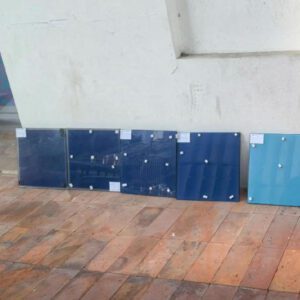
Yes — and this is one of the specification capabilities that distinguishes BIPV glass from rack-mounted solar in design-sensitive commercial projects. Color options range from standard grey-blue (monocrystalline silicon appearance) through custom ceramic frit colors achieved by printing on the inner glass surface, which does not contact the PV cells. Transparency levels can be specified in 5–10% VLT increments from 10% to 70% for most commercial thin-film products. Pattern printing — geometric patterns, corporate logos, or custom artwork — is achievable through selective cell placement or printed interlayer techniques, with power output reduced proportionally to the non-cell area of the pattern. Request physical sample panels for any custom color or pattern specification before finalizing the order — the actual appearance under real daylight conditions, including the transmitted light color through the glass, must be approved by the architect and the building owner before production begins.
14. How should warranty claims for PV glass delamination or cell failure be documented and escalated?
The documentation that supports a successful warranty claim for BIPV glass delamination or cell failure begins at installation, not at the point of failure. The complete evidentiary package required for a manufacturer warranty claim includes: installation records confirming proper handling procedures were followed (no edge impacts, no glass tipping, correct storage orientation); sealant and framing installation photographs confirming the perimeter detail was completed per specification; commissioning test report showing correct output at installation; monthly performance monitoring records showing the output trend from commissioning to the point of identified failure; thermal imaging photographs of the failed unit showing the delamination or hotspot pattern; and an independent IV curve trace confirming the performance shortfall relative to the warranted output. Manufacturers who receive a complete documentation package of this type resolve warranty claims in 4–8 weeks on average. Manufacturers who receive an undocumented claim or one where the installation records are missing typically take 4–6 months — or dispute the claim entirely.
15. What certifications and training should installation teams hold for commercial photovoltaic glass projects?
The minimum qualification standard for a commercial BIPV glass installation team combines credentials from two domains: solar electrical installation そして glazing/facade installation. For the solar electrical scope, NABCEP PV Installation Professional certification is the industry standard credential, increasingly required by commercial project owners in bid qualification requirements. For the glazing scope, applicable glazing contractor licensing varies by state — confirm the specific license category required in the project jurisdiction before bidding. For BIPV glass-specific installation training, leading manufacturers including ジャ・マオ・ビップフ offer product-specific training programs covering glass handling procedures (edge protection requirements, A-frame transport protocols), frame assembly and sealing, electrical connection and rapid shutdown compliance, and commissioning test procedures. Invest in manufacturer training before the first project — the avoided callback cost from correct first installation more than recovers the training investment on a single commercial project.
This guide is written exclusively for industry professionals — curtain wall and roofing contractors, photovoltaic EPC and energy service firms, building material brands and distributors, architects, consultants, and design institutes — who are specifying, delivering, and optimizing photovoltaic glass installations on commercial projects. Every statistic and specification cited reflects published 2025 industry data; verify current product availability, incentive rates, and code requirements with your project team before finalizing any specification or financial model.