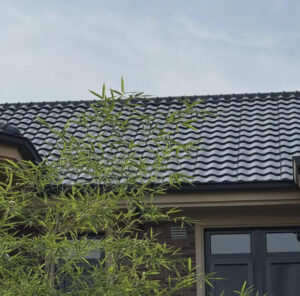
A homeowner in Austin, Texas added a 10 kW rooftop array in early 2025. Two oak trees shade the western roof plane for roughly four hours each afternoon. The installer recommended microinverters instead of a string inverter. Twelve months later, the system’s monitoring dashboard showed 14,200 kWh of production — 19% more than the string-inverter estimate of 11,930 kWh for the same panels. At Austin Energy’s $0.11/kWh rate, that gap is $249.70 in extra annual savings, or $6,243 over 25 years.
That outcome is not unusual. The choice between a microinverter and a string inverter is one of the most consequential decisions in any solar project, yet many homeowners and even some installers default to one type without fully weighing the trade-offs. This guide presents the real numbers — failure rates, efficiency data, cost breakdowns, shade-performance studies, warranty terms, and expansion scenarios — so you can match the right inverter architecture to your specific roof, budget, and long-term goals.
Solar Inverter Basics
What Is a Solar Inverter?
A solar inverter converts the direct current (DC) electricity produced by photovoltaic panels into the alternating current (AC) used by your home’s appliances, lighting, and the utility grid. Without an inverter, the power your panels generate is unusable. According to EnergySage, the inverter is often called the “brain” of a solar energy system because it also manages grid connection, safety shutdowns, and performance monitoring.
Inverter efficiency — the percentage of DC power successfully converted to AC — directly affects how much electricity reaches your home. Modern inverters achieve 96–99% efficiency, but that 3-percentage-point range means the difference between losing 40 W and losing 10 W on every 1,000 W of DC input. Over 25 years on a 10 kW system in a location with 1,600 peak sun hours, that gap translates to roughly 12,000 kWh of lifetime production.
Types of Solar Panel Inverters
Three main architectures dominate the residential and small-commercial market in 2026:
String inverters connect panels in series (a “string”) and route all DC power to a single centralized box, typically wall-mounted in a garage or beside the main electrical panel. One inverter handles the entire array.
マイクロインバータ are small, panel-sized units mounted directly behind each solar module. Every panel gets its own dedicated inverter, converting DC to AC right at the rooftop.
String inverters with power optimizers are a hybrid approach. DC-to-DC optimizers are installed at each panel to condition the voltage, but the DC-to-AC conversion still happens at a centralized string inverter. SolarEdge’s HD-Wave system is the most widely deployed example, achieving up to 99.2% peak efficiency at the inverter stage.
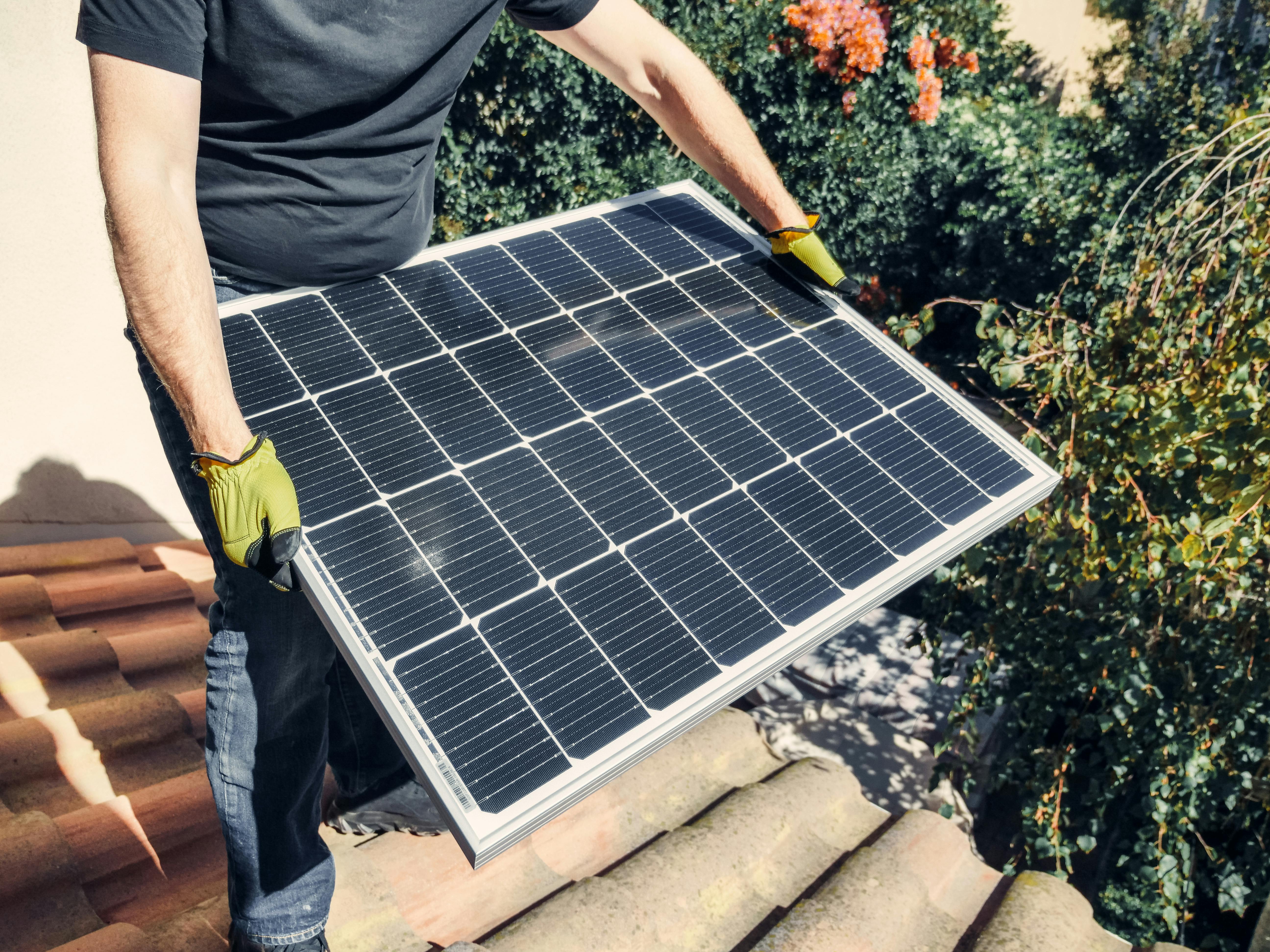
Solar Microinverter Overview
How Solar Microinverters Work
A microinverter sits behind each individual solar panel and performs DC-to-AC conversion at the module level. If your system has 24 panels, it has 24 microinverters. Each unit operates independently: it tracks its panel’s maximum power point (MPPT), converts the output to grid-frequency AC (240 V / 60 Hz in the U.S.), and feeds that power into a common AC bus cable that runs along the rooftop down to your breaker panel.
This architecture means that the performance of any single panel has zero effect on its neighbors. If one panel is shaded by a chimney, covered by bird droppings, or experiences a cell crack, only that one panel’s output drops. Every other module in the system continues producing at its individual maximum.
Pros of Solar Microinverters
Superior shade performance. Field studies cited by EnergySage and monitoring platforms show that microinverters deliver 5–25% higher output than string inverters under partially shaded conditions. For a 10 kW system in a moderately shaded environment producing 13,000 kWh/year on microinverters, a string inverter might yield only 10,400–12,350 kWh — a gap of $71–$286/year at $0.11/kWh.
Panel-level monitoring. Every microinverter reports its wattage, voltage, and energy production individually. Enphase’s IQ8 series, for instance, feeds real-time data to the Enphase App, letting homeowners and installers pinpoint a failing panel in seconds — without a truck roll. A SolarInsure analysis found that less than 1 in 800 microinverters experience failure, making individual unit replacement rare and targeted.
25-year lifespan and warranty. Enphase, APsystems, and other leading brands offer 25-year warranties on microinverters, matching the performance warranty of the panels themselves (PV Magazine). Across the system’s life, you are unlikely to replace any inverter hardware.
Inherent NEC 2023 rapid-shutdown compliance. Because microinverters convert to low-voltage AC at the panel, they automatically satisfy the NEC 690.12 requirement to reduce conductor voltage to 30 V within 30 seconds outside the array boundary (EnergyScape Renewables). No additional rapid-shutdown devices are needed.
Lower DC voltage = higher safety. Microinverters operate at 48–60 V DC, compared to 300–600 V on a string inverter bus. Lower voltage reduces arc-flash risk and is inherently safer for firefighters accessing the roof (1Komma5).
Cons of Solar Microinverters
Higher upfront cost. Microinverters add $1,500–$3,000 to a typical residential system compared to a string inverter. NuWatt Energy puts the installed cost at $0.50–$0.70/W for Enphase microinverters versus $0.30–$0.45/W for SolarEdge string inverters with optimizers — a $1,600–$2,000 premium on an 8 kW system.
Rooftop maintenance access. If a microinverter does fail (0.05% annual rate per エンフェーズ), a technician must work on the roof to replace it. This adds labor cost and weather dependency to the repair.
Slightly lower peak conversion efficiency. Enphase IQ8 microinverters achieve 97% CEC weighted efficiency, while SolarEdge’s centralized HD-Wave inverter reaches up to 99% CEC weighted efficiency (NRG Clean Power). In unshaded conditions, the string inverter converts marginally more DC power into AC.
Best Uses for Solar Microinverters
Microinverters are the strongest choice when the roof has multiple planes or orientations (east/west split, dormers, gables), when trees, chimneys, or neighboring structures cast partial shade, when the homeowner plans to add panels later (each new panel simply gets its own microinverter), or when the project must comply with NEC 2023 without adding separate rapid-shutdown equipment.
String Inverter Overview
How String Inverters Work
A string inverter connects panels in one or more series “strings.” All panels in a string feed their DC output through a common conductor to a single centralized inverter, which performs the DC-to-AC conversion. Most residential string inverters support 1–3 MPPT inputs, allowing you to wire separate roof planes on independent trackers. Commercial units may have 4–6 MPPTs.
The key electrical limitation is the “weakest link” effect: within a single string, the panel producing the least current constrains the entire string’s output. If one panel in a 12-panel string drops to 70% due to shade, the other 11 panels are also pulled down toward that level. Power optimizers mitigate this by conditioning each panel’s voltage independently before it reaches the string inverter.
Pros of String Inverters
Lower equipment cost. A quality string inverter (SMA Sunny Boy, Fronius Primo, SolarEdge Home Hub) costs $750–$1,250 for a 5 kW residential system — roughly half the price of a microinverter equivalent (EcoFlow).
Higher peak conversion efficiency. SolarEdge HD-Wave inverters achieve 99.2% peak / 99% CEC weighted efficiency. SMA’s Sunny Boy series hits 97.6% CEC. On an unshaded, single-plane south-facing roof, a string inverter will convert slightly more power than microinverters at the same DC input.
Ground-level access for maintenance. String inverters mount on a garage wall or utility area. If a replacement is needed, the technician works at ground level — no roof access, no harnesses, no weather-dependent scheduling.
Faster installation. Wiring a single string inverter is simpler than mounting and connecting 20+ microinverters on the rooftop. For installers, this means higher crew productivity and lower labor cost per project.
DC-coupled battery integration. String inverters (especially hybrid models) support DC-coupled battery connections, which can be 3–5% more efficient than the AC-coupled approach used with most microinverter systems (ProGreen Solar).
Cons of String Inverters
10–15 year lifespan. Most string inverters carry 10–12 year warranties, and field data confirms the typical replacement window falls between year 10 and year 15 (SolarReviews). On a 25-year panel system, you will likely pay $1,500–$2,500 for at least one replacement inverter.
16× higher failure rate. Industry tracking shows string inverters fail at 0.89% (89 per 10,000 units), versus 0.05% for microinverters — a 16× gap that drives significantly more warranty callbacks (Preta Power).
Single point of failure. If the centralized inverter goes down, the entire array produces zero power until it is replaced. With microinverters, a single unit failure affects only one panel — the remaining 95%+ of the system keeps generating.
Additional hardware for NEC 2023 compliance. String inverters require separate power optimizers or UL 3741-listed PV Hazard Control Systems to satisfy rapid-shutdown requirements, adding $500–$1,200 in equipment cost.
Best Uses for String Inverters
String inverters are optimal for simple, unshaded south-facing roofs with a single plane, for budget-constrained projects where upfront cost is the primary driver, for large commercial arrays on flat roofs with no obstructions, and for projects that prioritize DC-coupled battery storage from day one.
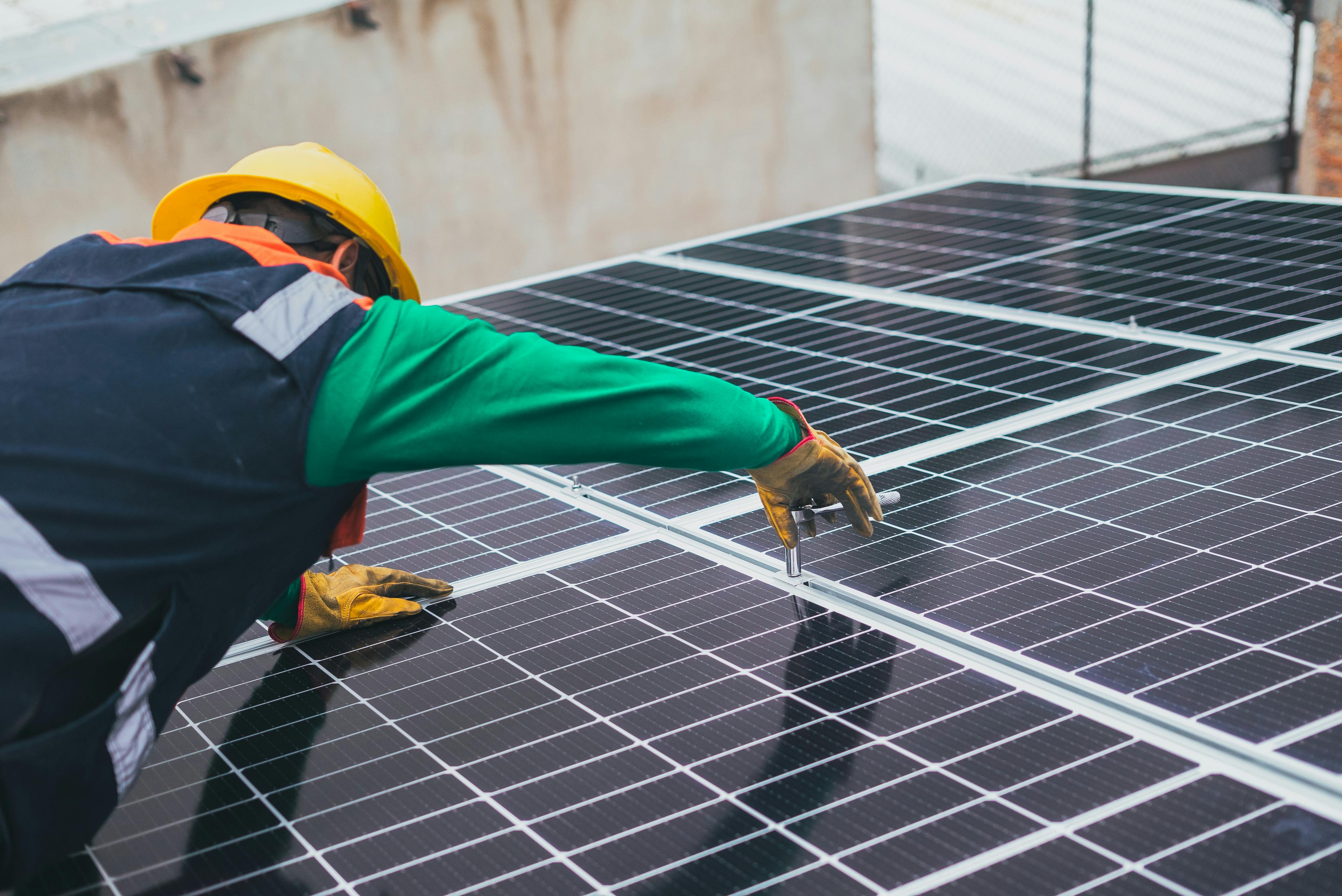
Microinverter vs String Inverter Comparison
Full Comparison Table
The table below captures every major decision variable. Copy it directly into Excel or Google Sheets for your project evaluation.
| Factor | Microinverter | String Inverter | String + Optimizers |
|---|---|---|---|
| Cost (5 kW system) | $1,500–$3,000 | $750–$1,250 | $1,200~$2,000 |
| Cost per Watt (installed) | $0.50–$0.70 | $0.15–$0.25 | $0.30–$0.45 |
| Peak Efficiency | 97–97.7% | 97.6–99.2% | 99.2% (inverter) + optimizer loss |
| CEC Weighted Efficiency | 97% | 96.5–99% | 99%まで |
| Shade Performance | 5–25% higher output in shade | Weakest-link effect | Mitigated by optimizers |
| Failure Rate | 0.05% (5 per 10,000) | 0.89% (89 per 10,000) | Inverter: 0.89% / Optimizer: ~0.2% |
| 保証 | 25年 | 10–12 years | Inverter: 12 yr / Optimizer: 25 yr |
| 寿命 | 20~25年 | 10~15年 | Inverter: 10–15 yr / Optimizer: 25 yr |
| モニタリング | Panel-level | System-level only | Panel-level (via optimizers) |
| NEC 2023 Rapid Shutdown | Inherently compliant | Requires add-on devices | Compliant via optimizers |
| システムの拡張 | Add 1 panel + 1 microinverter | May require new string or inverter swap | Add optimizer + reconfigure string |
| Battery Compatibility | AC-coupled | DC-coupled or AC-coupled | DC-coupled (more efficient) |
| DC Voltage on Roof | 48–60 V | 300–600 V | 1 V per optimizer (safe-state) |
| Installation Speed | Slower (mount each unit on roof) | Faster (single wall-mount) | Moderate (optimizers + inverter) |
| Maintenance Location | Rooftop | Ground-level | Optimizers: roof / Inverter: ground |
| Best For | Complex roofs, shade, expansion | Simple roofs, budget projects | Moderate shade, battery-ready |
Sources: EnergySage, NuWatt Energy, EnergyScape Renewables, SolarInsure, Enphase, SolarEdge, NRG Clean Power, EcoFlow.
Cost Differences
On an 8 kW residential system with 20 panels, the inverter cost breaks down as follows: Enphase IQ8 microinverters at $150–$215 per unit total $3,000–$4,300. A SolarEdge Home Hub string inverter with 20 power optimizers runs $2,400–$3,600. A standalone SMA Sunny Boy string inverter without optimizers costs $1,200–$1,800, but adding NEC 2023 rapid-shutdown devices brings it to $1,700–$3,000.
The upfront gap narrows substantially when you factor in the mid-life replacement cost. Replacing a string inverter at year 12 costs $1,500–$2,500 including labor. Microinverters have no scheduled replacement over 25 years. On a 25-year total cost of ownership (TCO) basis, the gap shrinks from $1,500–$2,000 to $0–$500 for many system sizes — and can actually favor microinverters when replacement inflation and downtime losses are included.
Efficiency and Shading
In unshaded, single-plane conditions, a string inverter system produces approximately 2–3% more AC energy than a microinverter system of identical DC capacity, because the centralized inverter’s 99% efficiency exceeds the microinverter’s 97%. On a 10 kW system yielding 15,000 kWh/year, that is roughly 300–450 kWh.
In partially shaded conditions, the relationship reverses dramatically. Field monitoring data from thousands of systems shows that microinverters produce 5–25% more energy than string inverters when shade affects even a fraction of the array. A common scenario: three of 24 panels shaded for two hours in the afternoon. On a string system, those three panels constrain the entire string, costing 8–12% of daily production. On a microinverter system, only those three panels lose output — the other 21 run at full capacity.
Reliability and Maintenance
The failure-rate data is unambiguous. Microinverters fail at 0.05% annually (roughly 5 units per 10,000), while string inverters fail at 0.89% — a 16× difference. For a solar installer managing 200 residential systems averaging 20 panels each, the math works out to approximately 2 microinverter replacements per year versus 1–2 full string inverter swaps. The microinverter replacements cost $150–$300 each in parts plus a roof-access service call; the string inverter replacements cost $1,500–$2,500 each but are ground-accessible.
のようなメーカーがある。 ジャ・マオ・ビップフ have published detailed comparisons of micro inverter brands to help homeowners evaluate warranty terms, failure rates, and compatibility across different panel configurations — particularly useful when pairing inverters with BIPV modules that have non-standard dimensions.
Warranty and Lifespan
The warranty gap is one of the most significant differentiators:
| Inverter Type / Brand | Product Warranty | 予想寿命 | Replacement Cost (incl. labor) |
|---|---|---|---|
| Enphase IQ8 (microinverter) | 25年 | 25年 | $150–$300 per unit |
| APsystems DS3 (microinverter) | 25年 | 25年 | $120–$250 per unit |
| SolarEdge Home Hub (string + opt.) | 12 yr inverter / 25 yr optimizer | 12–15 yr inverter / 25 yr optimizer | $1,800–$2,500 (inverter swap) |
| SMA Sunny Boy (string) | 10 years (extendable to 20) | 10~15年 | $1,500–$2,200 |
| Fronius Primo/Symo (string) | 10 years (extendable to 20) | 10~15年 | $1,500–$2,300 |
Over a 25-year system life, a string inverter owner should budget for at least one full replacement. A microinverter owner is statistically unlikely to need any replacement during the same period.
システムの拡張
Microinverters simplify future expansion. Adding four panels to a microinverter system means adding four more microinverters and connecting them to the existing AC bus — no inverter re-sizing, no string reconfiguration, no voltage recalculation. This is why Jia Mao Bipv’s inverter product line emphasizes modular compatibility: whether you are starting with a 3 kW starter system on a sunroom skylight or scaling to 15 kW across the full roof, the microinverter approach grows one panel at a time.
String inverters require capacity planning from day one. If your initial 6 kW inverter is maxed out and you want to add 3 kW of panels, you may need a second inverter or a complete swap to a larger unit — adding $1,000–$2,000 to the expansion cost.
Monitoring Features
Microinverters provide panel-level monitoring by default. Each unit reports real-time power, energy, voltage, and current independently. This generates 10–20× more data than system-level monitoring (LinkedIn analysis), enabling precise fault detection. If one panel’s output drops 15% due to a cracked cell, the monitoring platform flags it immediately — before the cumulative loss becomes noticeable on a utility bill.
String inverters provide system-level or string-level monitoring. You can see total production but cannot isolate which panel is underperforming without physically inspecting the array. Adding power optimizers (SolarEdge, Tigo) upgrades string systems to panel-level visibility, but at additional hardware cost.
Inverter Cost Comparison — Bar Chart
The chart below compares the installed cost per watt across the three inverter architectures.
Installed Cost per Watt by Inverter Type (2026)
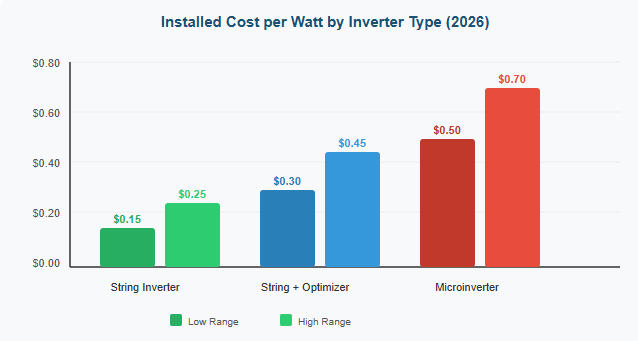
Source: NuWatt Energy, EcoFlow, EnergySage (2026)
Global Microinverter Market Share — Pie Chart
The microinverter market is valued at $5.58 billion in 2026 and is projected to reach $16.82 billion by 2034 at a 14.7% CAGR (Fortune Business Insights). The pie chart below shows the estimated brand share of global microinverter shipments in 2025–2026.
Global Microinverter Market Share by Brand (2026 Est.)
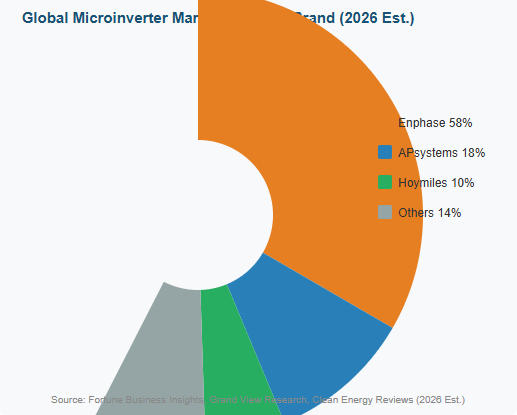
Source: Fortune Business Insights, Grand View Research, Clean Energy Reviews (2026 Est.)
Special Considerations for Solar Panel Inverters
Roof Complexity and Shading
Before selecting an inverter, conduct a site-specific shade analysis. Tools like Aurora Solar, Helioscope, or even a simple Solar Pathfinder can quantify annual shading losses by hour and month. If the analysis shows more than 10% annual shade impact, microinverters or string inverters with per-panel optimizers are the clear choice. Below 5% shade impact, a basic string inverter provides the most cost-effective solution.
Real example: A 7.5 kW system in Portland, Oregon on a hip roof with four planes and a chimney. Aurora Solar modeling predicted the microinverter configuration would generate 9,870 kWh/year versus 8,440 kWh/year for a single-string inverter — a 17% advantage worth $157/year at Portland General Electric’s $0.11/kWh rate.
Future Expansion
If there is any chance you will add panels within the next 5–10 years — for an EV charger, heat pump, home battery, or growing family — microinverters eliminate re-engineering risk. Each additional panel gets its own inverter. No string recalculation. No inverter up-sizing. For homeowners building their system in phases, this flexibility alone can justify the upfront premium.
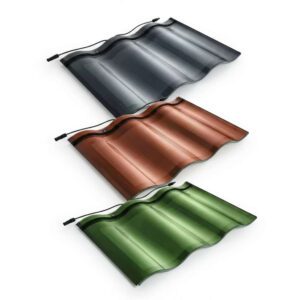
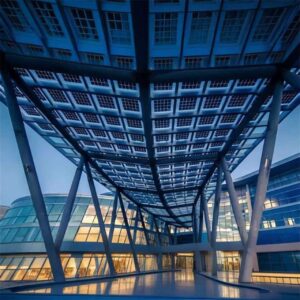
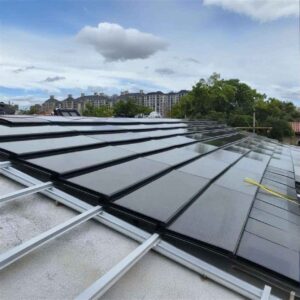
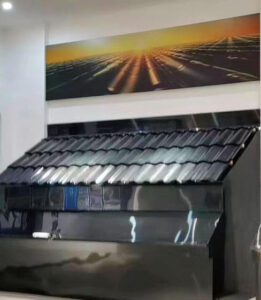
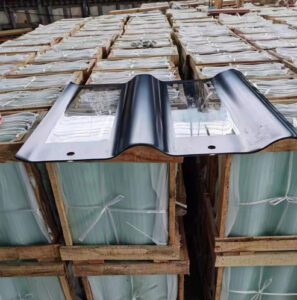
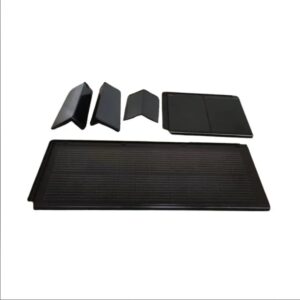
Jia Mao Bipv’s product lineup includes BIPV roof tiles, transparent solar panels, and standard PV modules in a range of wattages — all compatible with microinverter architectures. A homeowner could start with 10 standard rooftop panels, later add BIPV skylights to a sunroom, and connect both subsystems on the same microinverter monitoring platform without hardware conflicts.
Battery Compatibility
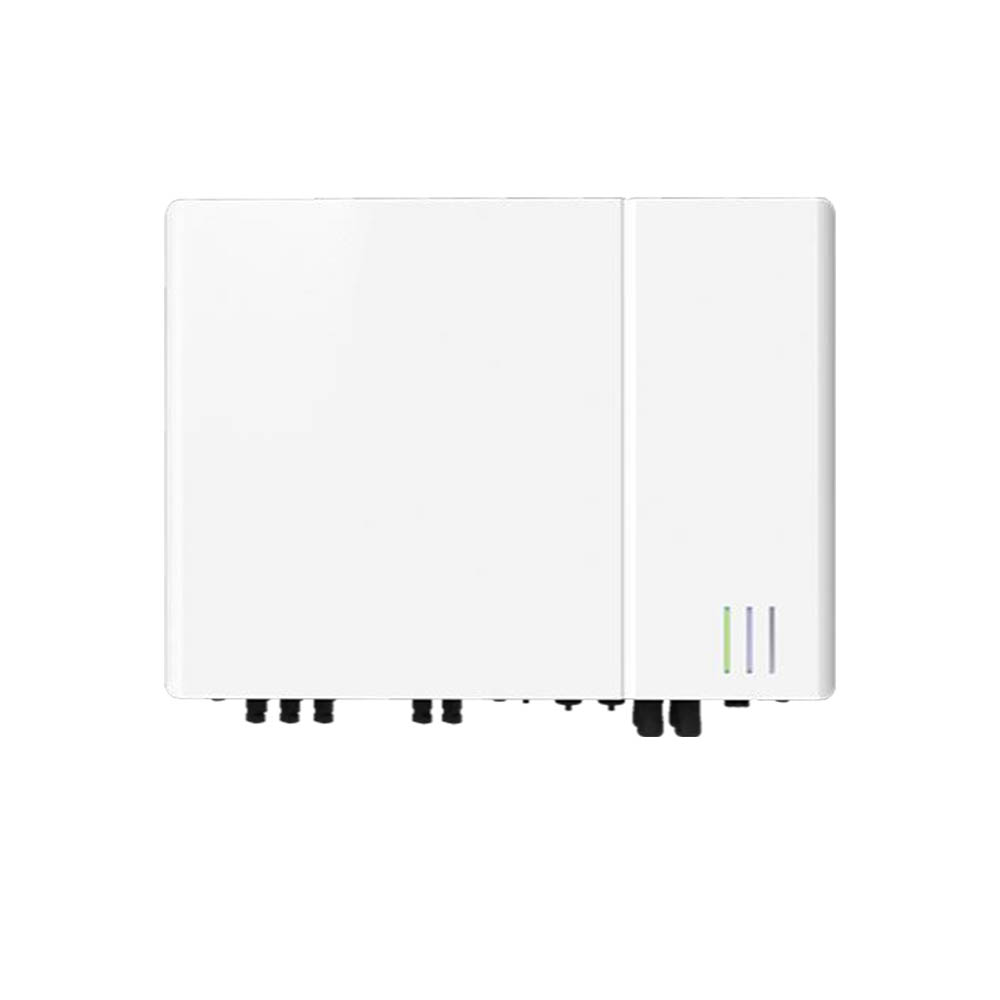
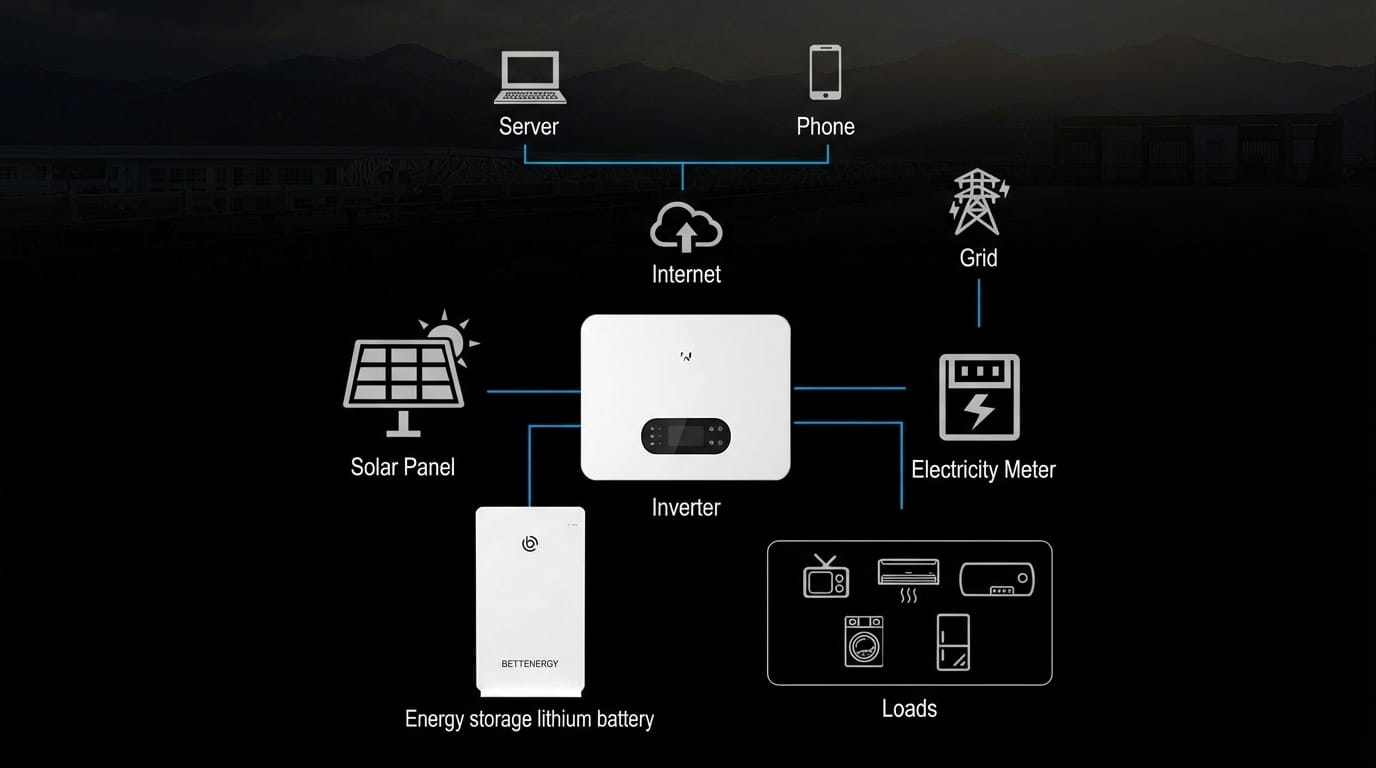
If you are planning to add battery storage, the inverter type affects your options. String inverters (especially hybrid models like the Jia Mao Bipv three-phase high-voltage hybrid inverter or SolarEdge Home Hub) support DC-coupled batteries, which avoid the double conversion loss (DC→AC→DC) of AC-coupled setups. DC-coupling is typically 3–5% more efficient for battery charge/discharge cycles.
Microinverter systems use AC-coupled batteries (Enphase IQ Battery, Tesla Powerwall, etc.). The AC coupling adds a small efficiency penalty (~3%) but provides complete independence from the solar array — meaning the battery can charge from the grid during off-peak hours regardless of inverter type.
Monitoring Needs
If you want to know exactly which panel is underperforming and why, microinverters deliver this by default. For string inverters, you need to add power optimizers (SolarEdge, Tigo) to get panel-level visibility. Without optimizers, you are limited to system-level data and must physically inspect the array to isolate problems.
How to Choose the Right Solar Inverter
Key Questions to Ask
Before committing to an inverter type, answer these five questions honestly:
| Question | If Yes → Consider | If No → Consider |
|---|---|---|
| Does your roof have multiple planes, dormers, or varied orientations? | マイクロインバータ | String inverter |
| Do trees, chimneys, or buildings shade any part of the array for >2 hrs/day? | Microinverters or string + optimizers | String inverter |
| Will you add more panels within 5–10 years? | マイクロインバータ | Either type works |
| Is upfront cost the primary constraint (and roof is unshaded)? | String inverter | Microinverters for long-term value |
| Do you want panel-level monitoring without extra hardware? | マイクロインバータ | String inverter (add optimizers if needed) |
Common Scenarios and Recommendations
| シナリオ | Recommended Inverter | Why |
|---|---|---|
| Simple south-facing roof, no shade, budget-focused | String inverter (SMA or Fronius) | Lowest upfront cost; maximum conversion efficiency on unshaded arrays |
| East/west split roof, partial afternoon shade | Microinverters (Enphase IQ8) | Independent panel operation recovers 5–25% shade loss; dual-orientation handled per-panel |
| Large commercial flat roof, no shade | String inverter + optimizers (SolarEdge) | Cost-effective at scale; panel-level monitoring for O&M |
| Phased residential build-out (start 5 kW, expand to 12 kW) | マイクロインバータ | Add panels and microinverters incrementally — no inverter swap |
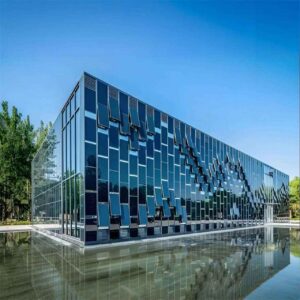
| BIPV façade or skylight integration | Microinverters or Jia Mao Bipv hybrid inverter | Non-standard panel sizes and orientations benefit from per-module optimization |
| Off-grid or battery-first design | Hybrid string inverter | DC-coupled battery integration is 3–5% more efficient |
Video: Microinverters vs String Inverters Explained
This video walks through the key differences between microinverters, string inverters, and hybrid inverters — covering how each works, when to use each type, and real-world performance comparisons:
25-Year Total Cost of Ownership: Microinverter vs String Inverter
To make the cost comparison concrete, here is a 25-year TCO model for an 8 kW residential system in a moderate-shade environment (10% annual shade impact).
| Cost Component | Microinverter System | String Inverter System | String + Optimizer System |
|---|---|---|---|
| Initial inverter hardware | $3,500 | $1,400 | $2,800 |
| Rapid-shutdown add-ons | $0 (built-in) | $800 | $0 (built-in) |
| Mid-life replacement (year 12) | $0 | $2,200 | $2,200 (inverter only) |
| Warranty service calls (25 yr est.) | $300 (1–2 micro replacements) | $500 (diagnostics + downtime) | $400 |
| Shade-related energy loss (25 yr) | $0 (panel-independent) | −$4,125 (15% avg. shade penalty) | −$1,375 (5% residual shade penalty) |
| 25-Year Total Cost | $3,800 | $9,025 | $6,775 |
Assumptions: 8 kW system, 12,000 kWh/year base production, $0.11/kWh utility rate, 10% annual shade impact, 2% inflation on replacement parts. Shade energy loss calculated as the annual kWh penalty × utility rate × 25 years.
In this moderate-shade scenario, the microinverter system has the lowest 25-year TCO by a wide margin — $5,225 less than the string inverter and $2,975 less than the string + optimizer system. The initial premium pays for itself by year 5.

The microinverter vs string inverter choice is not about one technology being universally superior. It is about matching the right architecture to your specific project conditions. Microinverters win decisively on shaded, complex, or expansion-planned roofs — delivering 5–25% more energy in shade, lasting 25 years without replacement, failing 16× less often, and complying with NEC 2023 without add-on hardware. String inverters remain the cost-effective choice for simple, unshaded roofs where upfront budget is the priority and DC-coupled battery integration is planned.
Before committing, run a shade analysis on your specific roof, calculate the 25-year TCO (not just upfront cost), confirm NEC 2023 compliance requirements with your local AHJ, and decide whether future expansion is likely. If your project involves BIPV integration — facades, skylights, or non-standard panel sizes — explore the hybrid and microinverter-compatible solutions from Jia Mao Bipv that are designed to work seamlessly across diverse panel configurations.
The right inverter does not just convert power. It determines how much electricity you produce, how long the system lasts, how much you spend on maintenance, and how easily you can grow. Choose accordingly.
Frequently Asked Questions (FAQ)
1. What is the main difference between a microinverter and a string inverter?
A microinverter is installed behind each individual solar panel and converts DC to AC at the module level. A string inverter connects multiple panels in series and converts all of their DC output to AC at a single centralized unit. The practical impact: microinverters allow each panel to operate independently, while string inverters link panel performance together — meaning one shaded panel can reduce the output of the entire string.
2. Are microinverters worth the extra cost?
In shaded or complex-roof scenarios, yes. Field data shows microinverters produce 5–25% more energy than string inverters under partial shade. On a 10 kW system producing 13,000 kWh/year, a 15% shade advantage equals approximately $214/year at $0.11/kWh — or $5,350 over 25 years. Combined with no mid-life replacement cost and a 25-year warranty, the upfront premium of $1,500–$2,000 is recovered within 5–8 years for most shaded installations.
3. How long do microinverters last compared to string inverters?
Microinverters typically last 20–25 years, matching the lifespan of solar panels. Most carry 25-year warranties. String inverters last 10–15 years and carry 10–12 year warranties. You will likely need to replace a string inverter once during your solar system’s 25-year life — at a cost of $1,500–$2,500 including labor (PV Magazine).
4. Do microinverters work during a power outage?
Standard microinverters shut down during a grid outage for safety (anti-islanding protection). However, Enphase IQ8 microinverters with the Enphase IQ Battery and System Controller can form a microgrid and power essential loads during outages. Similarly, hybrid string inverters paired with batteries can provide backup power. Backup capability depends on the complete system design, not just the inverter type.
5. Which inverter type is better for battery storage?
String inverters — especially hybrid models — support DC-coupled batteries, which are 3–5% more efficient for charge/discharge cycles than the AC-coupled approach used with microinverter systems. If battery storage is a primary design goal, a hybrid string inverter (see Jia Mao Bipv’s hybrid vs. grid-tie comparison) provides the most efficient integration. Microinverter systems use AC-coupled batteries (Enphase IQ Battery, Tesla Powerwall), which work well but have slightly higher round-trip losses.
6. Can I mix microinverters and string inverters on the same system?
No. Each solar array requires a single inverter architecture. You cannot connect some panels to microinverters and others to a string inverter within the same system. However, a property can have two separate systems — for example, a string inverter on the main south-facing roof and a microinverter system on a shaded east-facing dormer — each with its own monitoring and grid connection.
7. What is the failure rate of microinverters vs string inverters?
Microinverters fail at approximately 0.05% annually (5 per 10,000 units), according to エンフェーズ そして SolarInsure. String inverters fail at approximately 0.89% (89 per 10,000 units). That is a 16× difference. Importantly, when a microinverter fails, only one panel is affected. When a string inverter fails, the entire array stops producing power until it is replaced.
8. Do I need microinverters for NEC 2023 rapid-shutdown compliance?
No. Microinverters inherently comply because they convert to low-voltage AC at each panel. However, string inverters can also comply by adding module-level power electronics (power optimizers) or using UL 3741-listed PV Hazard Control Systems. The additional compliance hardware for string inverters costs $500–$1,200, which narrows the price gap with microinverters.
9. Which inverter type is best for commercial solar installations?
For large, unshaded commercial roofs, string inverters with power optimizers typically offer the best cost-to-performance ratio. For commercial buildings with rooftop obstructions (HVAC units, vents, parapets) or BIPV façade integration, microinverters provide more flexibility. The decision should be based on a site-specific shade analysis and the building owner’s expansion plans.
10. How does inverter choice affect solar panel monitoring?
Microinverters provide panel-level monitoring by default — you can see the real-time output of every individual panel. String inverters provide system-level monitoring only. To get panel-level visibility on a string inverter system, you need to add power optimizers (SolarEdge, Tigo), which adds cost. Panel-level monitoring enables faster fault detection and typically generates 10–20× more diagnostic data than system-level monitoring.