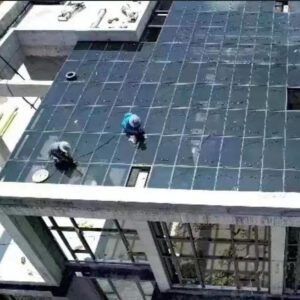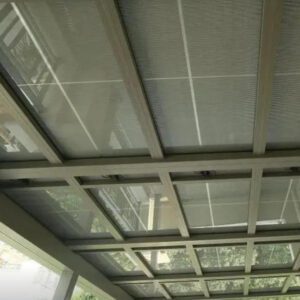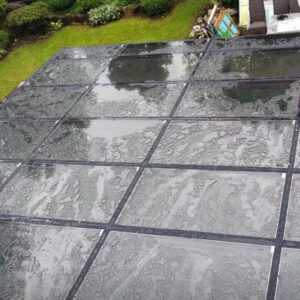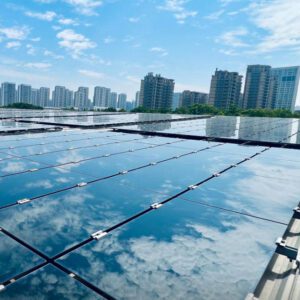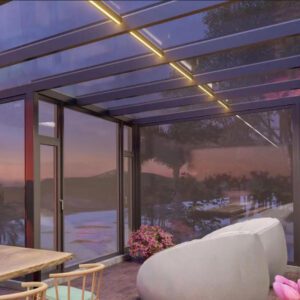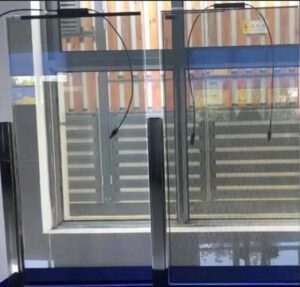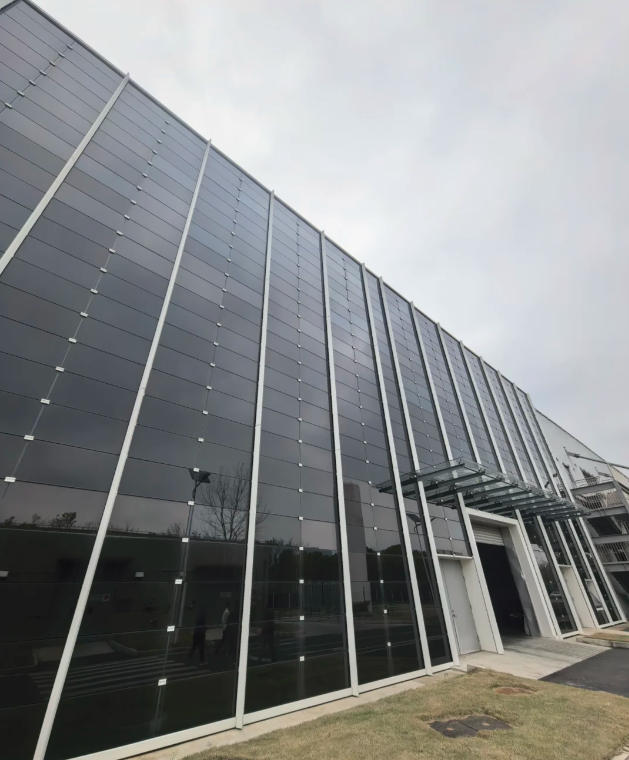
A solar power glass curtain wall system does two jobs simultaneously: it encloses the building and generates electricity from the same surface area.
The Building Envelope Has a New Job
The curtain wall has always been the most demanding component on any commercial building project. It has to handle structural loads, manage water intrusion, control heat gain, and deliver the architectural vision—all while surviving 30 years of weather exposure. It is expensive to design, complex to install, and nearly impossible to change once the building is occupied.
Now it has one more job: generating electricity.
Solar power glass—photovoltaic cells laminated between glass layers and engineered to function as building envelope components—is no longer a novelty specification on award-winning architecture projects. The global BIPV (Building-Integrated Photovoltaics) market reached an estimated USD 34.78 billion in 2025 and is projected to hit USD 250.91 billion by 2035, according to Precedence Research. That growth is being driven by regulatory pressure, rising energy costs, and a fundamental shift in how commercial buildings are valued.
For curtain wall contractors, specialized glazing firms, photovoltaic EPC providers, building material distributors, and the architects and consultants who specify these systems: this is the technology that is reshaping your value proposition. Not in five years. Now.
This article covers what solar power glass actually delivers—backed by performance data, cost figures, and real project outcomes—so you can make informed decisions for your projects and clients.
Quick Definition: What is BIPV? BIPV stands for Building-Integrated Photovoltaics. Unlike rack-mounted solar panels added to a finished building, BIPV products replace conventional building materials—glazing, cladding, roofing—while simultaneously generating electricity. A solar power glass curtain wall panel does the same structural, thermal, and waterproofing job as conventional glazing. It also converts sunlight into electricity.
1. Seamless Integration Without Aesthetic Compromise

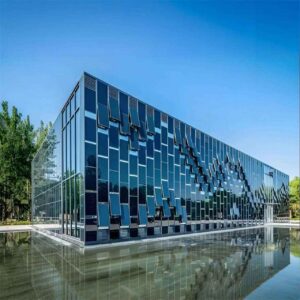
Modern solar power glass is available in custom tints, transparency levels, and patterns that integrate with high-end architectural vision—not against it.
The Architect’s Real Problem
Architects specifying sustainable facades face a conflict most structural engineers do not have to manage: the sustainability target and the design intent pull in opposite directions. Traditional rack-mounted solar panels look like industrial equipment bolted to a building. They satisfy the energy performance requirement. They do not satisfy the client’s vision for a premium commercial tower, corporate headquarters, or mixed-use development.
Solar power glass resolves this conflict by making the energy-generating surface the building surface itself.
What Customization Actually Looks Like
Current-generation solar power glass offers a level of design flexibility that most specifiers have not yet encountered in project specifications:
Transparency (VLT): Visible Light Transmittance options range from 10% to 90% depending on cell type and density. A vision zone can maintain 30–40% VLT—adequate for occupant daylighting—while the spandrel zones use denser cell layouts for maximum power output.
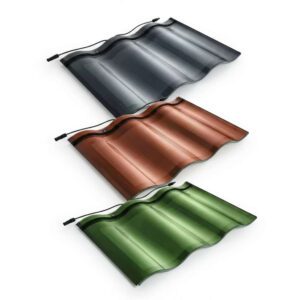
Color and Tint: Neutral grey, bronze, blue-green, warm gold, and custom RAL-matched colors are available from manufacturers including Jia Mao BIPV, whose colored glass line uses proprietary cell arrangement technology to maintain color consistency across large facade areas without visible cell patterning artifacts.
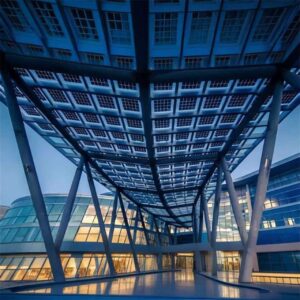
Cell Pattern and Geometry: Laser-scribing techniques allow thin-film cells to be patterned into geometric, branded, or organic designs. In lobby glazing and atrium applications, the interplay of light through patterned solar glass has become a deliberate design element, not a compromise.
Size and Shape: Panels up to 3,000 × 2,000 mm are available in standard production; custom dimensions and curved glass configurations support complex geometries that standard solar panels cannot accommodate.
What This Means for Your Clients
For architects specifying a 20-story commercial tower with a premium curtain wall specification, the specification conversation changes from “solar panels vs. design integrity” to “which solar glass configuration best serves the design intent.” That is a fundamentally different conversation—and a more productive one.
Industry Insight: The Atlassian Central Tower in Sydney incorporated 1,794 custom solar PV louvres by Onyx Solar across 40 floors. Each louvre serves as both an architectural shading element and an electricity-generating surface—a dual function that the conventional design toolbox does not provide.
2. Dual Functionality: Structural Envelope + On-Site Energy Generation
One Surface, Two Revenue Streams
The economic logic of solar power glass in curtain wall applications is straightforward: the facade surface is already being paid for. A conventional premium curtain wall in a commercial building costs $290–$470 per m² installed. Every square meter of that surface is generating zero electricity. Solar power glass converts the same surface into a power-generating asset—at an incremental cost that delivers measurable ROI over the building’s operating life.
Energy Output: What the Numbers Show
Facade-mounted solar glass does not match the output of a south-facing tilted rooftop array. That is the honest starting point. What it does provide is power generation from envelope surface that would otherwise be completely passive.
Vertical south-facing facades in mid-latitudes capture approximately 60–70% of the energy of an optimally tilted rooftop system, according to BIPV performance data from Spirit Energy’s curtain wall analysis. East and west facades capture 40–60%. These figures are after accounting for the vertical orientation losses.
For a commercial building with 2,000 m² of south-facing curtain wall area using semi-transparent solar power glass at 100 Wp/m²:
| Metric | Calculation | Result |
|---|---|---|
| Installed capacity | 2,000 m² × 100 Wp/m² | 200 kWp |
| Annual specific yield (south vertical, Central Europe) | 900 kWh/kWp | — |
| Annual energy generation | 200 kWp × 900 kWh/kWp | 180,000 kWh/yr |
| Value at $0.15/kWh | 180,000 × $0.15 | $27,000/yr |
| Value escalated at 3%/yr over 25 years | Cumulative | ~$950,000 |
Sources: IEA PVPS Task 15 performance data; Spirit Energy BIPV curtain wall analysis.
Urban buildings with constrained roof areas—which describes virtually every commercial high-rise in a dense city center—gain power generation capacity that no rooftop installation can provide. A 40-story tower may have 3,000 m² of usable roof but 18,000 m² of curtain wall surface. Even at 60% of rooftop efficiency, the facade delivers far more total generation potential.
No Additional Land, No Additional Structural Footprint
For EPC contractors and energy service providers designing distributed generation for commercial clients, facade BIPV eliminates the site constraint problem. The power-generating surface is the building itself. There is no competition with parking, landscaping, or adjacent tenants for space. There is no additional structural foundation required. The generating asset and the building envelope are one system.
3. Significant Reduction in Building Energy Costs and Grid Dependency
The HVAC Effect That Most Analyses Miss
The energy value of solar power glass is not limited to the electricity it generates. Advanced solar glazing systems also significantly reduce the building’s cooling load—and that combined effect materially improves the economics.
Research published in a 2025 study on semi-transparent BIPV systems found that solar heat-reflective glass technology within curtain walls reduced heating demand by 40.8% and improved lighting efficiency by 24.9%. A separate review of BIPV curtain wall systems documented building energy consumption reductions of 5–27% depending on climate zone, smart glass technology, and building orientation.
The IEA PVPS Task 15 BIPV performance data confirms that BIPV glazing with 20% Visible Light Transmittance reduces cooling loads by up to 23.2% compared with conventional clear glazing—an energy saving that operates independently of and in addition to the electricity generated.
Cumulative Savings Over 10–25 Years
The following table models combined energy savings for a representative 10,000 m² commercial office building in three U.S. climate zones, using solar power glass on south and west facades (approximately 1,800 m² of total glazed area):
| Climate Zone | Annual Generation (kWh) | Annual HVAC Saving (kWh) | Combined Annual Value | Cumulative 20-Year Value* |
|---|---|---|---|---|
| Hot-Dry (Phoenix, AZ) | 198,000 | 84,000 | $42,300 | $1.14M |
| Mixed (Atlanta, GA) | 162,000 | 61,000 | $33,450 | $900K |
| Cold (Chicago, IL) | 126,000 | 38,000 | $24,600 | $662K |
Assumes $0.14/kWh blended rate, 3% annual utility escalation, 25% south/west facade glazed with solar power glass at 110 Wp/m².
For building owners and developers focused on operational cost reduction, the combined generation and thermal performance of solar power glass makes it one of the few envelope upgrades that delivers measurable, quantifiable financial return over the building’s lifespan.
4. Enhanced Building Sustainability and Green Certification Credits

Buildings specifying solar power glass curtain walls gain measurable LEED and BREEAM credit points—positioning owners as credible sustainability leaders, not just claimants.
LEED v4.1: Specific Credits and Point Pathways
For consultants and design institutes working on LEED-certified commercial projects, solar power glass in curtain walls contributes to multiple credit categories under the LEED v4.1 rating system:
Energy & Atmosphere — Renewable Energy Production (EA Credit): This credit awards points based on the percentage of total building energy demand offset by on-site renewable generation. A 200 kWp solar curtain wall on a building with 800,000 kWh annual energy consumption offsets approximately 22.5%—qualifying for 2–3 EA credit points depending on the LEED version and project type.
Materials & Resources — Building Product Disclosure and Optimization: BIPV glass products that replace conventional cladding materials (glass-for-glass replacement) reduce the material extraction and manufacturing impact per functional unit of facade area. Manufacturers with Environmental Product Declarations (EPDs) for their BIPV glass products—including Jia Mao BIPV—provide the documentation needed for MR credit compliance.
Innovation Credit: Innovative integration of on-site generation into the building envelope—particularly when combined with battery storage or building energy management system integration—can qualify for Innovation credit points that reward technology leadership.
BREEAM Alignment
Under the BREEAM certification system, solar power glass curtain walls contribute primarily to the Energy category, which carries the highest available credits in BREEAM’s weighted scoring framework. Buildings targeting BREEAM Excellent or Outstanding must demonstrate energy performance substantially above the building regulations baseline—a threshold that is materially easier to reach when the envelope itself is generating electricity.
The Competitive Advantage of Specification Leadership
For architects and consultants advising developer clients on portfolio ESG strategy: specifying solar power glass in curtain walls positions the building as a power-generating asset from the opening day of occupancy. This is a measurable, documented characteristic—not a marketing claim—that aligns with ESG disclosure requirements and sustainable finance standards that are becoming mandatory for institutional investors.
5. Increased Asset Value and Market Differentiation
What ESG-Focused Tenants and Investors Are Actually Paying For
The commercial real estate market in 2025 is bifurcating between buildings that can document their energy performance and those that cannot. Institutional tenants with corporate net-zero commitments—technology companies, financial institutions, professional services firms—are increasingly requiring documented energy performance data before signing long-term leases. Buildings that generate their own electricity from the facade can provide that documentation in a way that conventionally glazed buildings cannot.
The glass curtain wall market was valued at $62.4 billion in 2024 and is projected to reach $104.2 billion by 2030. Within that growing market, solar-integrated facades command premium positioning because they deliver what institutional tenants and ESG-focused investors are paying for: documented, verified on-site generation that reduces grid dependency and carbon intensity.
Property Value: The Data Behind the Premium
Aurora Solar’s residential solar research documents a 4% average property value premium for solar-integrated properties. Commercial building evidence is more project-specific, but the underlying dynamic is the same: a building with documented on-site generation and reduced operating costs commands higher rents and better capitalization rates than an identical building without those characteristics.
For building material distributors and developers: a 4% value premium on a $50 million commercial building is a $2 million asset value increase. The incremental cost of upgrading from conventional to solar power glass curtain wall on that building—typically $120–$280 per m² on the facade area—is a fraction of that value uplift.
Talking Points for Marketing Power-Generating Buildings
Distributors and developers positioning solar-integrated facade buildings to premium commercial tenants should ground their conversation in specifics, not generalities:
- Annual kWh generation documented by a certified monitoring system
- Carbon intensity reduction expressed in tCO₂e per year and per tenant square foot
- Utility cost savings per year translated into rental equivalent value
- Green certification level (LEED Gold, BREEAM Excellent) with documented credit breakdown
- 25-year performance warranty from the glass manufacturer with clear warranty administration process
These specifics transform a solar curtain wall from an architectural feature into a quantified financial asset—which is exactly how sophisticated commercial real estate buyers evaluate it.
6. Low Maintenance and Long-Term Durability
How Solar Power Glass Compares to Conventional Curtain Wall
One of the most common concerns from general contractors and facility managers encountering solar power glass for the first time is maintenance complexity. The reality is more straightforward than the concern suggests.
Solar power glass in curtain wall applications does not add meaningful operational complexity to the building’s maintenance program compared to conventional glazing. The glass surface is maintained using the same building maintenance unit (BMU) or rope-access program already required for the curtain wall. The electrical system requires periodic inspection—typically every 2–3 years—from a qualified PV technician, which is a modest addition to standard building services.
Self-cleaning coatings significantly reduce maintenance frequency. Jia Mao BIPV’s ultra-clear tempered glass features a self-cleaning surface coating that reduces maintenance costs by approximately 30%—a saving that compounds meaningfully across a 500 m² commercial facade over a 25-year operating period.
Natural rain-washing on vertical installations provides ongoing surface cleaning that horizontal rooftop panels do not benefit from. A south-facing vertical BIPV facade in a temperate climate with regular rainfall typically requires professional cleaning only once annually, versus two to four times for a horizontal rooftop array.
Durability Testing: What the Standards Actually Require
Solar power glass specified for curtain wall applications must pass both photovoltaic performance standards and building envelope standards—two separate certification frameworks that address different failure modes.
| Test Standard | What It Evaluates | Why It Matters |
|---|---|---|
| IEC 61215 | Thermal cycling, damp heat, UV, mechanical load, hail | PV electrical performance durability |
| IEC 61730 | Electrical safety, fire classification, wet leakage | PV safety qualification |
| ASTM E331 / AAMA 501 | Wind-driven rain penetration | Building envelope water intrusion |
| EN 12600 / ANSI Z97.1 | Pendulum impact (body impact resistance) | Occupant safety |
| NFPA 285 (U.S.) | Facade fire propagation | High-rise building code compliance |
| ASTM G154 | Accelerated UV weathering | Coating and encapsulant durability |
Products that carry only PV certification without building envelope testing have not been verified for curtain wall use. Specifiers should require documentation for both certification tracks.
The 25-Year Performance Warranty
High-quality solar power glass products carry a 25-year power performance warranty guaranteeing a minimum of 80% of rated output at year 25. This is comparable to the warranty offered by the leading conventional PV module manufacturers—and it applies to a product that is simultaneously serving as the building’s primary weather barrier.
System degradation rates for quality glass-glass BIPV modules run approximately 0.3–0.5% per year—at the lower end of the range for PV products generally, because glass-glass construction provides superior encapsulant protection compared to glass-backsheet modules. A module rated at 100 Wp at installation will typically produce at least 88 Wp at year 25.
7. Design Flexibility and Custom Engineering for Complex Projects

BIM-coordinated installation sequences for complex solar power glass curtain wall geometries reduce field errors and installation time on projects where custom engineering is required.
Modular Sizing for Standard and Non-Standard Geometries
The factory-controlled manufacturing environment for solar power glass allows dimensional customization that field-fabricated conventional glazing cannot match. Panel dimensions up to 3,000 × 2,000 mm are available in standard production runs. Custom dimensions for non-standard bays, corner conditions, and irregular facade geometries are accommodated through made-to-order manufacturing with written project commitments.
For specialized contractors working on complex curtain wall projects—sloped glazing, unitized systems with non-rectangular panel shapes, facades with integrated shading systems—the dimensional flexibility of solar power glass manufactured to project-specific requirements eliminates the field adaptation work that adds cost and introduces error risk on conventional custom glazing projects.
Curved Glass Applications
Semi-transparent solar power glass is available in curved configurations for architectural applications requiring cylindrical or conical geometry. This capability extends solar power glass to facade types—curved glass towers, elliptical buildings, cylindrical cores—where conventional flat-panel solar installations are technically impractical.
Curved BIPV glass typically uses thin-film cell technology (amorphous silicon or CdTe) rather than crystalline silicon, because thin-film cells can tolerate the bending stress of glass forming. Output per square meter is lower than flat crystalline silicon panels (30–70 Wp/m² versus 80–150 Wp/m² for flat semi-transparent c-Si), but the architectural capability it enables justifies the performance trade-off on appropriate projects.
BIM Compatibility and Pre-Fabrication for Faster Installation
BIM-based design workflows for curtain wall systems now accommodate solar power glass components with the same level of parametric modeling previously available only for conventional glazing. Revit families and BIM objects for BIPV glass products allow architects and facade engineers to:
- Model precise energy output by facade orientation within the building energy model
- Coordinate conduit routing, junction box placement, and string layout within the curtain wall cavity
- Identify clash conditions between the electrical system and structural framing before fabrication
- Generate shop drawings directly from the coordinated model, reducing interpretation errors
Unitized curtain wall systems—where complete facade panels are pre-assembled in the factory and hoisted into position as finished units—are particularly well-suited to solar power glass integration. Factory assembly of BIPV panels into unitized frames allows electrical connections, weatherproofing details, and structural framing to be completed under controlled quality conditions, reducing installation time and eliminating the weather exposure risks that affect site-assembled systems.
8. Streamlined Collaboration Across Disciplines
Why Siloed Specifications Create Expensive Problems
Solar power glass in curtain wall applications brings together structural engineering, building envelope design, electrical engineering, and facade installation in a way that no other building product does. When these disciplines operate in separate silos—each completing their scope without coordinating with the others—the results are predictable: electrical conduit that conflicts with structural members discovered during installation, waterproofing details that require redesign after the electrical routing is fixed, and inverter placements that cannot be accessed for maintenance.
The projects that deliver solar power glass curtain walls on budget and on schedule are those that integrate these disciplines at the earliest design stage.
Recommended Integrated Design Workflow
A practical integrated workflow for solar curtain wall projects runs through five coordinated stages:
Stage 1 — Facade Irradiance Analysis: Before product selection, commission a facade-specific solar irradiance analysis for each building orientation. This determines which facade zones justify the investment in solar power glass and which should use conventional glazing. A facade receiving less than 600 kWh/m² annually will not generate sufficient energy to recover the cost premium.
Stage 2 — Coordinated Product Specification: Select solar power glass products that meet both PV performance requirements (IEC 61215/61730) and building envelope requirements (fire, impact, water intrusion) for the project jurisdiction. Engage the structural engineer, facade engineer, and electrical engineer simultaneously at this stage.
Stage 3 — BIM Coordination: Build the complete solar curtain wall system in a coordinated BIM model, including electrical components. Run clash detection before fabrication begins.
Stage 4 — Factory Hold-Point Inspection: Perform electroluminescence (EL) imaging on a statistical sample of produced modules at the factory before shipment, establishing a baseline performance record and detecting any manufacturing defects before delivery.
Stage 5 — Commissioning and Handover: Commission the electrical system with string-level testing and system monitoring configuration as part of the facade installation sequence—not as a separate post-construction activity.
Digital Performance Modeling Tools
Several digital tools support the performance modeling that makes integrated workflows possible:
- PVsyst — industry-standard energy yield simulation with facade-specific modeling capability for shading, orientation, and climate data
- Aurora Solar — automated layout optimization and irradiance mapping for complex facade geometries
- IESVE or EnergyPlus — whole-building energy modeling integrating facade solar generation with HVAC loads
Distributors and EPC providers who offer performance modeling as a service—running PVsyst simulations for clients’ specific projects—are providing technical value that advances the project specification and positions them as essential early-stage partners rather than late-stage product suppliers.
9. Future-Proofing Buildings Against Energy Regulations and Carbon Taxes
The Regulatory Pressure Is Already Here
The regulatory environment for building energy performance is tightening on every major commercial market, and the trajectory is clear: buildings that cannot demonstrate measurable energy performance will face financial consequences—in the form of reduced asset values, higher operating costs, and eventually, retrofit mandates with compliance deadlines.
European Union — EPBD: The revised Energy Performance of Buildings Directive requires all new EU buildings to be zero-emission by 2030. New public buildings must meet zero-emission standards from January 2028. Existing commercial buildings must meet renovation milestones: the worst-performing 16% of non-residential stock must be upgraded by 2030. Facade-integrated solar generation is explicitly recognized as a contribution pathway under the directive.
United States — California Title 24: California’s Title 24 Building Standards Code requires new commercial buildings to install solar PV systems. The 2025 code update, effective January 2026, tightens requirements further. While the code does not mandate BIPV specifically, facade-integrated solar generation counts toward the required generation capacity—making solar power glass curtain walls a code-compliance pathway for commercial towers where rooftop space is constrained.
Carbon Taxes and Embodied Carbon Accounting: The EU’s Carbon Border Adjustment Mechanism (CBAM) and expanding carbon pricing schemes across North America create increasing cost pressure on buildings with high operational carbon intensity. A building generating 20–30% of its electricity from its own facade has a materially lower grid electricity draw—and therefore lower carbon cost exposure—than an identical building with conventional glazing.
The Cost of Waiting: Why Retrofit Is More Expensive Than Integration
The economic argument for integrating solar power glass in new construction and major renovation projects now—rather than planning to retrofit later—is straightforward but consistently underestimated.
A solar power glass curtain wall integrated into a new commercial building during initial construction replaces conventional glazing. The incremental cost is $120–$280 per m² over standard curtain wall glazing. That incremental cost is the investment basis for the energy savings and generation value that follows.
A solar power glass retrofit on the same building, installed 10 years after construction, requires removal of the existing curtain wall, structural assessment of the existing frame, electrical system installation in a finished building, tenant disruption management, and waste disposal of the removed glazing. Retrofit costs typically run 2.5–4× the integrated installation cost for the same square footage—before accounting for tenant disruption costs or project delay penalties.
For clients who are planning new commercial construction or major curtain wall renovations: the financial case for integrating solar power glass now rather than retrofitting later is not marginal. The cost differential is substantial and the regulatory pressure is moving in one direction only.
A Strategic Roadmap for the Transition
For contractors, EPC firms, and distributors helping commercial clients navigate the shift from conventional to energy-generating facades, a practical transition framework looks like this:
Phase 1 (Now — 12 months): Identify current and pipeline projects with curtain wall specifications. For each, commission a facade irradiance analysis to identify which orientations justify solar power glass. Begin supplier qualification process with certified BIPV glass manufacturers.
Phase 2 (12–24 months): Pilot solar power glass on one or two projects with favorable economics—south-facing facades in high-electricity-cost markets, clients with LEED targets, or buildings in jurisdictions with strong incentive programs. Document performance data and installation process.
Phase 3 (24–48 months): Standard-specify solar power glass for all qualifying facade zones based on pilot project data and updated incentive analysis. Build in-house expertise in BIM modeling, energy yield simulation, and electrical commissioning for BIPV systems.
Jia Mao BIPV: Manufacturing Scale and Technical Capability for Commercial Projects
For curtain wall contractors, glazing distributors, and EPC firms evaluating solar power glass suppliers for commercial-scale projects, manufacturing capacity and technical support capability are not secondary considerations—they are the primary variables that determine whether a project specification is executable.
Jia Mao BIPV operates at 3 GW annual production capacity from their facility, making them one of the largest dedicated BIPV glass manufacturers available to international commercial projects. Their product range covers the full specification spectrum required for commercial curtain wall applications:
- Transparent BIPV glass: VLT 10–90%, crystalline silicon or thin-film cell options, standard and custom dimensions
- Colored BIPV glass: Custom RAL color matching with invisible busbar technology, suitable for high-visibility architectural facades
- Semi-transparent spandrel glass: Higher cell density for maximum power output in non-vision facade zones
- Curved and specialty configurations: For complex architectural geometries
Certifications held include IEC 63092-1, IEC 61215, IEC 61730, and B1-grade flame retardancy under GB 8624—providing the documentation package that commercial building permit submissions and utility interconnection applications require.
For project-specific technical support including BIM component files, energy yield simulations, structural load calculations, and LEED documentation assistance, contact the Jia Mao BIPV technical team directly.
Watch: How BIPV Solar Facade Systems Work
▶ Click to watch: A practical overview of BIPV technology, facade integration methods, and performance data for curtain wall contractors, EPC firms, and architects.
Performance and Cost at a Glance
The following table provides a reference-range summary of solar power glass performance and cost metrics for commercial curtain wall projects. Use these as planning benchmarks, not final design values—project-specific figures depend on location, facade orientation, product selection, and local incentive programs.
| Metric | Semi-Transparent Curtain Wall BIPV | Opaque Solar Cladding BIPV | Source / Notes |
|---|---|---|---|
| Installed cost (product + framing + electrical + labor) | $410–$750/m² | $355–$640/m² | Jia Mao BIPV product data; market analysis 2025 |
| Electrical output | 80–150 Wp/m² | 150–200 Wp/m² | IEA PVPS Task 15; manufacturer data |
| Visible Light Transmittance | 10–40% | 0% (opaque) | Product specification |
| SHGC improvement vs. clear glazing | 15–35% cooling load reduction | N/A | ScienceDirect BIPV/T study 2025 |
| Annual energy yield (south vertical, Central Europe) | 72–135 kWh/m²/yr | 135–180 kWh/m²/yr | IEA PVPS specific yield data |
| Payback on incremental cost (new construction) | 7–15 years | 4–10 years | Spirit Energy BIPV analysis |
| Power performance warranty | 25 years (≥80% output) | 25 years (≥80% output) | Standard for certified products |
| Degradation rate per year | 0.3–0.5% | 0.3–0.5% | Green Fuel Journal BIPV durability review |
| Fire rating (U.S.) | NFPA 285 required above 40 ft | NFPA 285 required above 40 ft | SFPE FPEeXTRA Issue 77 |
Build Facades That Power the Future
Solar power glass is not an add-on technology or a sustainability label. It is a structural, thermal, and electrical system integrated into the one component every commercial building already has to pay for.
For curtain wall and roofing contractors, it is a value-added specification that increases project scope and margin without requiring new trade skills—installation follows standard glazing practice, supplemented by certified electrical commissioning.
For photovoltaic EPC and energy service providers, it is a scalable distributed generation asset that turns every commercial facade into a power plant without consuming additional land, additional structural footprint, or additional grid interconnection points.
For building material brands and distributors, it is a premium product in a high-growth market segment where gross margins of 25–40% are achievable and defensible—fundamentally different economics from commodity panel distribution.
For architects, consultants, and design institutes, it is the envelope technology that simultaneously delivers design freedom, sustainability credentials, green certification credits, and future regulatory compliance—all from a single specification decision.
The regulatory trend is unambiguous. The EU’s EPBD mandates zero-emission new buildings by 2030. California’s Title 24 already requires commercial solar. Carbon pricing is expanding. The buildings being designed and specified today will be operating through these regulatory environments for 30+ years. Solar power glass integrated now is the cost-effective path. Retrofit later is the expensive one.
Three next steps for your firm:
- Commission a facade irradiance study on your next major curtain wall project to identify which orientations justify solar power glass and what the expected annual yield would be.
- Request a product specification package from a certified BIPV manufacturer—including BIM files, structural load calculations, energy yield simulations, and certification documentation—to evaluate integration into your standard specification workflow.
- Model the 25-year economics for at least one client project using current electricity rates, applicable incentives, and the specific facade area being considered. The financial case almost always surprises clients who have only seen the headline installed cost.
For manufacturers, distributors, and EPC contractors looking to explore Jia Mao BIPV’s solar power glass product range for curtain wall applications, visit the BIPV module and photovoltaic glass product catalogue or review real-world BIPV project case studies documenting performance across commercial facade installations.
Glossary of Key Terms
BIPV (Building-Integrated Photovoltaics): Solar cells integrated directly into building materials—glass, cladding, roofing—that replace conventional building products while generating electricity. The defining characteristic is functional replacement, not addition.
VLT (Visible Light Transmittance): The percentage of visible light that passes through a glass panel. Higher VLT means more daylight and view; lower VLT typically means higher solar cell density and greater power output per m².
SHGC (Solar Heat Gain Coefficient): The fraction of solar radiation that passes through glass as heat. Lower SHGC means better thermal performance in hot climates. Advanced solar glazing can achieve SHGC values of 0.10–0.30, significantly reducing cooling loads.
Wp/m² (Watts-peak per square meter): The rated electrical output of a solar panel under standard test conditions per unit area. Semi-transparent BIPV glass typically produces 80–150 Wp/m²; opaque solar cladding achieves 150–200 Wp/m².
EPBD (Energy Performance of Buildings Directive): The EU legislative framework setting energy performance standards for buildings, including the 2030 zero-emission new buildings mandate.
BIM (Building Information Modeling): A coordinated 3D digital model of a building that integrates structural, architectural, and MEP information, enabling clash detection, energy simulation, and shop drawing generation before construction begins.
Specific Yield (kWh/kWp): The annual energy production per kilowatt of installed PV capacity, adjusted for location, orientation, and system losses. South-facing vertical facades in Central Europe typically achieve 800–1,000 kWh/kWp annually.
C-PACE: Commercial Property Assessed Clean Energy—a financing mechanism in 40 U.S. states that funds solar installations through a property tax assessment, enabling 100% project financing without traditional credit lines.
Questions fréquemment posées
FAQ 1: Can solar power glass be customized to match our project’s specific transparency and color requirements?
Yes. Modern solar power glass offers VLT options from 10% to 90% and is available in neutral grey, bronze, blue-green, warm gold, and custom RAL-matched colors. Cell arrangement technology from manufacturers like Jia Mao BIPV maintains color consistency across large facade areas without visible patterning artifacts. Custom panel dimensions up to 3,000 × 2,000 mm and curved configurations are available for non-standard geometries.
FAQ 2: How does the energy output of solar curtain walls compare to traditional rooftop PV systems?
South-facing vertical facades capture approximately 60–70% of the energy of an optimally tilted rooftop system at the same location. East and west facades capture 40–60%. While lower than rooftop output, facade BIPV generates power from surface area that would otherwise produce nothing—and for high-rise buildings with constrained roof areas, the total facade generation potential substantially exceeds what the roof can accommodate.
FAQ 3: Is structural reinforcement needed when replacing standard glazing with solar power glass?
In most new-construction applications, no. Solar power glass is engineered to meet standard curtain wall load requirements—wind load, seismic, and dead load—within the same framing system as conventional glazing. Standard glass-glass BIPV modules weigh approximately 20–22 kg/m², comparable to premium laminated safety glass. For retrofit applications, structural assessment is required to confirm existing frame capacity.
FAQ 4: What maintenance is required for solar power glass in high-rise buildings?
Maintenance follows the same program as conventional curtain wall glazing: periodic professional cleaning using BMU or rope-access equipment, and sealant/gasket inspection as part of the building envelope maintenance cycle. Electrical inspection every 2–3 years is the additional requirement. Self-cleaning coatings available from manufacturers like Jia Mao BIPV reduce cleaning frequency by approximately 30%, offsetting a meaningful portion of the high-access maintenance cost.
FAQ 5: How do we integrate the electrical output into the building’s energy management system?
BIPV curtain wall systems include string inverters or microinverters that convert DC output to grid-compatible AC. These systems integrate with building management systems (BMS) through standard communication protocols—Modbus, BACnet, or Ethernet—providing real-time generation monitoring, fault detection, and performance data compatible with tenant ESG reporting requirements.
FAQ 6: Are there fire safety concerns with integrating PV into facades?
Fire safety for BIPV facades is a real technical concern that requires proper specification—not a reason to avoid the technology. NFPA 285 testing is required in the U.S. for facade systems on buildings above 40 feet, and the test must be performed on the complete assembly (not just the module in isolation). Products using thicker glass (≥3.2 mm) and POE or ionomer encapsulants—rather than standard EVA—demonstrate significantly better fire performance in large-scale testing. Always require NFPA 285 documentation for the specific assembly configuration being proposed.
FAQ 7: Can solar power glass be used in renovation projects or only new construction?
Both. Retrofit applications are viable when the existing facade is at or near end-of-life, making replacement necessary regardless. In this scenario, the incremental cost of upgrading to solar power glass over conventional replacement glazing is the relevant investment, not the total system cost. Retrofit projects where the existing facade is still serviceable face longer payback periods because the full system cost must be recovered—but they remain viable in high-electricity-cost markets and buildings with strong sustainability mandates.
FAQ 8: What is the typical payback period for a commercial building using solar power glass?
Payback on the incremental cost over conventional glazing runs 7–15 years for semi-transparent curtain wall BIPV and 4–10 years for opaque solar cladding in spandrel zones, depending on facade orientation, local electricity rates, and applicable incentives. When the federal Investment Tax Credit (where applicable), accelerated depreciation (MACRS 5-year in the U.S.), and state incentives are included, payback periods compress by 25–40% relative to pre-incentive calculations.
FAQ 9: How do we handle wiring and junction boxes within the curtain wall system?
Integrated busbar channels within the curtain wall mullion system route electrical conductors without visible surface wiring. Junction boxes are located in the cavity behind the panel at standardized positions coordinated with the facade framing grid. In unitized curtain wall systems, electrical connections are made at the factory as part of panel assembly—reducing on-site electrical work to inter-unit connections and inverter wiring. Coordination of electrical routing with the curtain wall shop drawings is a critical early-stage design step.
FAQ 10: Does solar power glass perform well in low-light or cloudy climates?
Yes, with performance that varies by cell technology. Amorphous silicon thin-film cells perform well in diffuse light conditions, maintaining higher efficiency relative to their rated output than crystalline silicon when irradiance is low. Perovskite-enhanced cells, currently in commercial development, perform efficiently in diffuse light and are particularly promising for vertical facade applications in northern European and Pacific Northwest climates where overcast conditions are common. Even in cloudy climates, a south-facing vertical facade in Seattle or London receives sufficient annual irradiance to justify solar power glass in buildings with meaningful facade area.
FAQ 11: Can we combine solar power glass with other smart glazing technologies such as electrochromic glass?
Yes. Hybrid BIPV-electrochromic systems are available for applications requiring dynamic control of visible light, solar heat gain, and electricity generation from the same facade element. These systems use electrochromic interlayers that can switch between clear and tinted states on demand—combined with photovoltaic cell layers that generate electricity from incident solar radiation regardless of the electrochromic state. Commercial deployments are currently limited, but several manufacturers including Jia Mao BIPV are actively developing self-dimming material integrations for commercial release.
FAQ 12: What support do you provide for architects and engineers during the design and specification phase?
Full technical specification support includes: BIM component files (Revit families) for the specific product being specified, energy yield simulations using PVsyst for the project’s facade geometry and climate, structural load calculations for wind and dead load at the required design pressure, NFPA 285 or EN 13501 fire test documentation for the proposed assembly, and LEED/BREEAM documentation packages for certification submissions. For Jia Mao BIPV’s technical support services on commercial projects, submit a project inquiry through their contact page with facade area, orientation, and project certification targets.