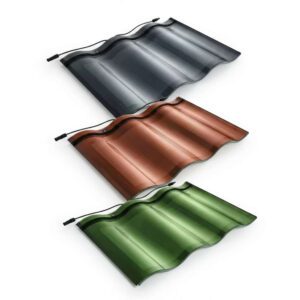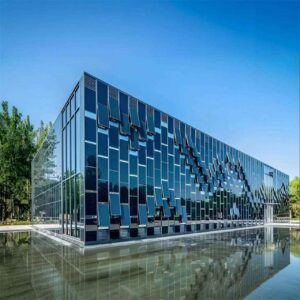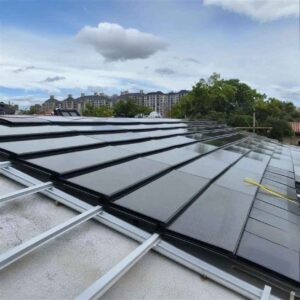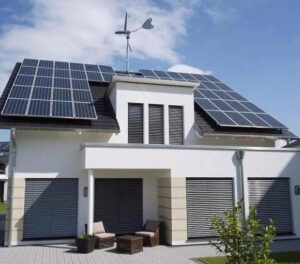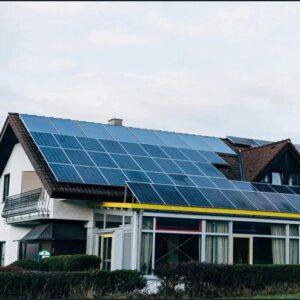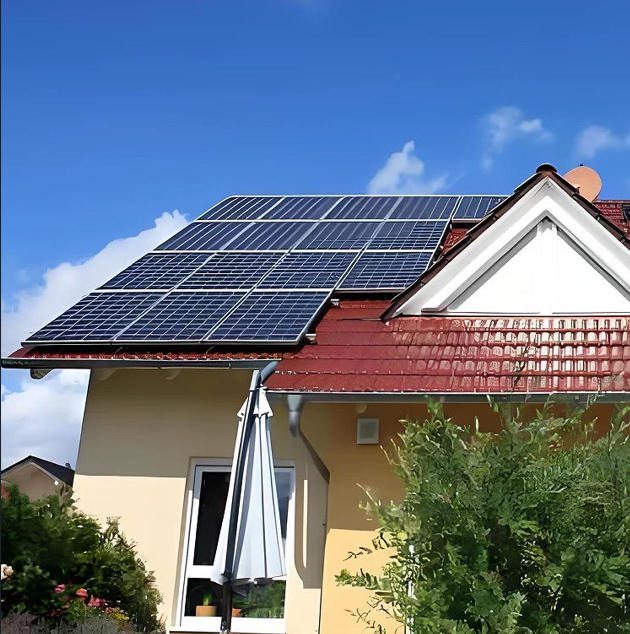
 An integrated solar roof. The glass tiles are the roof itself, not equipment bolted on top of it. Image: Wikimedia Commons, CC0.
Thesis: Integrated solar roof systems (BIPV) change the game for builders and energy companies. They remove the clash between solar racks and community design rules. Contractors and architects can deliver solar that HOAs approve, performs well, and works as a real, structural roof.
I. Introduction
A. The Conflict: Homeowners Want Solar, HOAs Want Uniform Streets
A Homeowner Association (HOA) is a private organization that governs a housing community and enforces its design rules. (See how homeowner associations work for background.)
The conflict plays out the same way in many communities:
- The homeowner signs a solar contract.
- The Architectural Review Board (ARB), the HOA committee that approves exterior changes, asks for drawings, samples, and street-view photos.
- The application stalls for weeks. Sometimes it comes back “denied” or “approved with conditions” that kill the project’s economics.
For an EPC or roofer, every stalled HOA file means sales time spent, a crew left unbooked, and a customer who may walk away.
B. The Technical Shift: From “Add-On” to “Integrated”
There are two ways to put solar on a pitched roof:
| Approach | What It Is | How the HOA Sees It |
|---|---|---|
| Add-on (rack-mounted PV) | Panels clamped to aluminum rails, bolted through the existing roof | “Equipment” or an “exterior modification” |
| Integrated (BIPV) | Solar tiles or shingles that replace the roofing material | Often classed as “roofing material” |
BIPV (photovoltaïque intégré au bâtiment) means solar products that do the job of a building material, such as a shingle, tile, or skylight, while also generating electricity.
C. Value Proposition
Integrated systems address a different pain point for each trade:
- Roofing contractors take on a higher-value scope instead of handing the roof to a solar subcontractor.
- EPCs lose fewer deals to HOA denials.
- Architects keep the roofline they designed.
- Distributors get a premium product line with repeat trade buyers.
D. Objective
This guide shows how to handle HOA approvals by treating solar as a material replacement, not an equipment add-on. It covers practical documents, numbers, and workflows for each stakeholder.
Remarque : HOA rules and state solar access laws vary widely. Treat this guide as industry practice, not legal advice. Have a local attorney review governing documents on contested projects.
II. The Limitations of Traditional Roof Racks (The Pain Point)
Traditional mounting systems create structural and aesthetic weak points that lead to HOA rejections.
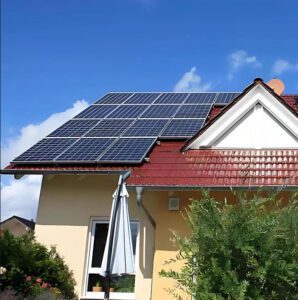
 A typical rack-mounted system: visible rails, raised panel edges, and exposed hardware. These details are what ARBs flag. Image: Alfred Twu, Wikimedia Commons.
1. Visual Disruption: The “Industrial Look”
Rack systems usually sit 10–15 cm (4–6 in) above the roof surface. From the street, ARB members see:
- Silver or black rail ends at the panel edges
- Gaps and shadow lines under the modules
- Conduit runs across the roof face
- Panel colors that don’t match the shingle or tile color
Most HOA design guidelines contain wording like “harmonious with the existing structure” or “minimize visibility from common areas.” Racks have a hard time meeting either test.
2. Structural Compromise: Penetrations and Warranties
A typical 8 kW rack system needs 40–80 roof penetrations. Each lag bolt goes through the underlayment and into the rafters.
Common results:
- Leaks at flashing points, often 3–7 years after installation as sealants age
- Voided roof warranties, since many shingle makers exclude damage from third-party penetrations
- Detach-and-reset costs when the roof needs replacement, which usually happens before the solar system reaches end of life
Industry insight: A 15-year-old asphalt roof with new solar on top is a common trap. The roof wears out around year 20–25. Removing and reinstalling the array then often costs $3,000–$6,000+ on a residential job, money the homeowner never budgeted.
3. Installation Friction: Approvals and Fines
Illustrative breakdown based on common ARB feedback that installers report. Most objections are about appearance, not electrical issues.
Even in states with solar access laws, HOAs can usually impose “reasonable restrictions.” In practice, that means:
- 30–60 day review windows
- Requests to move panels to a less productive roof face
- Fines or forced removal when systems go in before approval
III. Understanding Integrated Solar Roof Systems (The Solution)
Integrated systems such as Voltaic and SunStyle treat the roof itself as the energy generator.
1. Material Replacement, Not Added Layers
With BIPV, the solar product is the roof covering. It does the job of a shingle or tile: it sheds water, resists wind uplift, and carries a fire rating.
The SunStyle solar shingle system from CertainTeed is a well-known example. Large-format glass shingles cover the whole roof plane, and active and inactive pieces look nearly identical.
 Solar shingles take the place of standard roofing units. There are no rails and no raised edges. Image: Wikimedia Commons.
Solar shingles (also called photovoltaic shingles) are solar modules sized and shaped like normal roofing units. You can read more in this overview of solar shingle technology.
2. Seamless Aesthetics
What a flush, integrated finish typically delivers:
| Fonctionnalité | Rack-Mounted PV | Integrated Solar Roof |
|---|---|---|
| Height above roof deck | 10–15 cm | 0–3 cm (in-plane) |
| Visible hardware | Rails, clamps, end caps | None or concealed |
| Color matching | Limited (black or silver frames) | Matched dummy tiles for full roof coverage |
| Edge treatment | Exposed panel edge | Integrated flashing at ridges, valleys, eaves |
Many systems use inactive (dummy) tiles, which look identical to the solar tiles but have no cells. They fill shaded areas and odd roof shapes so the whole roof looks the same.
3. Engineering Synergy
An integrated roof combines three jobs in one layered assembly:
- Waterproofing: underlayment plus interlocking tiles and flashings
- Structure: wind uplift resistance and fixings into battens or the deck
- Power generation: cells, connectors, and wiring routed under the tiles
If you want to compare tile formats and specs, our team at Jia Mao Bipv has published a professional buyer’s guide to solar roof tiles that covers fire ratings and efficiency ranges.
IV. Strategic Advantages for General Contractors & Roofers
BIPV lets roofing contractors move from maintenance work into high-value energy installation.
 Tile-setting skills carry over directly to solar tile work. The new skill is the low-voltage DC connection. Image: Wikimedia Commons.
1. Streamlined Workflow
With racks, the sequence is roof → wait → solar crew → electrician. With BIPV, the roof and solar go in together:
Typical residential timeline (about 2,500 sq ft roof). Most of the time saved comes from removing the wait between trades. Results vary by system and crew experience.
Fewer mobilizations mean:
- One scaffold or fall-protection setup
- One dumpster
- One final inspection window (where the building authority allows it)
Notre step-by-step BIPV roof tile installation guide walks through roof prep, underlayment, flashing, and wiring in order.
2. Warranty Consolidation: No More Blame Game
When a rack-mounted roof leaks, the roofer blames the solar installer’s penetrations and the solar installer blames the roof. The homeowner is stuck in the middle.
With an integrated roof:
- One contractor owns the weather-tightness
- One product warranty (often 25 years on power, with matching weather-tightness coverage on many systems)
- One point of contact for the homeowner
3. Market Differentiation
Luxury homeowners often turn solar down because of how it looks, not because of cost. “Invisible solar” opens up that segment:
- Average residential re-roof ticket: $15,000–$30,000
- Integrated solar roof ticket: often $60,000–$120,000+ depending on size and region
That’s a big jump in revenue per job for a crew whose skills you mostly already have.
V. Technical Considerations for Architects & Design Institutes
Integrated solar lets architects keep their design intent without giving up energy performance.
1. Architectural Harmony
BIPV keeps three things that matter in design review:
- Silhouette: the roof profile stays the same, with no raised rectangles
- Texture: tile or slate patterns continue across active and inactive areas
- Color field: a single tone across the roof plane
2. Material Specifications in BIM
BIM (Building Information Modeling) is a 3D digital model of the building that holds data about every component.
Add BIPV to BIM at schematic design, not after permit:
| Design Stage | BIPV Task |
|---|---|
| Concept | Solar access study and roof-face orientation |
| Schematic | Select tile family, active vs. inactive layout |
| Design development | Electrical string layout, inverter location, conduit paths |
| Construction documents | Flashing details, fire setbacks, ridge vents, BOM |
Industry insight: Design teams that model BIPV early usually get 15–25% more active area than teams that add solar later. Vents, skylights, and plumbing stacks can be grouped on the north or least productive face before anything is fixed.
3. Regulatory Navigation: The “Material Replacement” Clause
Many HOA documents regulate “equipment,” “appurtenances,” or “rooftop structures” separately from “roofing materials.”
Many roofing-material clauses only ask that replacements match:
- Approved color palette
- Approved material type (tile, slate, shingle)
- Profile and texture
When a BIPV product meets those criteria, the architect can submit it as a roofing material. That usually means a simpler review path. State law also matters. For example, California Civil Code Section 714 limits HOAs to “reasonable restrictions” on solar. Under Florida Statute 163.04, an HOA cannot ban solar collectors outright.
VI. The EPC & Energy Service Provider Perspective
Integrated systems lower customer acquisition costs by removing the “HOA barrier.”
1. Higher Conversion Rates
Customer Acquisition Cost (CAC) is the total sales and marketing cost to win one signed customer.
In HOA-heavy territories, a large share of leads drop out after the homeowner reads the CC&Rs. CC&Rs (Covenants, Conditions & Restrictions) are the HOA’s binding rulebook. Leading with an integrated product changes the sales conversation:
- From: “We’ll try to get it past your HOA.”
- To: “This is a roof replacement that also makes power.”
2. Increased Project Value
| Metric | Rack Solar Sale | Integrated Roof Sale |
|---|---|---|
| Product category | Commodity panels | Structural upgrade |
| Typical ticket | $20,000–$35,000 | $60,000–$120,000+ |
| Price competition | High (many bidders) | Lower (few qualified installers) |
| Financing story | Energy savings only | Roof + energy savings |
3. Long-Term Asset Value
Research from Lawrence Berkeley National Laboratory, Selling into the Sun, studied more than 22,000 home sales across eight states. It found buyers paid a measurable premium for homes with owned PV systems, roughly $4 per watt installed.
An integrated roof adds one more selling point: appraisers see a new roof et solar as a single permanent improvement, not equipment that might need removal.
VII. Case Studies: Real-World HOA Bypass Successes
These examples show the move from rejection to approval.
The following are composite examples drawn from patterns that contractors and EPCs commonly report. Figures are representative, not from one named project.
1. Case Study A: The Luxury Community That Banned Racks
Setting: A gated community of about 300 homes with clay-look concrete tile roofs. The ARB had denied several rack-mounted applications on “street visibility” grounds.
What changed: The installer resubmitted using terracotta-toned solar tiles plus matching inactive tiles, filed under the HOA’s roof replacement section.
Result:
- Approved at the first ARB meeting
- No conditions on panel placement
- Two neighbors asked for quotes within the next quarter
2. Case Study B: Solar Folded Into a Scheduled Re-Roof
Setting: A regional roofing contractor with a homeowner whose 22-year-old asphalt roof was failing.
What changed: Instead of re-roofing now and adding racks later, the contractor quoted one integrated scope.
Result:
- Total project time: about 5 working days instead of 10+ across two trades
- One permit sequence and one warranty
- The homeowner’s single loan covered both roof and energy system
3. Analysis: The “Approval Pivot”
The real difference shows up in the submission package:
| Document | Rack-Mounted Submission | Integrated Roof Submission |
|---|---|---|
| Application category | Exterior modification / equipment | Roofing material replacement |
| Visual exhibit | Photo-sim showing panels on roof | Material sample + color chip |
| Height detail | Racking section drawing | Roofing section (flush) |
| Neighbor notice | Often required | Often not required for like-for-like roofing |
| Typical ARB questions | Placement, visibility, glare, conduit | Color and texture match |
Conseil : Always bring a physical sample tile to the ARB meeting. Board members are often homeowners, not engineers. Holding the product in their hands answers most of their questions.
VIII. Comparative Analysis: Roof Racks vs. Integrated Systems
A technical comparison of performance, cost, and lifespan.
1. Aesthetics: Industrial vs. Architectural
| Facteur | Roof Racks | Integrated BIPV |
|---|---|---|
| Profile | Raised 10–15 cm | Flush with roof plane |
| Street appearance | Visible “equipment” | Reads as roofing |
| HOA category | Equipment | Material (often) |
2. Durability: Exposed Racking vs. Integrated Shielding
| Facteur | Roof Racks | Integrated BIPV |
|---|---|---|
| Roof penetrations | 40–80 typical | Few or none through the waterproof layer (fixings under laps) |
| Wind exposure | Gaps allow uplift under panels | In-plane design, tested as roof covering |
| Debris and pests | Nesting space under panels | No cavity for nests |
| Roof replacement conflict | Detach-and-reset needed | Roof and solar share one lifecycle |
3. ROI: Short-Term Savings vs. Long-Term Value
Illustrative 25-year view for a similar-sized home. Racks win on day one. The gap narrows once you count the roof itself, reset costs, and HOA risk.
Bottom line:
- Racks are cheaper per watt and usually more efficient per square meter.
- Integrated roofs cost more upfront but replace a roof you were going to buy anyway. They also avoid detach-and-reset and make HOA approval easier.
For a deeper comparison with efficiency figures, see our analysis of solar roof tiles vs. traditional panels.
IX. Implementation Roadmap for Distributors & Brands
How building material distributors can make integrated solar a core product line.
1. Training the Trade
Most roofers already have about 80% of the skills BIPV needs. The gap is:
| Skill Gap | Training Format | Typical Duration |
|---|---|---|
| DC connector handling and polarity | Hands-on bench session | Half day |
| String layout and labeling | Classroom + drawing review | Half day |
| Integrated flashing details | Mock-up roof training | 1 day |
| Safety: working near live DC | Classroom + field demo | Half day |
| Commissioning basics | Ride-along with electrician | 1–2 jobs |
Video: How in-roof solar is fitted (Viridian Solar case study)

https://www.youtube.com/watch?v=sf_cDswsZyo
2. Strategic Partnerships
The model that works best pairs:
- Roofing GC: owns the envelope, sells the re-roof
- EPC or licensed electrician: owns design, interconnection, and commissioning
- Distributor: supplies stock, training, and marketing materials
Distributors who set up this partnership in a region become the place where both trades come for product. If you’re comparing manufacturers for a new line, our review of how to choose a solar roof tile partner lists the main questions to ask.
3. Certification and Compliance
BIPV must pass both electrical and roofing standards:
| Requirement | Ce qu'il couvre |
|---|---|
| UL 61730 / IEC 61730 | PV module electrical and fire safety |
| UL 7103 | BIPV roof coverings: fire, wind, weather, impact, electrical |
| Fire classification (UL 790 / ASTM E108) | Class A/B/C roof fire rating |
| Wind uplift (e.g., ASTM D3161 / UL 1897) | Resistance to wind loads |
| NEC Article 690 (US) | PV wiring, rapid shutdown, labeling |
UL’s BIPV testing and certification program explains how UL 7103 combines these checks. For permit offices that are new to BIPV, the residential BIPV plan check and permitting guidelines are a useful reference to share.
X. Conclusion
A. From “Mounted” to “Integrated”
Rack-mounted solar treats the roof as a platform. Integrated solar treats the roof as the power plant. That one change removes the most common reasons HOAs say no: visibility, profile, and the “equipment” label.
B. Call to Action for Industry Professionals
- Roofers: quote solar as a roofing scope on your next re-roof.
- EPCs: offer an integrated option in HOA-heavy zip codes before the first sales call.
- Architects: model BIPV at schematic design.
- Distributors: build training and stock around one or two proven tile families.
Jia Mao Bipv supplies solar roof tiles, PV glass, and BIPV components to contractors, EPCs, and distributors. You can explore the Jia Mao Bipv solar building material range or read our strategic guide to solar roof tiles for contractors and EPCs to plan your first integrated project.
C. The Future of “Invisible Solar”
In high-end residential markets, the question is moving from “Should we add solar?” to “Which roofing material makes power?” As BIPV costs fall and more HOAs see approved examples, integrated roofs will become the default in communities where appearance matters. The firms that build crews, partnerships, and approval playbooks now will lead that market.
Glossary of Key Terms
| Term | Plain-English Meaning | Example |
|---|---|---|
| BIPV | Solar products that act as building materials | Solar tiles replacing clay tiles |
| HOA | Private body that sets and enforces community rules | A gated community board |
| ARB | HOA committee that reviews exterior changes | Approves roof color |
| CC&Rs | Binding HOA rulebook | Clause limiting “rooftop equipment” |
| Material replacement | Swapping one roofing material for another | Shingles → solar shingles |
| Inactive (dummy) tile | Non-generating tile that matches solar tiles | Used near vents or shaded areas |
| Penetration | Any hole through the roof’s waterproof layer | Lag bolts for rack mounts |
| Detach-and-reset | Removing and reinstalling solar for roof work | Common at year 15–20 |
| UL 7103 | US safety standard for BIPV roof coverings | Required by many permit offices |
| BIM | 3D model holding building component data | BIPV layout in Revit |
| CAC | Cost to win one customer | Sales + marketing ÷ deals |
Questions fréquemment posées
1. How do integrated solar systems differ from traditional panels in terms of HOA “material” classifications?
Rack panels are usually reviewed as “equipment” or an “exterior modification.” Integrated solar tiles and shingles replace the roof covering, so they can often be submitted under the “roofing material” section of the CC&Rs. That section typically checks only color, texture, and profile. Classification depends on the exact wording of each HOA’s documents.
2. Does replacing a roof with BIPV void the original structural warranty of the home?
Usually not, if the roof structure can carry the load and the system is installed to the manufacturer’s instructions and local code. Replacing the roof covering does end the old shingle warranty, but the BIPV system’s own roofing and power warranties take its place. Confirm deck condition and rafter capacity before you start.
3. What is the typical installation time difference between a roof rack system and an integrated system?
A re-roof followed by rack solar often takes 10 or more calendar days across two trades. An integrated roof on a similar home typically takes 4–7 working days with one coordinated crew. Most of the time saved comes from removing the gap between trades.
4. How do integrated solar materials handle thermal expansion compared to traditional shingles?
Glass solar tiles and their aluminum or polymer parts expand differently from asphalt. Good systems handle this with interlocking laps, slotted fixings, and flexible flashings. Installers should follow the specified fixing patterns and gaps exactly, because over-tightened fixings are a common cause of cracked tiles.
5. Which specific HOA clauses are most effectively bypassed using integrated solar technology?
The clauses most often avoided are those covering “rooftop equipment,” “appurtenances,” “visible mechanical devices,” and “structures above the roofline.” Integrated roofs still have to meet the roofing-material clause, which usually covers color, material type, and texture.
6. What are the primary electrical certification requirements for BIPV compared to standard PV?
Both need module safety certification (UL 61730 / IEC 61730) and must meet wiring codes such as NEC Article 690. BIPV roof products also need roofing certification, usually UL 7103 in the US, plus fire class and wind uplift ratings, because they act as the roof covering.
7. How does the cost-benefit analysis change for a homeowner when solar is tied to a roof replacement?
The real comparison becomes “new roof + racks” against “integrated roof,” not “racks” against “integrated.” Once you subtract the cost of a roof the owner needed anyway and add avoided detach-and-reset costs, the price gap shrinks a lot. Payback is often longer than for racks, but total property value is often higher.
8. Can integrated solar be retrofitted onto existing roofs, or is it strictly for full replacements?
Most integrated systems need the existing roof covering removed on the planes where they are installed. Some systems allow a partial install on one roof face blended with matching conventional material. In practice, the best time for BIPV is during a scheduled re-roof or new build.
9. What is the expected lifespan of integrated solar materials versus traditional roof racks?
Quality BIPV tiles typically carry 25–30 year power warranties, and glass-based tiles can outlast asphalt shingles. Rack-mounted panels also last 25–30 years, but the roof underneath often needs replacing first, which forces a detach-and-reset partway through the system’s life.
10. How do architects integrate BIPV into the early design phases to ensure HOA approval?
Add BIPV to the BIM model at concept stage. Group vents and penetrations on less productive roof faces, choose a tile color from the HOA palette, and prepare street-view renderings that show a uniform roof. Bring physical samples to the pre-application meeting.
11. What training do traditional roofing crews need to transition to BIPV installation?
Crews usually need 2–4 days of focused training: DC connector handling, string layout and labeling, integrated flashing details, and safety around live DC. A licensed electrician should still handle inverter connection and commissioning where local rules require it.
12. How is the maintenance of integrated solar systems handled compared to accessible roof racks?
Integrated roofs have no cavity under the panels, so debris and nesting problems are rare. Monitoring software flags underperforming strings. Replacing a single damaged tile means removing nearby tiles in a set sequence, so the work should be done by a trained installer instead of a general handyman.