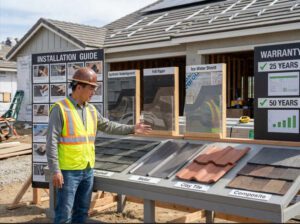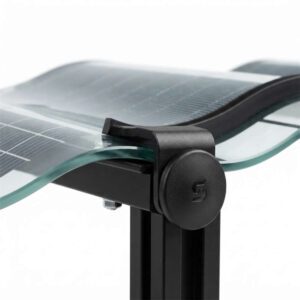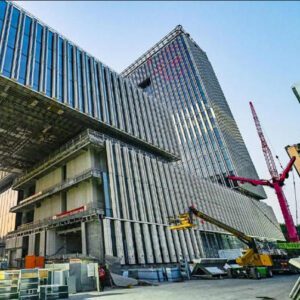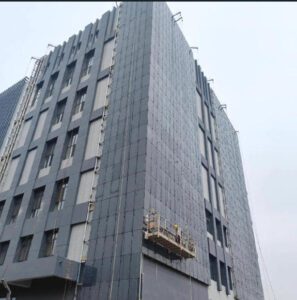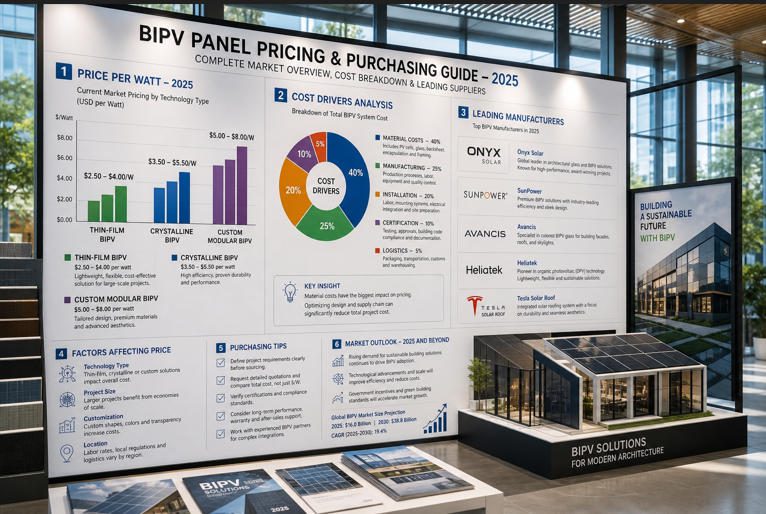
BIPV pricing in 2025 is harder to compare than traditional solar panel pricing. A roof-mounted module is usually judged in dollars per watt. A BIPV panel must also work as glass, cladding, roofing, shading, or a facade element. That changes the cost equation.
This guide explains how to compare BIPV panel price per watt in 2025, how manufacturers structure quotes, what models and integration types cost more, and how buyers can evaluate total value instead of chasing the lowest line item.
Traditional photovoltaic modules have a simple comparison habit: buyers ask for the module price per watt, then compare inverter, racking, labor, permitting, and financing. BIPV does not work that neatly.
Building-integrated photovoltaics, or BIPV, means the solar product becomes part of the building envelope. The envelope is the outer layer of the building: roof, facade, skylight, canopy, curtain wall, or cladding. The Whole Building Design Guide BIPV overview explains that BIPV collector elements are located directly within the building envelope or canopy structure.
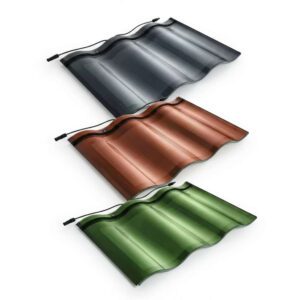
That dual role changes pricing. A BIPV glass panel is not only a solar module. It may also replace tempered glass, laminated glass, a spandrel panel, a roof tile, a rainscreen cassette, or a shading device.
This guide focuses on manufacturers, models, and practical buying tips. It also explains how to validate a compelling price-per-watt claim before it becomes a change order during construction.
Overview of BIPV pricing in 2025
What constitutes price per watt for BIPV systems
Price per watt means the cost divided by the rated direct-current power capacity of the module or system. If a 400 W BIPV module costs $240, the module-only price is $0.60/W.
But BIPV buyers must ask what is included. A quote may refer to:
- Module-only price: PV glass, roof tile, or cladding panel before installation.
- Hardware price: module plus inverter, brackets, wiring, junction boxes, monitoring, and protection devices.
- Installed system price: hardware, design, labor, permitting, commissioning, and grid connection.
- Facade-integrated price: installed BIPV cost minus the cost of conventional glass, cladding, or roofing it replaces.
The U.S. Department of Energy’s PV system cost benchmark methodology separates module, inverter, structural balance of system, electrical balance of system, fieldwork, office work, and other developer costs. BIPV projects should use the same discipline, even when the product is being bought through a facade package rather than a solar EPC contract.
Installed price per watt = Total installed system cost ÷ Installed DC watts
Incremental BIPV cost = BIPV facade or roof cost – conventional facade or roof cost
Typical range by technology and integration level
In 2025, BIPV prices vary widely because products are not interchangeable. Roof-integrated tiles, transparent photovoltaic glass, opaque facade cladding, skylights, and custom curtain wall units have different manufacturing and installation requirements.
For European BIPV glass-glass modules, METSolar reports typical module pricing around 120–250 €/m², with broader ranges from about 95–380 €/m². For broader BIPV systems, the same analysis notes a common range of about 200–625 €/m² depending on product type and integration complexity.
That is why a square-meter price often tells the truth faster than a watt price for facade projects. A transparent BIPV glass unit may cost more per watt because it intentionally sacrifices active cell area to transmit daylight. It may still be the right product for a lobby, atrium, skylight, or curtain wall.
| BIPV product type | Common pricing basis | Indicative 2025 range | Why the range moves | Best comparison method |
|---|---|---|---|---|
| Solar roof tiles / shingles | $/W or $/m² | Often higher than standard rooftop modules after installation | Tile format, waterproofing, roof geometry, labor intensity | Compare against roof replacement plus solar generation |
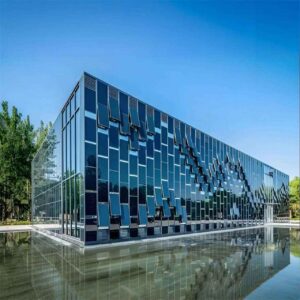
| Opaque BIPV facade cladding | $/m² and converted $/W | Often within the 200–625 €/m² BIPV system band | Panel size, color, mounting, fire testing, wind load | Compare against metal, stone, ceramic, or glass cladding |
| Transparent BIPV glass | $/m² | Usually higher $/W than opaque panels | Transparency, laminated glass specification, cell spacing, IGU design | Compare against high-performance curtain wall glass |
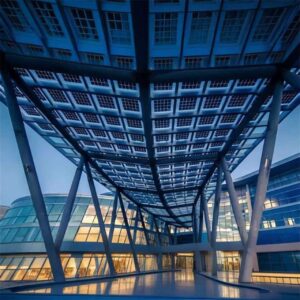
| PV skylights and canopies | $/m² and project package | Highly project-specific | Overhead glazing safety, drainage, framing, access | Compare against structural glass canopy plus solar value |
| Custom color / patterned BIPV | $/m² | Premium over standard black or blue-black modules | Color process, batch size, mockups, optical performance | Compare against architectural facade value and energy yield loss |
Factors driving recent price changes
Several 2025 forces are changing BIPV pricing:
- Lower mainstream PV module costs: commodity solar module prices remain far below the levels of a decade ago, pushing buyers to expect lower BIPV prices too.
- Higher customization demand: architects increasingly request colors, patterns, custom sizes, semi-transparency, or concealed busbars. These features can raise cost even while commodity PV prices fall.
- Tariff and supply-chain uncertainty: SEIA reported that U.S. module prices across segments rose 2–5% in Q1 2025, while trade actions and tariff changes continued to affect project economics in the Solar Market Insight Q2 2025 report.
- Higher-efficiency cell adoption: TOPCon and other higher-output technologies can reduce balance-of-system cost per watt because fewer panels may be needed for the same capacity.
- Building-code pressure: fire testing, facade testing, wind load certification, and water penetration requirements can add cost but reduce risk.
Key drivers of BIPV pricing
Panel efficiency and integration requirements
Panel efficiency means how much sunlight a panel converts into electricity. Higher efficiency usually lowers the number of modules needed for a target capacity. In BIPV, however, the most efficient panel is not always the best fit.
A 22% efficient opaque module may produce more power than a semi-transparent glass unit. But if the project needs daylight and outward views, the lower-output transparent product may be the correct specification.
Jia Mao Bipv’s transparent BIPV glass for facades shows why this matters. Transparency levels, cell spacing, visible light transmission, and solar heat gain control all affect the final cost and output. Buyers should ask for both electrical data and glazing-performance data.
Building integration vs standard modules
A standard solar module has one main job: produce electricity. A BIPV module may need to do five jobs at once:
- Generate electricity.
- Keep water and wind outside.
- Meet facade or roof structural loads.
- Match the architect’s visual design.
- Allow safe replacement after installation.
This is why BIPV price per watt can look expensive beside rack-mounted PV. The comparison is incomplete unless the avoided cost of roofing, glass, cladding, or shading is included.
Installation complexity and project scale
Installation complexity often matters more than the module price. A simple BIPV roof on a low-rise building may be straightforward. A high-rise curtain wall with custom glass sizes, tight tolerances, fire-stopping, rope access, and concealed wiring is a different cost category.
Project scale also changes price. A one-off custom facade may have engineering and mockup costs spread across a small number of panels. A campus or multi-building project can standardize dimensions, brackets, wiring routes, and spare modules.
How to compare BIPV manufacturers
Evaluating warranties and serviceability
A BIPV warranty should be read like a building-envelope warranty and a solar warranty together. Ask for:
- Product warranty: covers materials and manufacturing defects.
- Power warranty: guarantees a minimum output after 25 or 30 years.
- Glass or weather-seal warranty: important for laminated glass, curtain walls, and skylights.
- Workmanship warranty: covers installation mistakes.
- Labor and access terms: states who pays for scaffolding, rope access, lifts, or facade removal.
Serviceability is just as important. A facade module on the 25th floor is not replaced like a rooftop panel. Buyers should ask whether a failed module can be isolated, removed, and replaced without disturbing adjacent panels.
Certifications, reliability, and track record
Common PV certifications include IEC 61215 for design qualification and IEC 61730 for safety. Building-integrated products may also need fire, impact, wind-load, water-penetration, and laminated-glass testing depending on jurisdiction.
Track record should be project-specific. A supplier that has delivered standard rooftop modules is not automatically qualified for custom facade glass. Ask for similar installations by product type, climate, building height, and integration method.
Support during design, permitting, and installation
The manufacturer’s support level can change the real project cost. A lower quote can become more expensive if the design team must solve unsupported details during construction.
Helpful support includes shop drawings, electrical string guidance, wind-load data, BIM coordination, installation manuals, spare-part planning, and commissioning checklists. For mounting coordination, Jia Mao Bipv’s photovoltaic bracket and solar mounting systems illustrate the type of structural and waterproofing information buyers should request early.
Top BIPV manufacturers to watch in 2025
Established global players and their strengths
Established BIPV players often have stronger certification packages, project references, and facade experience. Their products may cost more, but the premium can be justified when the project has strict building-code, fire, or aesthetic requirements.
Common strengths among established suppliers include:
- Documented performance warranties.
- Experience with custom glass or facade contractors.
- Tested mounting and waterproofing details.
- Better spare-part and replacement planning.
- Clearer technical support during permitting.
Emerging companies with innovative solutions
Emerging manufacturers are pushing new colors, lightweight formats, semi-transparent glass, perovskite research, flexible surfaces, and prefabricated BIPV units. Some offer attractive pricing because they are building market share.
The risk is not innovation itself. The risk is missing evidence. Buyers should request third-party test reports, financial stability information, warranty insurance if available, and field-performance data from similar climates.
Geographic focus and market segmentation
Regional focus matters. European suppliers often emphasize facade compliance, glass products, and architectural integration. North American companies may focus on roofing, cladding, and code-compliant building products. Asian suppliers often bring scale, customization capacity, and competitive manufacturing economics.
For buyers sourcing internationally, confirm shipping terms, customs exposure, local certification acceptance, and who is responsible if a replacement panel is needed five years later.
Popular BIPV models and their wattage profiles
Low-watt versus high-watt modules and integration options
Low-watt BIPV modules are not automatically inferior. Many are designed for transparency, small roof-tile formats, complex geometry, or curved surfaces. High-watt modules are more useful where active area is large and appearance constraints are lower.
| Model category | Typical wattage profile | Primary benefit | Pricing caution | Best-fit application |
|---|---|---|---|---|
| Solar roof tile | Lower watts per unit; many units per roof | Roofing appearance and distributed layout | Labor and waterproofing can dominate cost | Residential roofs, villas, heritage-sensitive projects |
| Glass-glass facade module | Medium to high watts per panel | Durable envelope integration | Wind-load and fire testing may add cost | Spandrels, rainscreens, commercial facades |
| Transparent PV glass | Lower watts per m² than opaque panels | Daylight, views, solar control | $/W may look high due to intentional transparency | Curtain walls, skylights, atriums, canopies |
| Colored BIPV panel | Often lower than black modules | Architectural matching | Color can reduce yield and raise production cost | Public buildings, branded facades, design-led projects |
| High-efficiency opaque module | Highest output per m² | Best energy density | May need visual treatment for premium facades | Industrial roofs, spandrels, parapets, canopies |
Aesthetic and architectural considerations
Architecture can override pure watt economics. A black high-output module may be unacceptable on a stone-colored civic building. A semi-transparent panel may be preferred even when it produces fewer watts because it preserves daylight and occupant comfort.
The buyer’s job is to price that design decision clearly. Ask the supplier to show the output difference between standard black glass, colored glass, patterned glass, and semi-transparent glass. Then decide whether the architectural value is worth the energy trade-off.
Case studies or use-cases by model type
A 12-story office building uses opaque BIPV panels in spandrel zones. The panels replace non-vision glass and avoid the cost of separate cladding. Price per watt is evaluated with avoided facade cost included.
A university atrium uses semi-transparent BIPV glass. The $/W is higher than opaque PV, but the glass reduces glare, keeps daylight, and turns a required skylight into an energy asset.
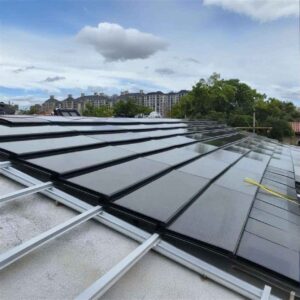
A villa roof replacement uses BIPV tiles. The buyer compares the quote against new roof tiles plus a separate rooftop PV system, not against PV modules alone.
Cost considerations beyond price per watt
BIPV-specific inverters, racking, and balance-of-system
Balance of system, or BOS, means the non-module equipment needed to make a PV system work. It includes inverters, cables, connectors, combiner boxes, disconnects, monitoring, grounding, brackets, and protection devices.
METSolar notes that BOS components can represent around 10–16% of BIPV installation cost, with higher shares for complex projects. Inverter selection also affects price. String inverters are usually cheaper, while microinverters and optimizers can improve performance in shaded or multi-orientation facades.
For buyers comparing electrical packages, review compatible BIPV inverter options together with shade patterns and monitoring requirements.
Labor, permitting, and integration costs
BIPV installation often involves both facade trades and electrical trades. Coordination cost is real. The facade contractor may control panel placement, while the solar or electrical contractor controls strings, junction boxes, inverters, grounding, and commissioning.
Permitting can include building review, electrical review, fire review, grid interconnection, structural calculations, and sometimes facade mockup testing. These costs vary by country, city, building height, and utility rules.
Lifecycle costs: maintenance and replacement
Lifecycle cost includes cleaning, inspection, monitoring, inverter replacement, access equipment, failed-module replacement, and end-of-life handling.
For a rooftop module, replacement may be simple. For a unitized curtain wall panel, replacement may require a building maintenance unit, rope-access technicians, or lane closure. That cost should be priced before purchase.
Financing, incentives, and total value proposition
Tax credits, subsidies, and utility programs
Incentives can change the ranking between suppliers. In the United States, buyers often start with federal tax credit eligibility and then check state or utility programs. The DSIRE incentive database is a practical starting point for U.S. projects.
For public, commercial, and institutional buildings, confirm whether BIPV costs are treated as solar equipment, building material, or a combined system under the applicable incentive rule. Documentation matters. Keep invoices separated by module, inverter, BOS, labor, and building-envelope components where possible.
Financing options and return-on-investment models
Common financing structures include cash purchase, construction financing, green loans, energy service agreements, power purchase agreements, leases, and tax-credit transfer structures where allowed.
ROI, or return on investment, compares the financial return with the cost. For BIPV, ROI should include:
- Electricity bill savings.
- Demand charge reduction where applicable.
- Incentives and tax benefits.
- Avoided cost of conventional roof, glass, cladding, or shading.
- Potential increase in asset value or leasing appeal.
- Maintenance and replacement costs.
Impact of utility-scale or building-scale projects
Large BIPV projects can reduce cost through standardization. Repeated panel sizes, consistent brackets, predictable wiring routes, and batch manufacturing all lower risk.
Small projects can still be valuable, but buyers should avoid over-customizing. A small custom skylight with unique glass sizes, special tint, and one-off framing can have a high $/W even if the module itself is not expensive.
Installation considerations and warranty implications
Design integration with existing buildings vs new builds
New construction usually gives BIPV its best economics. The system can replace planned building materials, and the architect, facade consultant, electrical engineer, and contractor can coordinate early.
Retrofits can work well when the existing roof or facade is due for replacement. If the building envelope still has many years of life, the buyer must justify removing functional material before installing BIPV.
Warranty terms for panels, inverters, and installation
Do not accept a single headline warranty statement. Ask for warranty documents before purchase. Compare:
- مدة ضمان المنتج واستثناءاته.
- Power warranty degradation curve.
- Inverter warranty and expected replacement year.
- Weatherproofing warranty for roof or facade integration.
- Glass breakage, delamination, corrosion, and seal-failure coverage.
- Labor, shipping, and access responsibility.
Post-installation service and monitoring
Monitoring helps detect faults early. It is especially important for facade systems because access is more expensive. Module-level monitoring may cost more upfront but can reduce diagnostic time when a string underperforms.
A good handover package includes as-built drawings, string maps, inverter settings, commissioning reports, cleaning instructions, spare-panel list, and warranty contacts.
Video: BIPV design principles and solar facade typologies. Use this as a visual reference when comparing roof, facade, transparent glass, and shading-integrated BIPV options.
Regional pricing trends and supply chain impacts
What regional differences mean for price per watt
Regional price differences come from labor rates, grid rules, certification requirements, import duties, logistics, currency movement, and local installer availability.
For example, a BIPV facade panel shipped internationally may look attractive at the factory-gate price. The final project price may change after freight, insurance, customs, local testing, replacement stock, and field labor are included.
Raw material costs and component availability
Glass, aluminum, encapsulants, silicon cells, junction boxes, inverters, and mounting metals all affect price. In 2025, buyers also need to watch inverter availability and tariff exposure.
SEIA’s market report notes that trade action and tariff uncertainty can influence supply chain strategy, component costs, and project timelines. For BIPV, the effect can be stronger because custom modules are harder to substitute quickly than standard solar panels.
Lead times and contingency planning
Lead time is a hidden cost. If a custom facade panel is delayed, the building enclosure may be delayed. That can affect interior work, tenant handover, and financing costs.
Contingency planning should include:
- Approved mockups before mass production.
- Spare modules ordered with the original batch.
- Alternative inverter or optimizer options.
- Clear shipping and damage-inspection procedures.
- Defined responsibility for replacement lead times.
How to estimate project ROI and total cost of ownership
Step-by-step ROI calculation for BIPV projects
Use a transparent ROI calculation before selecting a manufacturer.
- Define the active BIPV area in square meters.
- Estimate installed DC capacity in watts.
- Model annual energy production using orientation, tilt, shading, and climate.
- Estimate self-consumed energy and exported energy separately.
- Calculate annual utility savings.
- Add incentives, tax credits, and avoided building-material cost.
- Subtract maintenance, inverter replacement, cleaning, and access costs.
- Compare payback, net present value, and internal rate of return.
For early-stage production estimates, use حاسبة الطاقة الكهروضوئية الكهروضوئية في NREL. For final investment decisions, use project-specific modeling that includes facade orientation and shading.
Sensitivity analysis: wattage, incentives, and energy savings
A sensitivity analysis tests what happens when assumptions change. For BIPV, test at least five variables:
- Installed cost per watt.
- Annual kWh production.
- Electricity price escalation.
- Incentive eligibility.
- Maintenance and access cost.
| السيناريو | Installed capacity | Annual yield | Electricity value | Incentive assumption | Buyer interpretation |
|---|---|---|---|---|---|
| Conservative | 100 kWdc | 800 kWh/kW/year | $0.12/kWh | No incentive | Use this to test downside risk. |
| Base case | 100 kWdc | 950 kWh/kW/year | $0.16/kWh | Partial incentive | Use this for budget approval. |
| Upside case | 100 kWdc | 1,100 kWh/kW/year | $0.20/kWh | Full incentive | Use this to understand potential upside, not as the only decision case. |
Risk assessment and mitigation strategies
Common BIPV pricing risks include unclear scope, unsupported warranty terms, certification gaps, long lead times, difficult replacement access, and optimistic production assumptions.
Mitigation is practical:
- Require a full scope matrix showing what is included and excluded.
- Ask for project-specific wind, fire, water, and electrical documentation.
- Use a facade mockup before full production.
- Order spare panels from the same batch.
- Make monitoring and commissioning part of the contract.
- Check that the quoted product matches the tested product.
The central lesson for 2025 buyers is simple: BIPV price per watt is useful, but incomplete. A BIPV panel is a solar generator and a building component. The right comparison includes watts, square meters, avoided material cost, installation complexity, incentives, maintenance, and replacement logistics.
Before choosing a manufacturer, ask for a clear price breakdown, tested product data, warranty documents, similar project references, and a service plan. A low module-only quote can lose its advantage if it creates higher facade labor, delayed permitting, or expensive replacement access.
- What exactly is included in the price per watt?
- Can you quote the same product in $/m² and $/W?
- What building material does the BIPV replace?
- Which certifications apply to this exact module and assembly?
- What is the lead time for production and replacement panels?
- Who pays for labor and access during warranty replacement?
- Can the system be monitored at module, string, or inverter level?
- What happens if the architect changes color, transparency, or panel size?
To validate a compelling price-per-watt claim, convert the offer into a full installed cost, compare it against the conventional building material it replaces, and run a sensitivity analysis. If the project needs custom solar glass, roof tiles, mounting systems, and electrical coordination, Jia Mao Bipv BIPV solutions provide a useful starting point for reviewing product categories and integration choices.
Need to compare BIPV pricing for a real project?
Prepare your drawings, target active area, transparency needs, roof or facade type, and expected grid connection. Then request a quote that separates module cost, BOS, mounting, installation assumptions, and warranty coverage. Visit www.jmbipvtech.com to explore BIPV product options.
الأسئلة الشائعة
1. What is a typical price per watt range for BIPV in 2025?
There is no single reliable range because BIPV products differ by roof, facade, glass, transparency, color, and installation method. Module-only prices may be quoted in $/W, while facade glass is often quoted in $/m². Many architectural BIPV systems are better benchmarked by square meter first, then converted into $/W using the actual rated capacity.
2. How do I compare BIPV models across manufacturers?
Compare the same scope: module-only, hardware package, or fully installed system. Then review efficiency, dimensions, glass build-up, fire and wind testing, warranty terms, lead time, replacement method, and project references. Do not compare a standard opaque module directly with transparent architectural glass without adjusting for daylight and facade value.
3. Do incentives apply to BIPV integrated designs?
Often yes, but eligibility depends on country, tax rules, system ownership, product classification, and documentation. Some programs may cover only the energy-generating portion, while others may allow broader project costs. Buyers should consult tax advisors and check local programs such as DSIRE in the United States.
4. What warranty considerations should I prioritize?
Prioritize the product warranty, power warranty, weatherproofing or glass warranty, inverter warranty, workmanship warranty, and access responsibility. For facade BIPV, labor and access terms are critical because replacing a panel on a tall building can cost more than the panel itself.
5. Why is BIPV often more expensive per watt than rooftop solar?
BIPV must perform as both a solar generator and a building material. It may need laminated safety glass, custom sizing, color treatment, waterproofing, facade brackets, fire testing, wind-load compliance, and coordinated installation. These requirements raise $/W but may reduce the separate cost of roofing, cladding, glass, or shading.
6. Should I compare BIPV by price per watt or price per square meter?
Use both. Price per watt is useful for energy economics. Price per square meter is essential for facades, roofs, skylights, and curtain walls because BIPV replaces a building surface. The strongest buying analysis compares $/W, $/m², and incremental cost over the conventional material.
7. Which BIPV products usually deliver the best ROI?
Opaque, high-output BIPV panels on sunny roof or facade areas often deliver the strongest energy ROI. Transparent PV glass can have a higher $/W, but it may still be financially attractive when it replaces expensive architectural glass and improves daylight or solar heat control.
8. How can I verify a manufacturer’s price claim?
Ask for a formal datasheet, warranty document, certification report, bill of materials, quotation scope, installation assumptions, and references from similar projects. Then calculate the installed $/W and $/m² yourself. If the supplier’s claim excludes mounting, inverters, shipping, design, or commissioning, it is not a full project price.
9. What is the biggest hidden cost in BIPV projects?
The biggest hidden cost is often coordination. If facade design, structural support, waterproofing, electrical routing, fire stopping, and commissioning are not coordinated early, the project may face redesign, site delays, or expensive custom fixes.
10. Is BIPV better for new construction or retrofit projects?
BIPV usually has better economics in new construction because it can replace planned building materials. Retrofits can also work well when the existing roof or facade is near end-of-life. If the existing envelope does not need replacement, the payback period may be longer.